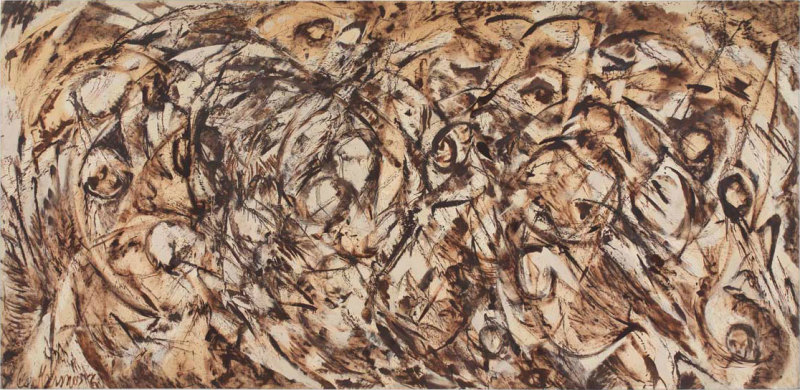
Lee Krasner, “The Eye is the First Circle”, 1960, oil on canvas, 235.6×487.4cm. Courtesy Robert Miller Gallery, New York. © ARS, NY and DACS, London 2016 Photo Private collection, courtesy Robert Miller Gallery, New York.
“… Like a Tongue to a Loosening Tooth.”
Thoughts in anticipation of the upcoming Abstract Expressionism show at the Royal Academy, 24th September 2016 – 2nd January 2017.
“…It seems that I cannot quite abandon the equation of Art with lyric. Or rather – to shift from an expression of personal preference to a proposal about history – I do not believe that modernism can ever quite escape from such an equation. By “lyric” I mean the illusion in an art work of a singular voice or viewpoint, uninterrupted, absolute, laying claim to a world of its own. I mean those metaphors of agency, mastery, and self-centredness that enforce our acceptance of the work as the expression of a single subject. This impulse is ineradicable, alas, however hard one strand of modernism may have worked, time after time, to undo or make fun of it. Lyric can not be expunged from modernism, only repressed.
Which is to say that I have sympathy with the wish to do the expunging. For lyric is deeply ludicrous. The deep ludicrousness of lyric is Abstract Expressionism’s subject, to which it returns like a tongue to a loosening tooth.”
TJ Clark, “In Defence of Abstract Expressionism,” Farewell to an Idea.
The RA blockbuster autumn extravaganza promises to seduce us with its knock-out line up of Abstract Expressionist paintings in its lofty neoclassical halls. But scrape beneath the veneer of showtime spectacle and the history of this movement is a battleground of interpretation. It is littered with the burnt out wreckage of a thousand blood-thirsty intellectual engagements between titans of art history from the Left and the Right. By comparison, art making now seems to operate in the uncanny silence that has descended on an ideological no-mans land. But first, please forgive a digression…

Gerhard Richter, “Cage 5”, 2006, oil on canvas, 300x300cm
I was asked to attend and talk at a symposium on John Hoyland’s legacy earlier in the year. It became clear to me how much of this afore-mentioned ‘wreckage’ I was determined to drag along to the proceedings, whilst other older and younger participants seemed to maintain a much more bright and breezy approach. Older artists and commentators talked of ‘late manners’, younger artists talked of Hoyland’s cosmic dream spaces and the sanctuary of the studio as an escape from the blight of social media. I found myself coming back time and again to the implications of the legacy of Abstract Expressionism and how it had been dealt with by the later generations, but especially by the likes of Gerhard Richter. I think Richter has successfully reinvented history painting via photography. But he has failed to reinvigorate abstract painting to anything like the same degree. Take the Cage paintings for instance. They court the idea of chance and contingency by referencing the name of the avant-guarde composer John Cage. By dragging layers of paint across canvases Richter reduces the tantalising suggestiveness of gallons of oil paint to the vague outcomes of repetitive physical actions with a squeegee. One also has to take the word ‘cage’ on its own terms too. A room of these paintings conjures the sour self referential painterly prison in which the painter whiles away their hours. Painterly invention happens as a byproduct of Richter’s almost forensic investigation via painting of an historical photographic image. Yet in abstract painting, he only seems capable of producing simulations and sometimes beautiful accumulations and debri via his ‘process’. One commentator at the symposium told us that Hoyland lived by the refrain “I paint therefore I am.” That’s all very gung-ho but it was Richter who pointed to a peculiar duality at the core of the endeavour of painting. He focused on the tension between doubt and belief in painting – he once called painting “pure idiocy”. Of course, this quip references Duchamp, who took great pleasure in goading painters. If Hoyland seems to have readily embraced Clark’s “ludicrousness of lyric” (especially in his ‘late manner’) then it’s Richter who personifies the desperate need to ‘expunge’ it.

John Hoyland, “Saffron Medusa”, 17.7.10, acrylic on cotton duck, 91x76cm
I mention all this not because I want to imagine Abstract Expressionism somehow magically liberated from the wreckage or the baggage of so many dichotomies, false or otherwise. But we are are so used to the narrative of the terminal downward tail-spin in painting, the ever decreasing conceptual circles and Duchampian conundrums for which Richter is a famous exponent. And we are also used to the clichéd view of painting inspired by Abstract Expressionism as the narcissistic outpourings of some heroic macho individual ego. How do we resist Clark’s attempt to cast the Abstract Expressionists as a mid 20th-century strain of decrepit bourgeoisie, acting like an artistic version of a suicidal aristocracy?

Clyfford Still, “PH-950”, 1950, oil on canvas, 233.7×177.8cm. Clyfford Still Museum, Denver © City and County of Denver / DACS 2016 Photo courtesy the Clyfford Still Museum, Denver, CO Photo: Courtesy of the Clyfford Still Museum, Denver, CO © City and County of Denver.
Abstract Expressionism and it new found painterly inventiveness whipped up the original and epoch-defining perfect storm of cultural criticism. But a storm’s energy is driven by the collision and the channeling of opposing physical forces. And this particular mid 20th-century strand of abstraction operated with a myriad of contradictions at its very heart. At once, it seems to pivot on an idea of the trenchant individual, as Clark points out. On another level the work begins to involve the notion of field-painting as an immersive experience aimed at encouraging the active engagement of the viewer’s own physical and psychological projections. For some the very idea of the individual was a welter of opposing desires and drives looking for some kind of revelatory cohesive expression in ‘the here and now’, in the special and peculiar qualities of paint liberated from the strictures of its European heritage. Yet Abstract Expressionism leans on notions of the timeless and mythological, the doom laden and the tragic. At the same time, though, it is supposedly the genius of a thoroughly new nation. Young and naive, its creativity was unhindered by the old world of power-hungry empires. For a while it stood in direct opposition to the perceived deathly grip on art of decadent Eurocentric cultures, enslaved as they were, to inbred and ossifying aristocracies. Greenberg and then Fried argued about points of continuity in art history, the baton of advanced art handed from Paris to New York. Clark talks of rupture and the the distorting effects of American capitalism as a defining characteristic of Abstract Expressionism. Serge Guilbaut explored America as a rising expansionist Empire in its own right, exporting its new art around the world as a ‘soft power’ influence and cultural bulwark against the Soviet threat.
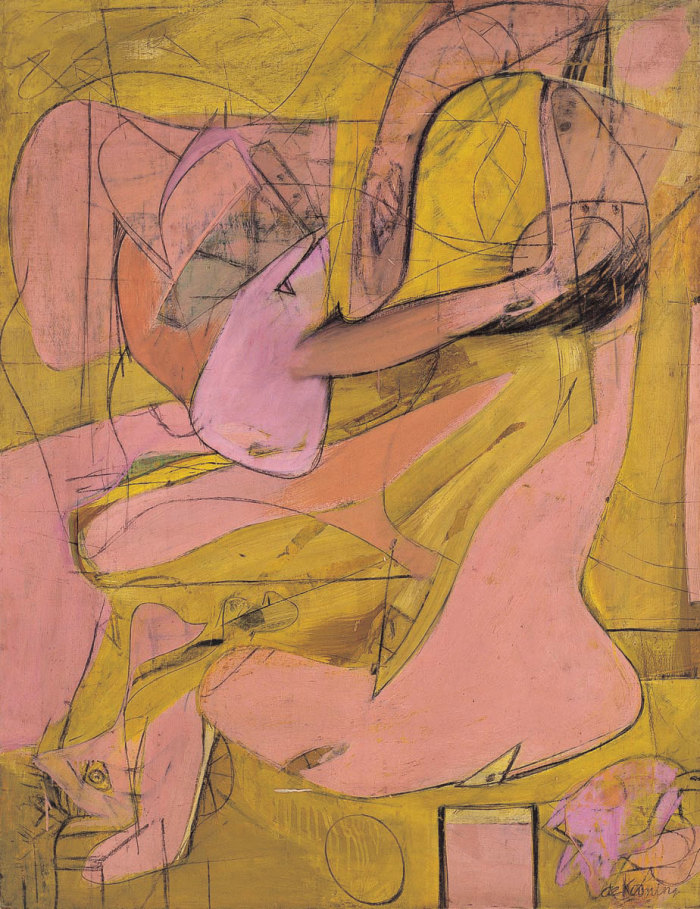
Willem de Kooning, “Pink Angels”, 1945, oil and charcoal on canvas, 132.1×101.6cm. Frederick R. Weisman Art Foundation, Los Angeles. © 2016 The Willem de Kooning Foundation / Artists Rights Society (ARS), New York and DACS, London.
Originally, of course, there was the very public war between Greenberg and Rosenberg over the true meaning and future of Abstract Expressionism, which is almost legendary. But there were other less shrill and possessive voices that are still echoing quietly through history, if one is prepared to listen. If we see this new American art as Meyer Schapiro did during this period then it becomes “….a social bond that furthers in aesthetic terms the process of human self-realization through the non-instrumental refinement of the senses, and through the critical engagement of the intellect…” Schapiro’s Marxism was dialectical and nuanced rather than purely economic and materialist. His anti-Stalinism was shared by many of the Abstract Expressionist who had turned their backs on the Socialist Realist art extolled by America’s ailing Communist party. They refused to reduce society to an oversimplified marxist model of a ‘base’ as purely economic and superstructure as just a cultural add on. They believed culture to be as important and integral to a healthy society as economic stability. Schapiro was also determined to highlight the connections and dialogues between art making and the social realms in which abstract art and artists existed. It is in this spirit that I believe a deeper and complex view of the legacy of Abstract Expressionism can develop. Just maybe, this might be a way forward – a way to embrace these artworks anew. It is easy to see them now as art historical monuments, fetishized and reified – drowned in the gallons of ink spilled in the attempt to apprehend them and bend them to whatever ideological ends. If we see history, like many of the Abstract Expressionists did, as a perpetually contested realm, the future always born of the ferment of these contestations in the making of art – in the living of life – then the artworks that constitute Abstract Expressionism are more than just another brand of formalism or heavy breathing machismo or the “ludicrousness of lyric”. Enjoy the show.

Franz Kline, “Vawdavitch”, 1955, oil on canvas. 158.1×204.9cm. Collection Museum of Contemporary Art Chicago. Gift of Claire B. Zeisler 1976.39. Photo Museum of Contemporary Art Chicago. Photography: Joe Ziolkowski © ARS, NY and DACS, London 2015.

Mark Rothko, “No. 4 (Yellow, Black, Orange on Yellow/ Untitled)”, 1953, oil on canvas, 269.2x127cm. Whitney Museum of American Art, New York. © 1998 Kate Rothko Prizel & Christopher Rothko ARS, NY and DACS, London.


When I see this show I want to start with looking. The broader history, politics and views of the critics can wait.
LikeLike
Come on Geoff – it’s very on-trend to get your political critique in early. What is it you want to look at?
More like “The End of the Line”. Are we still interested in this stuff? I suppose I’m looking forward to one or two early Pollocks and the Krasner, but I can’t help but feel, looking at the other illustrations to this essay with a rather sinking heart, that the tooth has fallen out a long time ago, it’s rotting under the pillow, and a lot of artists have deceived themselves in the vain hope that the tooth fairy of minimalised spontaneous expressivity is going to materialise sometime soon. Personally, I’m looking forward more to the Rauschenberg at Tate than I am to this, though I could be severely disappointed there too. But at least he occasionally had an “eye” for things, and a bit of vitality.
So here’s a challenge: we know the Richter and the late Hoyland are crap. So someone tell me the good qualities and values of the Rothko or the Still illustrated here, and why they are any better. No contextualising or generalising allowed. And definitely no French philosophy. Stick to qualities within the individual work. Good luck.
(I can sense Alan G. saddling up his very high horse on the top terrace of his vertiginously tall ivory tower right now. Steady, Alan, it’s a long way down.)
LikeLiked by 2 people
I want to look at everything – and today I did. I also had a chat with Stephen Buckley in the pub later on.
LikeLike
I tend to agree with you. What you see is what you get. If you begin with this in mind you’re less likely to feel short changed.
The context in many cases can confuse but often add interest.
LikeLike
I think it might be more important than ever to call a lot of this work out for what it is, and I don’t mean to sound disrespectful. There is much to be admired, but also a lot that fails to live up to the hype. I was recently in the States and saw quite a bit of Rothko and Still. I found the colour in some Rothkos, particularly at MoCA in LA, to glow and pulsate (though you could ask for more than that), and I did marvel at times at his preparedness to take his idea that far. But other times I wondered why he had to paint so many of them. The Clyfford Still room at SFMoMA helped me to decide that I wasn’t interested in Still’s work. It all looked very stiff.
A lot of the time I think the problem is what gets shown. We are supposed to believe that this was a radical time of experimentation but so many major museums seem to just angle towards the most obvious and iconic works, so that the general gallery going public have every chance at being able to recognise who did what, take the obligatory selfie, tag the institution and perpetuate the flow of people into the museum. The same could be said for a lot of the older figurative art shown, but there is something kind of tedious about the iconicism of the “distinct styles” that the 50s work offers. Is there not something so predetermined and cute about a signature? The quasi-surrealist line work in the above de Kooning, say?
It seems important to be critical of much of this work now because painting, particularly abstract painting, is cool again. And yet everyone just seems to be repeating all this 50s stuff, or Richter, or Bauhaus, (stuff which might not have been that flash the first time around) without even seeming to recognise that is what they are doing. I don’t mean to can a whole period of important painting, rather express my disappointment with some of the more famous works from that time and a current milieu that seems destined to waste a lot of time doing the same stuff, almost unawares.
LikeLiked by 1 person
Re: “A lot of the time I think the problem is what gets shown.”
Good point. I like looking in those Christie’s sale catalogues and seeing the work that is in private collections.
LikeLike
This from the self-penned catalogue essay from the show “Alan Gouk: New Paintings” at Poussin Gallery, 2012:
“It has been the self-engendered, if at times poorly understood destiny of my generation of painters to bridge the gulf between the ardent spirituality of the Abstract Expressionists, with all their rhetorical excesses, and the over-cool design-conscious aesthetic of the post-painterly generation – a destiny which has been grasped with varying degrees of clarity and steadfastness. Why Patrick Heron has been so crucial is that he was one of the first to put his finger on the flaws, both of the Abstract Expressionists’ brusque advertised spontaneity (when present), and the distanced decision-making at a remove from the flow of the painting process of the first phase of post-painterly abstraction (the later Olitski and Poons are partially exempt). That is, until the reappraisal of Matisse/Picasso which began in the 1980’s and was given new impetus in 2002 by the Golding/Cowling version at Tate Modern, rendering the whole American intervention almost irrelevant.”
A really interesting passage from Alan, and I concur with the sentiment of the last sentence – that the contribution to painting of the Americans is overrated, particularly by comparison with Matisse. I would go further and say that (perhaps Hofmann apart) these works are going to prove to be less and less important in the future. But what’s also interesting is Alan’s contradictory and compulsive belief in an unchallengeable destiny, in which he has to participate with “steadfastness” in bringing together what he admits to being two rather dubious idioms of painting, simply in order, as he sees it, to be of any account as a painter now. This is his fate, it seems.
But this linearity is the thing that has to be broken; it’s the thing that prevents better progress and understanding in abstract art. If you swallow whole the meagre offerings of painters like Rothko and Still, the chances are you’ll never get very far beyond their limited aesthetic. And one thing the Americans certainly didn’t do for abstract art is invent for future generations some developable and substantial abstract content. What little content there is stops dead at the point where their individual signature styles die, along with the artist. Good for the art market, bad for art. Bring back John’s “perpetually contested realm” by all means, but let’s not contest the value of these dead paintings for too much longer.
LikeLiked by 1 person
I am flattered that Robin feels it necessary to drag me into these controversies, which are more controversies of criticism and interpretation than they are of fact, and that he is so obsessed with my writing and his “compulsion” to disagree with it, nit-picking in order to find a way of inserting his Knife of bile wherever he can. It is all too easy for someone who is determined to erase his own past, and deter people from access to it, to forget what it was like to live through the 1960s and 1970s , when first the A.E.s and then the post painterlies were omni-present in every aspiring artists consciousness, like it or not. And utterly disingenuous too to overlook the extent to which my writings in this period and subsequently were among the few cogent critiques of the prevailing assumptions of the discourse which surrounded the painting (and the sculpture, later). But of course you wouldn’t know that from the way Robin paints it. You’ld need to do your homework.
Patrick Heron’s critique, which began at the first sight of the 1956 Tate show of the A.E.s and escalated through the 1960s with his spat with Greenberg, is well known and has the advantage over all the colourful phraseology and “extravagant prose” which Greenberg so effectively pilloried, of being by a painter who knew a thing or two from the inside what the pressure of the historical moment was, and why these painters could not just be swept aside with some glib nonsense about “abstract content”. Remember that the A.E.s had begun with the “Subjects of the Artists” manifesto and polemic, and we’re trying to “put in” subject-matter, misguidedly of course, rather like trying to “put in” content.
Most of the discourse since, and up to the present, has been just that, extravagant prose, righteous phrase making and colourful socio-political wiff-waff. Heron addressed the painting directly as an engaged painter, and cut through all that. I fear we are destined for a lot more wiff-waff, with Robin’s bigoted attacks On everything modern at the helm, on this site as well as in the media at large. T.J. Clark’s self serving and arrogant intro is a locus classicus of self satisfied and self advertising rhetorical excess. So there’s a tradition to be followed, an easy trap for the would be pundit of post modernism. Linearity schminearity.
,
LikeLiked by 1 person
And as for Rauchenberg, we all saw through that one way back in 1964. Reminds me of ” not since Jasper Johns’ final literalisation of the canvas surface has a painting’s meaning been looked for in its unmediated visual qualities” or some such. It goes to show how astray ones powers of perception can be led by a programmatic agenda, cock-eyed and conceptually wrong headed. Rauchenberg – vitality? You must be joking.
LikeLike
I don’t know why you think these paintings need defending. They need no defense from me. There is nothing I could say that would make them any more palatable to the prejudiced eye. They can speak for themselves.I can’t believe we are still going over the same old ground. If anyone wants to know what I think about the A.Es –see my Letter From NewYork, one of the first articles on Abstractcritical in 2011?
However, what they do need defending from is yet another salvo of anti-modernist invective from the purblind apostle of the nearly-new — deeply reactionary stance masquerading as radical (how many times have we seen that in the past). Again I am forced to reiterate Rohko’s statement — ” a painting expands and quickens in the eye(or mind) of the sensitive observer. It dies by the same token”.
Meanwhile over on Brancaster, participants are obliged by the nature of the FORMAT ( microphone and video broadcasting to the world) to rationalise and defend their work even before it has cooled down.
If a work is successful the artist should not be able to say why or how ( not for a while at least). It should be as much of a surprise to them as it is to others, and no easier to rationalise, (as seems to have happened with Mark).
As well as giving over-attention and praise to work that doesn’t merit it, you are intellectualising and analysing to death work that doesn’t require it. A simple value judgement, approval or disapproval would be more effective and useful to the participant. It’s all coming from the wrong place. The work is one thing, and it’s rationalisation quite another, except when the latter is interfering and messing up the former. Too much of the mind in all of it, Mark and Hilde excepted.
Hasn’t it dawned on you yet that the more you refine your conception of “abstraction” , to the point of damned near refining it out of existence, the more your verbalisations could equally well apply to art the very opposite of anything you would want (unless of course Rauchenberg is your bag).
LikeLike
Mmm… “simple value judgement, approval or disapproval”… now, do we know anyone supercilious enough to do that, I wonder…?
LikeLike
Alan’s article here: http://www.abstractcritical.com/article/letter-from-new-york/index.html
LikeLiked by 1 person
I always found it helpful to understand Rothko in terms of Husserl’s eidetic reduction. Husserl was trying to pin down where reality was located and found it made sense to place it in our cognitive apprehension of the world. It is in the eye/mind’s apprehension of the world .Heidegger took issue with this by saying this perceiving subject is already in the world and that being-in-the world takes precedence over the structure of the perceptual apparatus and how it structures the world. I think this points to why Rothko is sometimes seems less appealing to the public than Matisse.Rothko’s painting is a too pure reduction of color logic and leaves out the world in which the artist moves.Matisse as he moves toward to purity of the cutouts is still a being among other beings or things and the cutouts still refer to bodies. Rothko is too much like a visit with the audiologist where you are asked to identify pure sounds in order to evaluate the quality of your hearing.The test will determine weather you are losing hearing or not but has nothing to do with hearing as it is used to create a world/space for the hearer. This reductive aspect of Rothko creates in me a lot of anxiety as what is left out of this reductive trope begins to grate on my sensibility. It is interesting to see how this exquisite dead end is pursued further by Ellsworth Kelly who separated pure colors into sculptural objects and then drops the color completely to just exhibit the plywood substrate that supports the colors.Digging a deeper and deeper hole of nihility. Ellsworth is still serious unlike the Zombie Formalists and the Provisonalists who deal with High Modernism as a commodity or with irony. However, they all thought highly enough of Modernism to deconstruct it, negate it or laugh at it.I deal with its lingering life here:http://martinmugar.blogspot.com/2013/12/zombie-artthe-lingering-life-of.html
LikeLike
Martin, I’m interested in what you say about the ‘anxiety’ you have with Rothko. It reminded me of an essay from the 70s by Lawrence Alloway concerning the “Residual Sign Systems in Abstract Expressionism”.
“…The term “gestural” is commonly applied to Abstract Expressionism with reference to conspicuous brushwork, but the term is also applicable to those of Newman’s paintings in which the whole work has a gestural function. The tall lines and man-sized area are a kind of gestural condensation……”
Although Alloway is talking about Newman here, I like the way he makes explicit the role of the ‘gestural’ and how it is absorbed into the painting surface by Newman and Rothko. Over the years I’ve spent a fair bit of time with the Rothkos at Tate. Not only in colour but in its application, the paint is creating tidal undertows- riptides and counter rhythms. For me they create in combination a very corporeal space full of slow and bloody undulations.
I think the best Ab Ex paintings somehow conflate a sense of interior or corporeal space with an exterior reality- the reality of the picture plane- in a very visceral and bodily way. Greenberg put like this…
“The best modern painting, though abstract, remains naturalistic to its core, despite all appearances to the contrary. It refers to the structure of the given world both outside and inside human beings.”
The Role of Nature in Modern Painting Partisan Review 1949. P 81
Like you Martin, I’m interested in what separates, say, Rothko and Newman from the likes of Ellsworth Kelly and Frank Stella. What is lost in translation between generations? And then, what is gained by ,sometimes, willed ‘mis-reading’?
Alloway goes on to say…
“Contrary to the notion therefore that the Abstract Expressionist artists started with the minimum, the truth is that they incorporated complex layers of cultural allusion into their art. In a real sense Newman, Rothko and Still were History Painters by inclination but Abstract painters by formal inheritance. That is why the work is remarkable, for the diversity of residual signs that are successfully bound into their art.”
LikeLike
Thank you for replying to my comment.I remember Robert Linsley http://newabstraction.net/ commented on an essay I wrote http://martinmugar.blogspot.com/2013/11/spiraling-downward-from-minimal-to.html with these words:
“I like the way you connect the battle of ideas and the layering of forms – your notion of the “oppressed” forms showing at the back of the picture.”
This is in regards to the painting of Al Held but I think applies to Rothko.Not oppressed in his case but covered over.There is the numinous glow of the colors but they float in a sea of darkness. All that is part of the expressive strength of the work.It points to what is left out or can’t be expressed. I guess my anxiety in front of Rothko’s work might better be expressed as a dread of the unknown.The lived sunlit reality and then nothingness. “Whereof one cannot speak,thereof one must remain silent.” Bringing up Newman reminded me of an artist friend referring to how the vertical lines in his work had to be experienced bodily in a gallery.It was a visceral experience.
Elsewhere, I have referred to the need in some artists, the late Held and Stella for example to squeeze all they know about the world through complexity into one painting and how they failed in a rather dramatic way. Maybe is best to let the painting point outside of itself to something it cannot contain.
As for Kelly and Stella I agree with what you wrote: there is always the misreading as a way of getting out from under the shadow of their antecedents. They destroy painting itself in their ambition to do so.
LikeLike
Well Ill have a punt as Ive missed abcrit for a while.Personally I like many of the commentators,even if I differ hugely with their perceptions.Im sad to hear Jb wont be enjoying the Ab Ex show.Its very important to retain ones innocence.Im really looking forward to it,and like Hoyland ,feel a kinship with the best of them ,Pollock and Rothko.Yesterday I repainted a fairly large 7ft by 10ft Brancaster failure from last year.Before I started I got out my monographs on Frankenthaler and Louis to give me Dutch courage.Through all the stooping and bending,my back gave out halfway through and I found all the thrashing about exhausting .I retreated and returning the next day ,was initially pleased with the result,creating light as in the natural world .By lunchtime Id gone off the work ,for exactly the reasons Alan mentioned-Id seen it before ,probably painted the same format in the 70s!Was it worth doing ,oh YES.Its what being a painter is,working everyday God sends,trying to improve ,create something new,allow passage of feeling to come through the medium.Sometimes I get fed up with the whole Ab crit /Brancaster experience for one simple reason .I dont beleive I know how to make Art,which to me contains some poetry ,some feeling.Its just not enough to assume because we are literate we can divert the course of Art History,or try to.Making Art,whatever that is ,for me ,is something that happens despite my beliefs,its an act of Grace,like a saxaphone solo,very occasional beauty and Truth.All I can do ,like the Abstract expressionists,is go in everyday and try again.The worse thing I can do is just create another OBJECT in the physical world,full of my prejudices,however elegant. .Fortuneatly every now and again ,something happens.Thats Painting.
LikeLike
Did you see the Imagine programme the other week with writer Meg Roscoff?
She questioned, where does the unique artistic voice come from. For her it was a connection to the ‘powerful’ unconscious. She put forward her case: Although some feel there are horrible things lurking in the unconscious, like anxiety and death, it is also where love, desire, creativity, imagination and dreams can be found. She claimed, without both the conscious and unconscious mind, you cannot make great art. There were interviews with actresses, a musician and writers. It is about risk, daring to go into the unknown and regardless of the art form, going into the ‘unspoken stuff’, you have to visit corners of yourself. It interviewed Susie Orbach, psychotherapist, who feels, within the arts there is a tremendous amount of learning and skill, that allows you to surrender and go within another part of yourself. What is inside your head, your unconscious, is the you of you; and what makes everyone unique. If there is no you of you, in your painting, poem or acting, then it is dead. That is where the magic comes from, in that it is spiritual, beyond your control. Lewis Hou a neuroscience researcher in Edinburgh, gave his take on the unconscious. When they scanned the brain of a musician, playing something he knew; and then improvising, the scans were significantly different, other parts of the brain were active. He talked about a part of the brain that develops through our teenage years, which controls right and wrong. To enter the unconscious, he feels, that part of the brain gets turned off, which allows a creative mind to go much deeper, in letting go of inhibitions and trusting in whatever comes flowing out. Meg Roscoff is an American writer based in London, which makes her comments clearer, as they understand the unconscious much more, even offer masters degrees under the heading Process Work.
LikeLike
Well said, Patrick. And shame on you John B. For heading up this piece with that nauseating Clarkism. Robin is sitting on a sequel to my article on Farewell to an Idea (on abcrit) titled False Moderacy or Immoderate Falsity, which ends with the remark — “Clark stands revealed as an ostentatious fraud”. Of which the lines you quote are a prime example. I thought You’ld have realised that by now. Perhaps Robin feels that two attacks on one of his favourite authors is one too many.
He is also sitting on two substantial articles of mine, on The Gypsy of Matisse, and Gauguin-Van Gogh – Matisse. Do they not fit in with his touted “more open agenda”?.
LikeLike
Take Samuel Barber’s Knoxville, Summer of 1915, as sung by its dedicatee Eleanor Steber, and recently by the wonderful Russell Thomas (on YouTube), a work that is so out with the progressivist/historicist canon that it is not even mentioned in Taruskin’s History of 20 century music (Vol. 4) ( as none of Barber’s music is) , despite the fact that it was envied and imitated by many followers in the American idiom he helped to found. Yet it is a work full of the finest feeling (call it nostalgia if you must) , expressed with limpid transparency in the plainest of tonal/pentatonic “language”, and speaking directly to anyone with ears that have remained uncluttered with all the cerebral compulsiveness which drives so much of the aspirational wanna-be avant-grade. Check it out again, for I’m sure you’ve heard it before! .
LikeLike
Try this guy, he’s the best singer around at the moment: https://www.youtube.com/watch?v=6VCpbMPhmWY
You see, I don’t mind your connoisseurship on music, but…
I’ve said it before. I’ll no doubt say it again. The big issue in abstract modernism (visual art, if we may return to it) as it has been practised up to now is the conflation, by varying degrees and by very many practitioners, of the feelings experienced by the artist when making the work, and the achievement (poetic or otherwise) embodied in the finished painting or sculpture. You are right, in a sense, Patrick, to get fed up with all this discussion and analysis, like Alan does, because of course it doesn’t of itself produce poetry and feeling. You are right too to admit to not knowing how to make art. But the yearning gets you nowhere in itself, and it’s too easy in modernism to justify the shallowness of one’s own achievement by “citing” the procedural precedents employed by artists like Rothko and Still. Alan’s Rothko’s quote, about painting’s expansion in the mind of the beholder, though it sounds sexy, is about as much use as a chocolate teapot.
One minute Alan praises Brancaster, the next he slates it. His opinion of Brancaster changes with his opinion of the work in question. He’s judge and jury, the great man of taste, never wrong. Or so one must hope, otherwise you fuck people up. And Patrick’s yearning for poetry and feeling is closely linked to Alan’s dismissive attitude to some of the Brancaster work, and his suggestion that some of it doesn’t bear examination, requiring only a cursory thumbs up or thumbs down. Both attitudes derive from a certain kind of insider taste and connoisseurship of an aggrandised recent art-history, inflated beyond measure. Such empathising with the early adopters of minimalised abstract art like Rothko can appear to justify one’s own work’s familiar banalities, and so pass them off as refinements of deep feeling and poetic sensibility, or as vehicles for that sensitivity. In the end, being overwhelmed in the tractor-beam of these Americans (they are the over-analysed ones, Alan!) proves a vicarious activity. You have to find your own way, Patrick, which may not appear as grandiose, but is truer. Paradoxically, it seems almost impossible at present to find your own way on your own, such is the amount of stuff standing in the way.
Mr. Williams has reminded us of more stuff: “Meg Roscoff is an American writer based in London, which makes her comments clearer, as they understand the unconscious much more, even offer masters degrees under the heading Process Work.” I bet they do, indeed.
LikeLike
I do despair with the attitude of some Brancasterites, especially how critical you are of everyone else who has gone before, many of whom added something positive to a painting or sculptural direction within abstract art; and achieving great success in doing so. The disregard also applies to those who do not hold their same narrow views. It is a cliquey group, who think their own work is something special within abstract art of today. It seems most are trying to offer an idea slightly different, then claiming monumental differences that have never been considered before. If only you painted or sculpted, rather than imposing new ways of thinking through dialogue; something worthwhile is more likely to be found. You will not find it, by wanting it to happen; it will find you, or more likely someone else. It seems conversation after conversation, Brancastrians strangle the life out of what they are trying to achieve; it is very much a scientific or theoretical approach. So obsessed with finding aspects to promote as unique, the basics and common sense are often lost along the way. Like the Emperor’s new clothes, if you can convince others through words that something new exists, there needs to be others who are in a position to point out the obvious. Well done Alan Gouk! How refreshing to hear sense from Alan Gouk, with his knowledge and experience; but also his authority. Often you reference Alan Gouk and encourage him to comment, yet when he does give an honest opinion it is often slammed by Mr Greenwood. I do question how productive the ABCRIT website is. Now every aspect, or even idea, is being made available. Nothing is new, no one can see the evolutionary steps, or monumental ones, as process can be accessed all of the time. When something new has been found, others will tell you; and it will have more meaning than the self-posturing statements within ABCRIT.
Recently, the group has started using video to record gatherings. Quality is so poor in sound and actually using a video camera. It would help if you had a tripod and microphone system; possibly someone capable of editing. Some do not have written transcripts, which would help.
My last post, I hoped would help Patrick Jones in offering another way of thinking. When he wrote; ‘I dont beleive I know how to make Art,which to me contains some poetry ,some feeling.’ I wanted to suggest an area to consider. Unfortunately, Mr Greenwood has to give his dismissive view of Americans understanding an area better than he does. ‘Mr. Williams has reminded us of more stuff: “Meg Roscoff is an American writer based in London, which makes her comments clearer, as they understand the unconscious much more, even offer masters degrees under the heading Process Work.” I bet they do, indeed.’
‘I bet they do, indeed.’ Yes at present they do, but I accept more and more in Britain are gaining an understanding. For those who are able to create paintings or sculpture directly, connecting with your unconscious is worth exploring. Mr Greenwood, I believe you employ a scientific or theoretical approach to create your sculptures. I cannot imagine you would recognise real artistic emotions.
Is there anything new to say within abstract painting, or sculpture? Not within ABCRIT!
Goodbye.
LikeLike
Hello, Keith Williams. You say, Good-bye. I say, Hello. Hello, hello. Just want to encourage you NOT to give up on Abcrit or Brancaster. Keep trying.
The websites are NOT entertainment, NOT for “everybody.” You have to “work”—put in time reading/watching—be ready to change your “thinking.” It’s been fun for me.
I just read this about “normal” websites: http://nymag.com/selectall/2016/08/the-video-revolution-in-media-is-already-here.html. What madness! How different Abcrit and Brancaster are!
LikeLike
Robin: you’re sitting on 3—three!!!—new pieces of Alan’s???
I’m reading a great book by a young woman named Maggie Nelson. Had never heard of her until somebody on Twitter mentioned her. The Art of Cruelty: A Reckoning. I’m only 100 pages into it, but so far it’s great—all about Not-Abstract content. And I just read a passage that made me think of you and Alan.
“I also think of the college freshman I once had in a poetry workshop who announced, after we read the poem “In Celebration of My Uterus” by Anne Sexton, that he’d rather die than read yet another poem about a woman’s uterus or period. Dear God, I thought, has something radically changed in high school education? Are the youth now inundated with such poems by the time they get to college? Or—more likely to my mind—was it that a handful of poems on the topic (or, more likely still, this single one) made him feel as though he’d had enough?”
I don’t mean to compare you, Robin, to a college freshman—or Alan’s writing to Anne Sexton’s. Just trying to make the point that your reservations about Alan’s writing are pretty fancy. Not everybody has known Alan as long as you have. Not everybody has read his writing. Some of us—certainly I am—maybe Maggie Nelson is—are kind of starving for his kind of writing.
Let me bring in Maggie again:
“In short, purporting to know in advance what difference a difference might make—or purporting to be sick and tired of it before it has elaborated itself—is one fast way of being rid of it. Often, to experience the dissonance—especially in art—one has to take the time, and leave open the divine possibility of being taken by surprise. When someone first told me, for example, about a 1992 piece by performance artist Nao Bustamente called “Indig/urrito,” in which Bustamente invites white men from the audience to join her on stage, get down on their knees in penance for 500 years of white-male oppression of indigenous peoples, and take an absolving bite out of the burrito she is wielding as a strap-on, I think I spouted off some lazy dismissal of the venture, citing a disinterest in collective guilt, identity politics, audience humiliation, and dominatrix chic.
“After watching a fifteen-minute performance of the piece (filmed at Theater Artaud in San Francisco, and available for viewing on the artist’s website), I realized I couldn’t have been more wrong. Largely due to Bustamente’s quick-witted humor and benevolently sarcastic persona, the piece transforms political cliché into absurdist theater, opening up space for comedy, unpredictability, titillation, and an unlikely camaraderie. The indictment made by the piece, if there is any, is multivalent: Bustamente begins by poking fun at a (nameless) arts organization that has offered to fund artists of color whose work “addresses the past 500 years of oppression of indigenous peoples,” and introduces her piece as a response. She then invites “any white man who would like to take the burden of the past 500 years of guilt” to report to the stage. After no one ascends, she moves on to invite “anyone with inner white men,” then “anyone who is hungry,” then “anyone who knows a white man who is hungry,” and so on. The concept of collective guilt—along with that of unswerving identity—receives all the complication id deserves, swiftly and hilariously.”
Again I’m not trying to compare you, Robin, with Maggie, etc. And while I think your reservations about Alan’s writing are fancy, I think they’re interesting too—just as I think Alan’s reservations about Brancaster are “fancy”/”interesting”/etc. Thing is: these reservations shouldn’t get in the way of publishing Alan’s great writing—or of “broadcasting” the great Brancasters.
Who knows how the Ab Ex show’s going to turn out? I expect the most important responses will appear at Abcrit. Maybe they already have. I don’t know of any other place that allows for Abcrit’s openness/complexity.
Here’s the last paragraph from Maggie’s book:
“Preserving the space for such responses has been one of the book’s primary aims. Of equal importance has been making space for paying close attention, for recognizing and articulating ambivalence, uncertainty, repulsion, and pleasure. I have intended no special claim for art or literature—that is, no grand theory of their value. But I have meant to express throughout a deep appreciation of them as my teachers. For, as Barthes suggests, insofar as certain third terms—however volatile or disturbing—baffle the oppressive forces of reduction, generality, and dogmatism, they deserve to be called sweetness.”
LikeLike
Jock, your statement “I don’t know of any other place that allows for Abcrit’s openness/complexity.” rather contrasts with Mr. William’s last ever comment. I would really like to know what Keith gets up to himself – is he an artist? Perhaps we’ll never know now. You can’t please everyone.
Of course you have to engage with both the conscious and unconscious when making art, but even Alan has said there is not much use in discussing it. T.J. Clark makes a right hash of it when he tries it on Cezanne. Putting emphasis on it is very counter-productive. What have you to say about my subconscious motivations, Mr. Williams? They are my business, not yours. My work is your business, or should be. You are free, like everyone else, to criticise or praise it on Brancaster.
Can I assure you I’m not ‘sitting’ on anything of Alan’s. And can I urge Alan to start his own website, where he would be able to publish anything he wants. I’m more than happy to publish the occasional essay from him, provided it bears some relation to abstract art. His essay on Matisse’s “Baroness Gourgaud” was excellent. I don’t have to agree with him on everything to be able to say that. That’s a large part of the point of Abcrit.
LikeLike
I’ve just been re-reading The Gypsy , and Gauguin etc. and have to say that if you think they have no relevance to abstract art it must be a very claustrophobic kind of abstraction you are interested in. There is a much bigger world out there. Why not print them and let your followers judge for themselves.
Here is a taster almost at random from the Gauguin piece. — ” Modern painting, which really does begin with Cezanne and Manet, shows us truths about vision, namely that we do not see the phenomena of the world rationally or according to mathematical formulae a la Piera Della Francesca (great though he is in his century). When we attempt to focus on an object, or one aspect of the visual field, the rest slips and slides away from focus, subliminal presences, ghosts of perception, and bringing a whole picture together on a flat surface necessarily involves a hierarchy of perspectives fighting for prominence, adjusted to one another, blurred, cursory, tentative, (and so photography lies). Brushwork is spatial, but space is irrational. Any art in which theory precedes practice is a falsification of vision. When we are immersed in appreciation of the work of a great painter and turn to see the quotidian world, everything is mediated by that artist’s irrational vision “… Etc……
LikeLike
If you want to talk about Brancaster stuff do it on the Chronicles site. Can’t Gouk and Greenwood sort it out somewhere else? It was sort of interesting for a short time. Its just getting silly now.
I will say this here though. I’m sure every participant has their own reasons for taking part in the Chronicles. They are not ‘Master Classes’. Art is full of cliques. Make no mistake about that! Its all very territorial. Talking openly about the work you make takes courage- its actually anti-clique because you are de-mystifying and pulling apart all the shared clichés on which so much discourse on art depends (contemporary and historical). The films are useful because you can see when you (and others) are struggling- when you are leaning on received ideas. To take criticism and make something good from it, is the point for me and the challenge.
Alan Gouk might be a living legend and some sort of authority to some, but the world is a big place- bigger than him. Abcrit should be bigger than him or Robin. I can quite happily say I don’t give a flying Duchampian urinal about what Alan Gouk or anyone else thinks about the Brancaster Chronicles. They are what they are. Its a bit high minded and patronising to think that I take every word uttered by the other participants to the core of my being. I listen, yes. But I always come back to my own impressions, intuition and knowledge. The engagement hones skills. That’s all.
If you want high end production values and no content littered with tedious clichés then stick to “Artsnight”.
LikeLiked by 1 person
Or this — ” Paraphrasing Gauguin’s published statements, his aesthetic (partially shared with Van Gogh, partly at loggerheads, and none of it in practice at this date), runs as follows :
Intuition over reason. Thought over sensation. The emotive effect of colours — ” emotion first, understanding later” . “Drawing derives from colour, and not vice versa”. “Art is an abstraction; derive this abstraction from nature while dreaming before it, and think more of the creation which will result than of nature”. — To Schuffeneker, August 1888. “Like music — it acts on the soul through the intermediary of the senses. Harmonious colours correspond to the harmonies of sounds”
“How little power a reasoned sensation is” — “An idea can be formulated, but not so the sensation of the heart. ” Notes Synthetiques c.a. 1888.
………..it anticipates so many of the convictions which would come to shape modern painting, and a great deal of Matisse’s Notes of a Painter, 1908, but none of it had been realised, or scarcely even hinted at in Gauguin’s own painting up till October 1888. (When he went to Arles).
Somewhat prescient, don’t you think.!? I can’t help thinking of Hilde’s paintings when I read this.
LikeLike
For the record: Alan suggests I’m holding back on TWO essays (not three, Jock), but the ‘Gipsy’ I rejected ages ago; and I’ve never seen the Gauguin one.
LikeLike
Your record’s great, Robin.
Two things about Alan:
He’s not a “legend” in New York. I’d never heard of him until I read your praise of his ‘80s writing in Abstract Critical. WHAT A GIFT!
There were three artist/writer/talker guys—very much like Alan, very different too—who spoke regularly at the Studio School during the ‘90s: Louis Finkelstein, Andrew Forge, and Sidney Geist. Unforgettable talks. And the work that went into the talks: unbelievable. I remember Sidney was trying to get a talk together when he was 90. He just didn’t have the strength to do it. He almost cried when Graham let him off the hook. Sadly most of those talks are forgotten now. It is so great to have at least some of Alan’s writing up at Abstract Critical and Abcrit.
And the guy who organized those talks, Graham Nickson, the dean of the Studio School. His reward for all the exhausting, “useless” work he put into organizing the talks: nothing but torment and abuse. Familiar?
LikeLike
It’s a pretty topsy turvy view of abstraction that features Basil Beattie? , Rauchenberg and Mary Heillman ? But excludes Gauguin, Van Gogh and Matisse, is it not? It makes no sense. And the Gauguin piece was sent to you in February 2016, from my wife’s computer. Check it out. I’ve sent it again now. No explanation of why The Gypsy of Matisse has no relevance for your readers. And I had no idea I was a legend in my own lunchtime.
Robin dragged me into this in a gratuitous act of provocation, and not for the first time. Why do I care, I keep asking myself? Why not let them stew in their own juices. Perhaps it’s because I feel I am in some way partly responsible. The old St Martins Forums, where the leading participants cut their eye-teeth, were more straight from the shoulder, a lot less encumbered with art-theoretical baggage, irreverent but not cruel, and a lot more fun. These Roundheads have turned it into a tedious talking shop. Of course there is some merit in everything; but it behoves speakers (into microphones) to be honest and not pussy-foot around with politeness dressed up in technical language.
The conceit that art “starts from scratch” with Brancaster, and Robin’s discovery that he was a world authority on painting and sculpture, obscures the obvious fact that there is so much back story to every mark on canvas and every weld and bolt. And to pretend otherwise is leading the participants up a garden path with rose tinted spectacles (literally in some cases) , and lulling them into a false sense of the currency of their efforts. Not so much ” the road less travelled”, — more up,a gum-tree without a paddle.
LikeLike
On The Gypsy you replied, “I may publish it later, just so’s I can disagree with what you say about Monet.” And on The Gauguin piece you said –” Bloody Hell! ( or some such) — why don’t you set up your own website”, back in February.
LikeLike
Why are we talking about two Alan Gouk articles that Robin may or may not have read, when we have John Bunker’s at hand? And in regard to Keith Williams’ question as to how productive Abcrit is, I would answer with a resounding VERY! What is not productive is quibbling about the forum itself and accusing people of bias and agendas. Everyone has an agenda, it’s not that upsetting. There was a period of several months either side of the last new year period when Abcrit reached new heights. Alan’s contribution was crucial in that, as arguments on a great range of topics carried through into the next, maintaining tremendous focus and humour the whole way through, even when heated. I learnt so much from Alan and Robin in that period of time. There is nothing better than Abcrit, and not just because the alternatives are so poor, but because Abcrit and abstract critical are so bloody good, and we’re all hooked on it.
Trying to bring the focus back to John’s essay now, I would say that I fluctuate a bit in how I feel towards this period of painting. There is that part of you that respects the achievements that set up so much of what we do now. There is the part that just simply likes what you see, and there is the part that feels unmoved at times. I feel uneasy about having to accept certain works for what they are simply because it was a stepping stone towards something else. Isn’t everything? I don’t feel like going in to bat for Cubism, even though that arguably gave us everything. Despite my admiration for Braque and Picasso, Cubism looks to me like a neat and clever yet inadvertent downgrading of painting and a misreading of what Cézanne achieved. Of course, when I say that, I immediately worry that I’m being a reactionary, no different to all the “rear-guard” artists and conservative critics who have always been there along the way. But can a lack of enthusiasm for Rothko really just be put down to not being a sensitive enough viewer? Doesn’t that award him some kind of unimpeachable status? It’s really hard, this art thing. Having voices like those on Abcrit and Brancaster is so important. You just cannot do it alone, or at least I can’t.
A question for John, what specifically would you say is successful about Richter’s history painting? Because all the ones I’ve seen simply fell in a ditch on a visual level, and the conceptual element puts him on shaky ground. Is it important to reinvigorate sub-genres?
LikeLiked by 1 person
Based on my limited time at the Richter retrospective at Tate Modern, it became quite clear to me that the ‘October’ paintings seemed to hit head on Richter’s Doubt/Belief dichotomy in a much more ambitious way. It had a social/historical and art historical dynamic to it. He had found a way to dig at a repressed social reality through photography and get some kind of meaning back into the paintings. Much of the other work including his abstracts felt flaccid and/or insipid in comparison. That hunch interested me. That got me thinking about Ab Ex as a kind of abstract art that felt active, haptic and dynamic. It also was about digging at repressed social realities. If we see modern art as Meyer Schapiro did during the period in which Newman, Rothko and Pollock lay down the gauntlet to America’s cultural establishment and the international art world at large, then there is still the belief that we are all potentially active participants in the ever evolving definitions of art and society, not simply passive consumers of the next novelty turn or spectacle. The argument between visual ‘complexity’ and ‘economy’ from Schapiro’s perspective, becomes more of a dialogue to be shared and extended. I see history as a socially negotiable and perpetually contested realm. Future art will always be born of the ferment of these ongoing dialogues- otherwise it becomes insular, parasitic and irrelevant.
LikeLiked by 1 person
I found many Richter abstracts to feel almost like parodies of an abstract painting. But I can’t say that I get much meaning from the “October” works either, though would probably have to spend more time with them. Doubt and belief are very necessary ingredients for any painter. I think it pervades much of the AbEx work. Some of them must have felt quite fraudulent at times, as they carried their ideas through to their extreme, often very Minimal ends. They wouldn’t have had much of a critical framework with which to judge their efforts by, and that anxiety must have influenced the trajectory of the work. Perhaps that is what pushed many to make sure of themselves by developing and sticking to a signature style that would provide some sort of safety net.
LikeLike
As Noella says: very well put, Harry.
Important “big” point about doubt and Ab Ex: makes me think de Kooning never stuck with a “signature style”—doubt kept pushing him on.
But I just want to say something quickly about the “smaller” point you make about Richter. I hear/read you saying there’s not much difference between Richter’s “abstract” work and his “figurative” work. I agree. I see it all as kind of watered-down Warhol (John, I see Warhol as the guy who tried to get some kind of meaning back into painting through photography—I also see Warhol as the guy who “killed painting” (to quote de Kooning in a drunken outburst)), but I think the important point is not that Richter’s not the greatest painter in the world: the important “point” has to do with this “abstract” vs “figurative” business.
There is no real abstract dimension to Richter’s work: (that’s why it all sucks).
Often here and at Brancaster, somebody will notice something “figurative” in a work and condemn the work because of it. Often that somebody is making a useful point—but he or she is using the word “figurative” in a special way. Listening to Tony Smart in a Brancaster Chronicle the other day, I wanted to say: Picasso is abstract: Metzinger is figurative.
What I’m saying/trying to say is pretty crude. Patrick Heron is more subtle in “Cubism, Constructivism and the Architect.”
“One of the things that is present in varying degrees in, for instance (and I intend the utmost disparity within the categories that follow), Michelangelo, Picasso, Rembrandt, Cezanne, Poussin, Bonnard, Henry Moore, Constable, and Matthew Smith, but is absent in varying degrees from Pieter Breughel the Elder, Paul Klee, Durer, Blake, Memling, James Ensor, Turner, Sutherland, and Gauguin is a sense of complete identity of means and ends. With the first group, however varied their genius and unequal their greatness, the form is the apt and adequate vehicle for the poetry or other meaning. Everything that is expressed at all is expressed transmuted into color, rhythm, mass and “architecture”; the latter being composition, design, structure. No emotion is present which has not been thus dissolved in the pictorial medium. Form and content are one. But the painters in the second list have all strained the pictorial means in the attempt to achieve their ends—an attempt that is somehow too direct, too literal. . .”
It’s in this “spirit” that I see Matisse’s “The Gypsy” as abstract. (I’ve never seen the painting—only just found out about it thanks to Alan.) Maybe John/Robin think I’m just a dim-witted Formalist. Maybe I am, but, John/Robin, you’ve got to admit it’s kind of crazy/kind of “fauve” to think of “The Gypsy” as simply a dull formalist painting.
One more small thing, John. You MIGHT be amused by this tidbit of Studio School history. (Sorry to keep bringing in the Studio School, but it does amaze me: the things the school has in common with “Brancaster”—with “Scotland.”) Mercedes Matter is thought of as the founder of the school, its presiding “spirit” even now after her death around 2000. She hated art historians. She would only let two into the school: Leo Steinberg and Meyer Shapiro.
LikeLiked by 2 people
Very well put Harry.
LikeLiked by 1 person
I like your style, Harry. You have become an important aficionado too, and are out-brancastering Brancaster in some ways. So why don’t you write a proper article about your detailed reaction to specific paintings you saw in New York, if I may anticipate Robin as editor. Better still, come to England and review this show. Why am I bringing up these articles? Because I would like to see them printed, that’s why. And because John’s somewhat pointless ” anticipation” of this show just rehearses all the verbiage that surrounds the paintings and interjects prejudicial discourse between them and us. Glad you got something out of earlier exchanges. I’m not sure I did!
LikeLiked by 2 people
Thank you Alan. I might just give it a shot. Coming to England is also very high on the agenda. From what I can tell, you have much better abstract art in your country than America does. Thanks again for all your contributions. I’d also like to see your articles printed.
LikeLike
Now there’s a thought Harry! We should arrange for you to do a Brancaster when you’re over here. You could invite Alan along so he can give you a very simple thumbs up or thumbs down. Or if he doesn’t want to come into the studio he could just do a happy face or a sad face through the window. No piffle paffle, political wiff waff or over intellectualising chit chat. Those were the days’ eh? D’où Venons Nous / Que Sommes Nous / Où Allons Nous. Happy face.
LikeLiked by 2 people
🙂
(perhaps we could do Brancaster with emoticons?)
LikeLiked by 1 person
LOL! And thank you for the offer, John. I wouldn’t knock it back.
LikeLiked by 1 person
Martin, I’m interested in what you say about the ‘anxiety’ you have with Rothko. It reminded me of an essay from the 70s by Lawrence Alloway concerning the “Residual Sign Systems in Abstract Expressionism”.
“…The term “gestural” is commonly applied to Abstract Expressionism with reference to conspicuous brushwork, but the term is also applicable to those of Newman’s paintings in which the whole work has a gestural function. The tall lines and man-sized area are a kind of gestural condensation……”
Although Alloway is talking about Newman here, I like the way he makes explicit the role of the ‘gestural’ and how it is absorbed into the painting surface by Newman and Rothko. Over the years I’ve spent a fair bit of time with the Rothkos at Tate. Not only in colour but in its application, the paint is creating tidal undertows- riptides and counter rhythms. For me they create in combination a very corporeal space full of slow and bloody undulations.
I think the best Ab Ex paintings somehow conflate a sense of interior or corporeal space with an exterior reality- the reality of the picture plane- in a very visceral and bodily way. Greenberg put like this…
“The best modern painting, though abstract, remains naturalistic to its core, despite all appearances to the contrary. It refers to the structure of the given world both outside and inside human beings.”
The Role of Nature in Modern Painting Partisan Review 1949. P 81
Like you Martin, I’m interested in what separates, say, Rothko and Newman from the likes of Ellsworth Kelly and Frank Stella. What is lost in translation between generations? And then, what is gained by ,sometimes, willed ‘mis-reading’?
Alloway goes on to say…
“Contrary to the notion therefore that the Abstract Expressionist artists started with the minimum, the truth is that they incorporated complex layers of cultural allusion into their art. In a real sense Newman, Rothko and Still were History Painters by inclination but Abstract painters by formal inheritance. That is why the work is remarkable, for the diversity of residual signs that are successfully bound into their art.”
LikeLike
John B, you have inadvertently gone some way to answer the question I started with, as to what is good about the Rothko. Your description is appealing: “a very corporeal space full of slow and bloody undulations.” but I can’t say I’ve ever experienced it. Does it apply to all Rothkos? I like it, but I find it’s vague and generalised.
“I think the best Ab Ex paintings somehow conflate a sense of interior or corporeal space with an exterior reality- the reality of the picture plane- in a very visceral and bodily way.”
By chance, and risking conflating the two sites again, I’ve just posted what amounts to a kind of combined rebuttal and agreement with this on Brancaster: https://branchron.com/2016/08/24/brancaster-chronicle-no-40-john-pollard-paintings/comment-page-1/#comment-395
LikeLiked by 1 person
Bruce Gagnier once visited Rothko’s studio, watched him paint for a while. Bruce was amazed by all the pigment Rothko had lying around: big boxes of cadmium red, etc. He’d never seen anything like it. Rothko would take the pigment, and rub it onto the rabbit-skin glue on his canvases.
Bruce has all kinds of love/respect for Rothko, but Bruce is not a color guy: he’s a drawing guy–and he asks, is there enough drawing in a Rothko to hold it together? Good question it seems to me. I don’t have an answer–but this drawing/color question seems to me to be important.
LikeLike
P.S. Can’t you see that if the truly awfully “bad” and not in the least abstract pictures of Basil Beattie are considered relevant to ABCRIT, but one of the pioneers of the very idea of abstraction, Gauguin, is not, there is something sadly amiss. But I don’t want to be a wet blanket and a drag on what is positive about this whole enterprise, as represented by Harry’s enthusiasm. So feel free to bar me from further participation. I think I’ve made my point, and there is no need to repeat it. If only others felt the same.
LikeLike
Bruce Gagnier, an artist (a great one), gave lunchtime art history lectures at the Studio School for many years. He introduced abstraction by talking about Gauguin and van Gogh.
LikeLike
“Bringing up Newman reminded me of an artist friend referring to how the vertical lines in his work had to be experienced bodily in a gallery. It was a visceral experience.”
Martin, can I suggest to your friend he tries hugging a lamppost.
LikeLike
Now is the time to say goodbyeeeee. Your left leg I like. It’s a lovely leg for the role. I’ve nothing against your left leg. The trouble is — neither have you!
LikeLiked by 1 person
LikeLiked by 1 person
Who’s the Dodo? I thought it was you, which is why I sent it to you. One last thing, and I really do mean last. — you’re spot on with that Heron Quote, Jock, and what a great quote it is. I didn’t notice it at first, what with the comments not being in the right chronological order. Compare it to that tosh from Lawrence Alloway. If you can’t see it, can’t sense it, can’t smell it, what makes you think it’s there. Maybe he was thinking of Motherwell’s Spanish Elegies, but to generalise from them — no, not on. Heron should have silenced John B. , but no fear. Back he comes with all that socio- political speculation. Darling Dodos!
LikeLike
I make that 43 very last things from the past year alone.
And Heron was wrong about Breughel.
Bye.
LikeLiked by 1 person
PPS. No 44. You’ve even started appropriating my jokes. It is indeed getting silly, sillier and sillier. And all the better for it. Such darling dodos!
LikeLike
Synergy or what? The Dodo skeleton shows a clear continuity from Smith’s Royal Bird to Tucker’s insights, to the From the Body episode (with skeletons) , to Robin’s latest steel and wood piece. Note the clear articulation and particularity of each element in both the Dodo and Yellow whatsit. A big step forward! Spooky?
LikeLike
1) Nobody knows what the fuck you’re talking about (nothing new there then) if they don’t follow Twitter. One day I’ll explain the internet to you. Bless.
2) It’s not all about you.
3) The dodo/Smith/Tucker/body comparison is bollocks. But that’s because you don’t yet get the three-dimensional imperative.
4) What happened to “steeliness”? (Or “woodiness”, for that matter?) Dropped, I hope.
5) What, no Christmas decorations? I’m disappointed.
6) That makes 45.
LikeLike
7) Try “sculpturaliness”
LikeLike
You know I was dismayed and sceptical when Tony Smart introduced the skeleton into the body projects way back in 1982? , but in the end it did help to concentrate focus on 3D articulation of a free-standing gravitationally conditioned structure. Smith’s Royal Bird and Jurassic Bird may be strung out in a line, but they serendipitously stirred the imagination for the future. The Dodo skeleton is three-dimensional if you care to look at it that way. Can’t you see the affinity with your new piece. Might as well put up a photo for your ABCRIT readers. We’ve strayed somewhat from the A.E.s and the Bunker piece, I’m glad to say.
LikeLike
P.S. Interesting that the sculptures are now being photographed for the Internet the moment they are finished, sort of. It’s called working for the internet’s approval. Scary! But enough of this tomfoolery. I’m off to play golf, for some time to come.
LikeLike
Modernist ease?
LikeLike
Since Smith is the Ab-Ex’s honorary sculptor, it’s not too far-fetched or ‘gatecrashing’ to talk about him here. Though they are amongst his better sculptures, ‘Royal Bird’ and ‘Jurassic Bird’ are flat, pictorial, figurative, almost pictographic, symbolic, and perhaps most fundamental of all, in terms of any comparison with what is happening now in new abstract sculpture (in Brancaster, of course – where else?), structured around symmetry/geometry.
As is the skeleton/body, which, as Alan suggests, are “gravitationally conditioned structure[s]”, though the Smiths avoid any such consideration by the use of concocted non-sculptural supports.
My new sculpture is, I trust, none of those things; certainly not flat/pictorial, and not even attempting to show a response to gravitational forces. My sculpture is free-moving in a fully three-dimensional, non-literal, non-geometric space of its own creation. I eschew all connection with the Gonzalez/Smith line of sculpture, which is (and for a long time has been) anathema to me. I absolutely hate semi-figurative “drawing in space”, especially when it’s NOT SPATIAL! There is a literal, historical connection to Smith, via Caro and welding, but not a sculptural connection of any validity. I am not a “steel sculptor”, as is now surely evident, even to you, Alan.
And there is a parallel here in supporting a largely uncritical stance to Ab-Ex painters, who are also often, if not always, flat, semi-figurative, symbolic or metaphorical, and structured around symmetry/geometry. Why I bang on about this, to the annoyance of part-time golfers the world over, is that it is really important to move on, move away from, get well clear of, comprehensively ditch, all the baggage that comes with the Ab-Exs and their followers (including, I might add, all John B’s political stuff), in order to progress and make good on the huge potential of both abstract painting and sculpture. We have to invent new stuff that’s got nothing to do with these guys.
Maybe Alan will never get this. It’s very worrying that he thinks this: https://pbs.twimg.com/media/Cq9ZfBeWYAAllxJ.jpg looks like a skeleton of a Dodo, or a figurative David Smith. I don’t see any connection at all. Alan is compelled to see a linear historcal link, even when it plainly does not exist.
LikeLike
Synergy is all—everything!
It is obvious that “Yellow Rattle,” Robin’s new sculpture, looks like a skeleton of a Dodo bird—so obvious that, understandably, Robin can’t see it. (Robin’s sculpture is terrific! It’s NOT about looking like a Dodo bird. It just does.)
I happened to have listened to this video of Michael Brenson talking about David Smith over the weekend. https://vimeo.com/41044183. It’s maybe “boring”—“just” biography, not much about sculpture—but how “exciting” are Robin’s “Victorian”—maybe simply “Freudian”—ideas about progress?
Robin talks about “a largely uncritical stance to Ab Ex painters.” I’m assuming he’s trying to say Alan’s stance is “largely uncritical.” But Alan lived through the ‘60s. He’s well aware of the very—maybe blindly—critical stance that just about everybody has taken toward Ab Ex painters and sculptors since, say, 1964 (the year the Studio School was founded). Alan does see things he values in Ab Ex painting and sculpture: he talks about them, keeps them “alive”—Studio School people did/do the same thing—so does Robin in his kind of crazy way.
I don’t think it’s far-fetched or “gate-crashing” to talk about David Smith or Robin’s new sculpture here. Robin does kind of flip out as he talks though. He becomes “political” in the way so many contemporary artists have. His “politics” might seem to be sophisticated—but they’re sophisticated “aesthetically,” not politically. (John Bunker’s “politics” are much more sophisticated “politically”—even though John’s “politics” are very tentative/shy.) I’m probably not being perfectly clear, but I think this might be the important thing about the Ab Ex show. How quick will we be to dismiss it all? How quickly will we say Cubism/Surrealism, the Smith/Gonzales line, been there/done that? I’m ADVANCED!!!
P.S. I also saw Mark Morris’s “Mozart Dances” over the weekend. Nice weekend! The Morris dance is even more ambitious than Robin’s sculpture. An evening long dance: 3 instrumental Mozart works: two concertos with a double piano sonata in the middle. It’s fun to think about Robin’s new sculpture and the Morris dance. Who’s in charge, the wood or the steel, the piano or the orchestra, the music or the dance? Is the whole dance just a stupid sop for rich old people? After all Mozart is dead, isn’t he?
LikeLike
Who gives a flying Duchampian urinal for Richter’s intentions and motivations? Let’s judge the paintings by the paintings. In the eighties Richter did some quite interesting highly-coloured abstract painting which challenged the norms of tastefulness in post-Greenbergian, post Ab-Ex, post-post-painterly abstract art. He did it largely by chucking into the mix some weird semi-figurative image-spaces. He couldn’t progress it, and turned to making the tedious banalities that are the squee-geed and “Cage”-type paintings. End of. I do think some of the eighties stuff is worth considering, but it’s for the most part very unresolved. He’s not really very good.
LikeLike
For me the ‘Cage’ series is not in the slightest sense abstract as the effects and imagery contained therein mimic comfortably (at least in my visual memory-bank) the distorted visual sensations produced by reflections of objects/lights etc. in moving or disturbed water. What I see tells me everything that I need to know about the abstract credentials of these paintings.For an abstract artist I’m not quite sure what it is about Richter that is ‘to beat’ for those who are of the ‘beating’ mind-set.
LikeLiked by 1 person
Wow! I wasn’t expecting all that gush,–not! As that fine Muslim gent said to Donald Trump — Have you even read the American constitution? Have you even read my Letter from New York, or On T.J.Clark’s Farewell to an Idea. And have you even read my Gauguin-Van Gogh – Matisse.?.
LikeLike
I have read your T.J. Clark essay. I edited and proof-read it, and sorted the illustrations – remember? A shit job. It’s a terrific essay.
When you can find someone to edit your Van Gogh/Gauguin/Matisse thing down from 9068 to about 5000 words (from which it would greatly benefit) and proof-read it for typos and punctuation, then source the approx. 30-odd illustrations that you appear to need, and sort all their copyright issues… well, then I might re-consider publishing. It’s not terrific.
Maybe Jock would like to volunteer?
(P.S. Don’t bother with “The Gipsy”)
LikeLiked by 1 person
Happy to volunteer. Can’t start until October 16 though. I’ve “edited” talks by Louis Finkelstein. Alan’s William Shakespeare compared to Louis! And I’m sure you’re wrong about “The Gypsy”!
LikeLike
What was missed in all that was that I Was saying I like the new sculpture. Smiley face. Is that not enough to be going on with?.
LikeLiked by 1 person
Not really, no. Not if you think it’s a dodo. 😦
LikeLike
I wouldn’t change a word. That would ruin it. Maybe the odd suggested edit? You’re the Internet expert, and could easily do,it if you wanted. By the way, the repros for this piece of John’s are a weak lot, by and large, and what Richter is doing there anyway Is anyone’s guess. Try Olitski’s Greek Princess-8 , 1976 , my Wild Orchid 1978 , (Sam could supply), with this Richter, 2006. At least the former two come into Robert Storr’s category of the genuine attempt to paint an abstract picture. But yes, it’s not all about me. It’s all about John and you.
LikeLike
Alan, I guess I am arguing that your’s and Olitski’s abstract paintings are more ‘real’ than Richter’s. But why? And has this something to do with Clark’s “ludicrousness of lyric”?
LikeLike
Doubt and belief are a reality, of course, but to reduce this tension to a set of procedural or conceptual games (remember, ‘games’ can be very ‘serious’) with in the medium of painting is something else. Where abstract painting fits in to a post- Duchampian art world remains ,for me anyway, fraught. Maybe that’s why Richter tries to ‘take on’ abstract painting? And ‘intentions’ are all well and good but I think these works are the least convincing kind of paintings he has made. I find the 80s abstracts particularly slick and flaccid simulations. They remind me of an old text book explanation of abstraction that hinged on the prejudice that an abstract painting is just an exploded microcosm of a ‘proper’ representational painting. The proof of this was supposedly to reside, as I remember, in a very close up detail of the hand holding paint brushes and a palette from a Rembrandt self portrait being placed next to a full sized image of a de Kooning. It implied that an abstract painting’s meaning resided almost entirely on virtuoso paint handling and will always be secondary to and always refer back to representational painting. Richter’s planks of high keyed colour limply floating on blurry photo-like painterly residue is a sort of ‘sign’ for an ‘abstract painting’ -it is not the thing itself. It is lost in a hall of mirrors- endless representations of representations- mirrors of course, being an old favourite of Richter’s too.
As for Harry talking of a lack of a ‘critical framework’ for artists in the Ab Ex era? Well, that’s why I’m interested in Schapiro. There were critical frameworks as much as the myth of the individual alienated soul plagued by doubt and succumbing to the ills born of success and the ‘signature style’ still permeates our understanding of Ab Ex. There were other ways, and still are, to think about Ab Ex. As for Robin’s recent comment concerning leaving historical baggage behind and making stuff totally anew… Well, like Richter, the intentions are there but do the results add up? I can see the arguments and Robin continues to make them as clearly as he can. My aim though, is not simply to reiterate and reproduce what has gone before (or make excuses for it) but to try better to understand how and why it was made the way it was. Part of that process is about the shifting historical attitudes and social contexts that allow us to see artworks in particular ways. I try to do this in the hope of bringing in to sharper focus the limitations of my own understanding of what might be happening now and in the future to abstract art.
LikeLiked by 2 people
I don’t buy into the alienated soul claptrap all that much either. My reference to doubts they would have harboured had more to do with the fact that whatever critical frameworks may have existed, many of them would either fall into very “essentialised” variations of works or give up on abstract altogether and return to figuration. This must have something to do with their doubts as to how much meaning the work had without reference. This is not a blanket criticism either. The reality would have been far more complex.
LikeLiked by 1 person
I couldn’t agree more with John B.s comment on Richter of August 30 th. I’m somewhat surprised and delighted at that. But the social background stuff is for the pundit rather than the painter. Best left to someone else.
But to Robin — When I extolled the steelwork in Kathy Gili’s Volante, Vervent 1,2and 3, Flow Free, and Episodes, (over on the Tim Scott Dialogues), (photos please), you were quick to say that they were figurative, whereas Yellow Rattle can’t be figurative because of your claimed intentions for it. None of these sculptures are “figurative”. But the juxtaposition of the Dodo with Rattle just reveals the intellectual parentage of the concept of an authentic three-dimensionality. So don’t say I don’t get this 3D thing. Do say — thank you Alan for putting us on the right track all those years ago, picking up on hints from the sculptors. And now, on professional advice , I am going out for a while. I may be gone for some time.
LikeLike
Just a quick point – I haven’t claimed any intentions for my work. Ambitions, yes. And I suspect Katherine would be the first to admit her work is at least semi-figurative. The fact that you still don’t see a difference between my work and the dodo – just like Jock – means you don’t get it, I’m afraid. Despite which, I do thank you.
On other matters – I’d say if you are embroiled in analysing the effects of the social context on what you and others are doing, and how and why you are doing it, you are probably not going to be making art at all yourself, and you are certainly not going to be making progressive abstract art.
John B. and Shaun, I don’t think it’s that difficult. The Ab-Ex guys, followed by the post-painterlys and the hard-edges came along at a time when it seemed the right thing to do – within the discipline itself – to take liberties with painting and stretch its definition as far as possible in lots of ways, but mainly along the minimalist path. As we have seen, if you reduce a discipline like painting or sculpture to its minimalist essence, you lose all content. We should try a different approach.
Content, not context, is the key to where we are at in the present, Shaun. And I don’t think you can make any rules about what is and what “is not the thing itself.” Richter might have succeeded. You cannot judge painting or sculpture by the artists’ intentions; only by the intentionality displayed by the work itself.
Personally John, I think the results do begin to add up – some of yours included.
LikeLiked by 1 person
P.S. The Olitski is in the Hirschorn Museum.
LikeLike
here it is, the Olitski, Greek Princess 8, 1976
Dire, isn’t it?
To be honest, whilst I know that Olitski is supposedly on the side of the angels, and that Richter is from the dark side, I don’t see much difference. I certainly think there are Richters from the eighties that are better than this Olitski, and probably quite a few others. Better than a lot of Frankenthalers, too. Before anyone gets carried away, let me say that I don’t think Richter is very good. But neither is Olitski, is he?
LikeLike
Robin, you’ve answered your own question by calling the Olitski “dire.” The painting means something. It is, as Alan said, “a genuine attempt to make an abstract painting.” That’s the answer in the context of John’s piece about Ab Ex/pre-Warhol painting. You can’t really call the Richter anything—or you CAN call it anything/everything. It means nothing.
I’m not trying just to dump obsessively on Richter—or Robin. I’m trying to understand the limitations of my own understanding, to quote John. But back to the abstract/figurative thing. Robin, you say Katherine Gili admits to making “semi-figurative” work. Are you going to have her put in jail? You’re not. I know. But it seems to me it’s useful to contrast her whole-hearted, “genuine” attempts to make Katherine Gili’s sculpture with Richter’s work. There’s no “semi” in Richter. This is an abstract Richter. That is a figurative Richter. What does it add up to? Just a successful business strategy.
LikeLike
Shaun, I take the view, in the context of this forum which aims primarily to exchange and discuss opinions, that what others report as seeing in any art that is made to be experienced visually is hugely important. I can’t imagine any approach or ‘line’ other than the sharing and comparison of visual assessment that would be as consistent, robust or relevant as a basis for any discourse or exchanges of views about abstract art. I feel no compulsion to vary ‘that line’ to accommodate other factors either when judging my own work or assessing that of others.
Richter’s ‘Cage’ series is an extreme and obvious case of a process that has resulted in works with a very un-abstract feel. The reality is that much abstract art falls into a much greyer area (that’s why Abcrit is such a lively place at times!) and I sense that what you are saying essentially is that it is very difficult to make a wholly abstract piece of art, maybe even ultimately impossible and I would entirely agree with that sceptical view. That said the pursuit of the prize is an exciting, if at times, bumpy ride that is able to accommodate honourable failure (even perhaps some of the contents of the ‘not proper abstract bin’) as well as success.
LikeLike
Never said he was — see above.
LikeLike
Not that it means anything at all — the maximum price for any Olitski — 550, ooo dollars, but ones from this period a lot less, 1976. For Richters of 2006 – 2011- £30 million and rising. For Gouk’s Wild Orchid 1978 — £15, ooo and it’s yours. A snip. Don’t keep goading me into a response!
LikeLike
Well lets see a bloody pic of Gouk’s Wild Bloody Orchid. I haven’t got one.
Was the “professional advice” that you were ruining your illustrious career by association with Abcrit/Brancaster?
So you’vebacked down on Olitski, eh? I’m backing Richter over Rothko now…
BTW that’s 54.
LikeLike
Honestly! Alan and Robin, it’s like Batman v Superman. Deep down, you both know you want to save the planet. Smiley face.
LikeLiked by 1 person
So who wins in that one? Or do we end up destroying earth?
LikeLike
I wonder if Richter visited The Stockwell show in 1978 with one of those parties of Germans that used to come around? Or maybe Greenberg gave him a few tips on a trip to Germany or on a Richter visit to New York that he belatedly remembered. That sounds like I credit “Cage ” as a painting , which I don’t. I agree with John B. on that. Richter over Rothko ? You cannot be serious? Stop it! Sam has Wild Orchid on C.D.
LikeLike
In response to Shaun, I won’t pretend that I understand what abstract content is, other than something that might emerge from a successful attempt to make a piece of abstract art ie. I share Alan Gouk’s view that abstract content is not something that you can consciously put into a work ( I hope that I’ve correctly understood Alan on that point). Broadly speaking though I think it would be accurate to say that making abstract art is an ambition that Robin and I share and I certainly agree with his view that ‘content, not context is the key’. Perhaps I’m wrong here but I see the urge to be driven or guided by general social/political context (whatever that might mean in a practical sense) as an attempt or need to inject wider purpose and relevance and I think that such a consideration could produce compromised results.
For me the key matter to address is just what exactly is the ” job in hand’ for me as an abstract artist working today against the background of the history to date of abstract art, what am I trying to achieve and why. If those questions can be answered then you will have all the relevance and context that is needed to sustain and drive activity.without looking elsewhere for it.
.
LikeLike
Ok, Shaun, I’m trying to say that I want a clear idea of what my purpose or ambition is as an artist working today within the on-going tradition of abstract art.(this being the context).As for why I have that ambition (to make wholly abstract art) it is because I believe that ideas about what abstract art can be,( what forms it can take etc. ).are still capable of being expanded. I hope this helps.
LikeLike
Here the Gouk: Wild Orchid: https://pbs.twimg.com/media/CrMhIm8XEAANmpo.jpg
LikeLike
Here’s Carl’s contribution of a Frankenthaler: https://pbs.twimg.com/media/CrMcE_iUkAAnofc.jpg
LikeLike
No prizes for guessing what I think of those two. Here’s a Richter from the 80s:https://pbs.twimg.com/media/CrMiUW3XEAArS5q.jpg
LikeLike
Fab, eh?
LikeLike
At a guess, and in anticipation of an image, I’d say that Wild Orchid is the better of the three, partly
because of its more modest size (the Richter is 118″ x 118″, the Oliski is 102″ x 132″, mine is 80 x 66″), partly because the colour is better, without that tea-stained effect in the Olitski, but mostly because there is none of that seeing through veils effect which causes ambiguous cloudy ,watery depth. Orchid is all upfront, maybe not “demarcated”, but certainly “resistant to the eye”, “of equal intensity”, more deriving from my once enthusiasm for Clyfford Still rather than for Morris Louis.
LikeLike
Here by way of contrast is a good painting. Spot the difference. https://pbs.twimg.com/media/CrMjO_tWAAA76ZM.jpg
LikeLike
Let’s face facts: the Olitski, the Gouk and the Frankenthaler are all Dodos! Along with quite a large number of other abstract paintings from this period/style/whatever. And, OK, the Richter is crap too, but at least it’s cheerful crap. He’s a total amatuer, Richter, but sometimes that’s better than being a smart-arse pro with high-falutin’ ideas.
LikeLike
Hooray! Robin has finally put an image up of one of my paintings on abcrit, even if it is an old one. Now try Mandalaysian Orchid 2016, so titled because of its distant affinity. Direct comparison is all. Like for like. Abstract for abstract. We all like Tintoretto, but he’s not ” genuinely trying to paint an abstract picture” is he? Or is he?
LikeLike
I’m like Harry, I learn from these arguments (I realise Alan has nothing to learn).
What I’ve learnt today is that pretty much any painting that purports to investigate the condition of painting itself, by means of staining, flatness, reiterating the edge of the canvas, stripes, orthogonal formats, Greenbergian theory, etc., etc., is actually much more boring than even the ironic shamatuerism of the evil 80s Richter.
What’s more, I don’t just like Tintoretto, I love him. He’s brimming with fantastic stuff. And he is a direct comparison, whether you like it or not. Face up to it. It’s just a painting. Can’t you match it? Can any abstract painting match it? Why not? Let’s do it!
And please, Alan, learn how to put your own pictures up. Learn at least that…
LikeLiked by 1 person
That’s not what you learned today. You’ve been saying it for years. In art-school terms it used to be known as the Brummie syndrome (Birmingham, for our American reader), as typified by the likes of John Walker, Trevor Halliday (remember him), spreading to Hughie O’Donoghue, Hugh O’Donnell, Manchester, Newcastle, — Sean Scully being another typical by-product — paint like the old masters, ie. Walker clumsily and in artistically heaving great sculptural shapes around in echo of Caro’s Straight Cut series, and grappling to turn bas relief into some semblance of pictorial art, muscle bound Rembrandtesque wrestling with dark and dread “hard won images” drawn machismically from paint used like asphalt — ending, all of it, like a stage-set for a modernistic version of Wagner’s Ring in a provincial German town, (early Christopher LeBrun) (Encounters at the National Gallery, transcriptions from the masters). The right love this kind of thing.
That’s what happens when you want to reverse and abandon the redefinition of painting’s relation to visual experience that has been going on in modern painting ever since Gauguin, Van Gogh and Matisse, and Cezanne and Manet too, and in which the painters in this forthcoming exhibition, that we haven’t even seen yet, and not only they, have , as Greenberg would say, continued to redefine, refocus, and renew , (yes even purify) the essential eloquence of the art of painting in its relation to visual sensation.
“That it respect the limitations of its medium and play to their strengths. The torturing of paint in the service of flaunting ones neuroses or bearing witness to the insanity of contemporary history is, in its own small way, a crime”…… And more in that vein. Proof read and punctuate that!
LikeLike
“That it respect the limitations of its medium…” doesn’t sound grammatically quite right. And it’s nonsense – what are the limitations, huh? Care to define them? Perhaps they’re just inventions to make it all easier – modernist ease-ier. Does the Tintoretto conform to these limitations?
LikeLike
The more I think on this, the more stupid it is. Do you really think Rothko, Still, etc have “continued to redefine, refocus, and renew, (yes even purify) the essential eloquence of the art of painting”, above and beyond the Tintoretto? And you call me purblind!
While we’re at it, where are all the planes in the Tintoretto? Or perhaps because it has none, it can’t be a great painting, eh? In a purified Stag’s arse (top left).
LikeLike
Yes, the Tintoretto conforms to those limitations (i.e., conventions). Tintoretto made paintings, including this one. His acceptance of those conventions (such as they were at the historical moment he made the painting) are what allows the thing he made to be recognized as a painting.
LikeLike
In great haste: this comment is SO helpful to this (more/less) American reader. Many of the guys Alan mentions have visited/taught at the NY Studio School. They weren’t the founding faculty. The founding faculty was mostly what might be described as second generation Ab Ex, people closer to Alan’s point of view (though the founding faculty mostly kind of hated Greenberg). The English guys were smart, serious, generous, but they seemed somehow incomplete to me. Alan has very clearly, very colorfully spelled out what made them “incomplete.” I can see them/their work better now. And I can understand the tension that was apparent between the two “camps” at the Studio School as something more than just a matter of personalities.
Also very helpful to see or at least think about Alan’s Wild Orchid beside Olitski’s Princess. I don’t want to make too big a deal out of work I’ve seen only in tiny reproductions, but the fearlessness, the full-of-life-ness, the “bigness” of Alan’s painting makes me think of Mondrian—and of Alan’s piece on Nicholson and Mondrian (http://www.abstractcritical.com/article/mondrian-nicholson-in-parallel-2/index.html): Alan surprised me by NOT going nuts over Mondrian, by, as I remember, preferring Nicholson—but Mondrian is Mr. Pure Proportion: he “demarcates”/draws: I’m not sure Alan thinks as much about proportion as a good boy should.
And good for Robin for bringing in Tintoretto—though I wish Tintoretto (and drawing) had been brought into John Pollard’s Brancaster: there kind of doesn’t seem to be much of a “vocabulary” for talking about drawing at Abcrit/Brancaster. The full name of the Studio School is the NYSS of DRAWING, Painting, and Sculpture. Drawing is first. And at the Studio School Tintoretto is very much an abstract painter. We’re taught to see the de Koonings inside/outside Tintorettos. . .
LikeLike
Interesting how you have mentioned drawing Jock, it almost seems as if it’s a separate category and perhaps doesn’t get enough scrutiny. Much as I think the Tintoretto is great, the female figure has a strange proportion which bothers me, but odd female proportions often occur in old masters, so maybe it doesn’t really matter if you can get past that?
LikeLike
Drawing in abstract art is a whole new topic. Someone (come on, Jock, seeing as your teaching the kids of New York this crap) ought to write an essay for Abcrit on it.
You can obviously have elements of drawing in abstract art – John Pollard and Anne Smart, for example, both have that – and it is not to the detriment of their work, but an integral part of the process of how they build a painting. But that’s probably not what Jock is talking about. I get the sense he is stressing the importance of drawing as a preliminary to painting or sculpture – in which case I think it is VERY problematic, almost always detrimental, to abstract art.
If you are an abstract artist, what are you going to draw? Rectangles? Stripes? Scribble? Are you going to practise your wrist movements for when to take up painting spontaneously? Or are you going to kill the thing before you start by planning proportions, formats and design moves? We’ve had that argument before. There is nowhere genuine to go with any of these if you believe that advanced abstract art is a discovery in and with the actual material itself, which can only be compromised by any kind of pre-emption. I repeat, drawing elements could be an integral part of that discovery, but as a preamble to it they are worse than superfluous.
LikeLike
it is very difficult to translate a drawing, abstract or other, successfully into a painting, and as Robin says can be problematic and possibly inhibiting unless used as a guide to composition. i do feel that drawing as part of a painting can be very exciting, but that is drawing while painting which is immediate and part of the process. It would be interesting to hear what Jock would say. I feel drawing, as a separate way of working, feels much more like sorting out ideas, and therefore almost a private function.
LikeLike
Cheerful amateurism? It’s like saying you prefer the sound track to a Tom and Jerry cartoon to Schoenberg’s Septet Suite, (and some people do). It’s the three ‘C’s — the corrosive and corrupting curse of the Internet. Here we are judging 11feet wide paintings on postage stamp back-lit reproductions of paintings we haven’t even seen, and issuing blanket dismissals of whole generations of painters on nothing more than blind philistinism,( though that’s once again to malign the Philistines, who it turns out were quite a cultured people).
On the seeing through and seeing in that pertains to the Olitski and Richter, that’s just what you don’t get in Monet’s Day Lilies 1914-16. They are right there, in and at the surface, and the rising and falling, advancing and receding are all in relation to a firmly established datum of continuous surface, physically present, of overlapping broken planes of colour. So Michael Fried is right when he says that the vision of homologous surface invented by the impressionists still lies behind the best of modern painting. And Bannard too is right when he says ,in critique of the post-painter-lies, that their opennesses and emptiness es ” do not give themselves fully to surface which is the first property of the art”. In my Principle, Appearance, Style , Artscribe June 1974 , I go on to qualify that considerably, but it’s largely right, right for modern painting that is. Tintoretto is another matter.
On purity –that’s what is so good about Hilde’s latest pictures, featured on Brancaster No 38. They are about the purest all colour paintings I’ve seen in some time( though of course I haven’t really seen them). So don’t please malign “purity”. It is beautiful on the rare occasions when it happens.
For my considered opinion on Greenberg and Modernism, see ibid on Abstractcritical.com .
LikeLike
In the good old days it was slides—not little JPEGs—that were the corrosive and corrupting curse. Louis Finkelstein hated slides. He hated words too—but, thank Goodness, he lectured regularly and at great length (with slides) at the Studio School. He also took students to museums. I remember standing in front of MoMA’s Waterlilies with Louis. I don’t remember exactly what he said. I doubt I understood all he was saying, but in all the important ways it was EXACTLY what Alan is saying.
Alan’s “Principle, Appearance and Style” appears in Studio International, June, 1974—not Artscribe. Publishers take note! Also note there’s a ridiculous number of things Alan’s written that haven’t even appeared in magazines—online or otherwise. These things are precious. When Alan says he wants out—I believe he’s serious. He knows, just as Louis knew, all this talk is hopelessly inadequate—but he also knows, thank Goodness, it’s better than nothing—and it’s so so much better than what passes for understanding today.
I don’t think drawing in abstract art (whatever that is!) is a whole new topic, Robin. You and Noella—even Alan—understand the important things about it. A painter doesn’t first draw the lines, then fill in the colors. A sculptor doesn’t make a drawing, and then turn it over to a fabricator. (That NEVER happens, right Robin?) Drawing is/should be part of “the process,” as Noella says.
At Brancaster the sculptors have a kind of special “vocabulary.” They use words like “three-dimensionality,” “physicality,” “spatiality” often and “effectively.” Robin has talked about the sculptors having a sense of getting somewhere. Maybe this “effectiveness” is illusory. Words are tricky. Maybe the sculptors are just a bunch of Dodos. Maybe the words are pushing them to be too “pure.” I think the words help the sculptors to see more. I think the words are useful.
At the Studio School (at least parts of it) there’s a kind of special “vocabulary” for drawing. There are three “forces” or sets of “ideas” associated with drawing. (Note how “abstract” these “forces” are—just like the words “three-dimensionality,” etc.) There are psycho-visual forces/perspective/Rembrandt. There are mechanical/axial forces/push/pull/Cezanne. And, overwhelmingly, there’s pure proportion/Mondrian. (Noella,the proportions of the Sussannah figure in the Tintoretto are perfect not because they correspond to the proportions of an actual human being, but because the relationships among the parts within the figure are “musical,” and the relationship of the figure to the rectangle is “musical.”) All painters and sculptors “use” these “forces” one way or another. Maybe it’s useful to think of this stuff as drawing. Maybe not. Color is a kind of fourth “force”—interesting in that it’s kind of separate from drawing, but not completely separate.
Alan has said many important/interesting things about Hilde’s painting, about the way the drawing comes out of the color, etc. I’d be happy to hear him say more. But I think what Tony Smart said in Hilde’s recent Brancaster was important too. He was unhappy about something. He said something like I wish that something or other wasn’t a rectangle. I think he was getting at drawing problem, at a general weakness in the drawing—a weakness than MIGHT be strengthened just by trying to bring some new words into the discussion—NOT by trying to paint the way Tintoretto or Mercedes Matter (the founding dean of the beloved Studio School) did. Hilde “understands” the word “color.” It doesn’t mean she can write about it, but it kind of allows her to paint. I’m not sure the word “drawing” is as helpful to her—it could be—maybe. . .
What does all this have to do with the Ab Ex show I’m not even going to see? Well, I expect there’ll be some de Koonings in the show. Darby Bannard loved de Kooning, isn’t that right? And there’ll be Pollocks and Rothkos. Rothko cut out most of the drawing in his paintings to release the color—but do the paintings still hold together? What about Pollock’s drawing? Very different from Tintoretto’s. . .
LikeLike
Thanks, Jock, for the Tintoretto appreciation, I understand what you are saying and can see the ‘musicality’.
LikeLike
There is really only one answer to all this. Show us ,Robin. Show us your own paintings, show us by example what you mean, otherwise it’s just wishful thinking.
Robin did a good painting once. It is called Vaulting Horse. 2009-10. (Photo please). Well I would say that wouldn’t I, since it is heavily influenced by paintings I had done 15 to 20 years previously, take your pick from 1991- 96,(the Bawd of Boddin for example), but most obviously The Twilight of the Dog-Roses.Since then he seems to have confused himself with all the talk, but I would be delighted to be proved wrong on that. So, I repeat, put up or shut up!
LikeLike
Sorry, not painting these days. So what? Doesn’t stop you mouthing off about sculpture, does it, and your last sculpture was 197?
Why don’t you put up a better modernist painting than the Tintoretto? And what do you mean, “Tintoretto is another matter”?
P.S. nowt wrong with wishful thinking.
LikeLike
You see, I know my limitations. And I know you can’t “start from scratch” either. If I wasn’t 77 years old and hadn’t touched a welding torch in over forty years, and have no sculpture studio or equipment, I might be tempted to have a go, with a team of assistants to help,me lift the stuff. I may send you by carrier pigeon a photo of the Sculpture No 1 I made at St. Martins in 1971, which was severely criticised by Tony Caro as setting a bad example to the students. (It included squashed tubes years before he began incorporating them himself). Maybe he was right, about the bad example. If I remember correctly you were upstairs making a hardboard replica of Marble Arch at the time. But please, no more of this. I want out. I really do.
LikeLike
Bye.
LikeLike
I think it’s possible, desirable, imperative even, for an abstract artist not to know what they are looking for and yet be able to discover and establish character and identity, through a working process that is governed by on-going visual assessment and which is ultimately measurable visually against clear ambitions and goals (for example the desire to work deliberately with complexity and variety of shape, colour and so on) That is, for me at least, a useful view of the creative /imaginative process, ‘the job’. There is in my view no certainty about what is there to be found and revealed through the working process or indeed any objective understanding needed for either viewer or maker of the myriad sources and influences that might inform the visual judgements that an artist makes.
To address the two questions that you pose (and I’m possibly misunderstanding the concept here) but ‘abstract content’ sounds too much like a sort of commodity or ingredient (perhaps rather in the same way that certain shapes, through repetitive use, have had bestowed upon them the status of being automatically abstract) so I’ll pass, if I may, on the opportunity to discuss it.
LikeLike
Maybe it’s time to knock Abcrit on the head. What do you think – have we all had enough of this? Are we getting anywhere or going in circles?
LikeLike
Come on Robin, we haven’t even got started yet! Maybe you should give yourself a rest from chasing your own tail or Alan’s tail for that matter- but you can’t shut abcrit down. I’ve written this piece in the hope it might fire other much more talented abcrit writers (or maybe some new potential contributors) to write about the Ab Ex show when it opens. I for one look forward to reading other’s responses to the actual works- as I’m sure the abcrit readers will.
LikeLiked by 4 people
I’m not sure that “getting anywhere” is all that important in discussions about art.
Even if they are roughly the same attitudes and arguments that get repeated in different words by different people, they are still that – different words by different people. None of us would find it necessary to paint or make sculpture if we thought there was any kind of ultimate truth to be found in words. No-one is going to be converted here (or anywhere else), but I bet that just about everyone has picked up something that has contributed either directly or indirectly to their thinking about art.
To any “silent readers” out there, I would say that in my experience, contributing to the conversation is a great test of one’s own ideas, whatever the subsequent reactions. It inspires a particularly intense and honest self-inquiry that is very much its own reward.
LikeLiked by 3 people
I understand the phrase, “knock on a door,” the phrase, “knock on wood”—not sure exactly what “knock Abcrit on the head” means: drastic change, ending it outright?
Anyway, my response is essentially the same as John’s and Richard’s. It’s been great for me. I’d be sad to see it go. At the same time (taking advantage of my season tickets), you, Robin, have to be excited/amused/whatever about it.
I talked about Abcrit with the guy I share studio space with today. He read John’s piece and all the comments. First time he’s gone that far with Abcrit, though I’ve been talking about it to him for years now. He got a kick out of it. Especially liked Patrick’s comment. Patrick brought the discussion “back to the work.” He very much liked your comments and Alan’s, the ease with which you guys “talk.” He didn’t like my comments. Crabby, calculated. Very American. (My friend is Australian.) Trying to sell something. He especially hated my bringing in the Studio School. (He’s an alumnus too.) I hope he’ll continue reading—maybe start commenting himself—but he has a family, teaching responsibilities, etc.
Can you do something special to keep my friend interested? To bring in more readers, more writers? Should you hire a consultant to get better “numbers”? I don’t think much of that way of thinking. I don’t think you do.
At the Studio School nothing ever changes—except people die. And things do seem to be on the verge of collapse. Many people consider the Studio School leadership irresponsible, stupid, etc. But the school has been on the verge of collapse from the day it was founded. I’m sure the Whitney Museum brought more people in to see their Jeff Koons show than the Studio School has in its 50 odd years in “business.” Question is obvious, answer too.
There are lots of good websites out there that try to appeal to lots of people and succeed not only in reaching lots of people but in delivering substance. Abcrit doesn’t. Neither does Nonsite. It’s great. Like Abcrit in many ways. Seems to be run by former students of Michael Fried. Very intellectually distinguished, but in touch with the “real” world. It has all kinds of resources you don’t have, but it’s worth keeping in mind.
You read Todd Cronan’s book on Matisse. Cronan’s a Nonsite guy. Charles Palermo is another one. He has a new book out: Modernism and Authority: Picasso and His Milieu around 1900. I just started it. It’s great—and what he has to say about “authority” is worth thinking about in the context of Abcrit. What kind of “authority” does Abcrit have? It’s easy to say “negligible”—to talk about money as the only “authority” that matters: Palermo doesn’t take that route.
Of course Picasso in 1900 wasn’t making abstract paintings. He never made abstract paintings. But then all painters and sculptors are abstract artists, as I’ve tried to explain. Thing is: in 1900 Picasso wasn’t even making cubist paintings. Cubism is so much fun to talk about! All the drawing in cubism, all the mechanical/axial forces!!! No color! But Palermo has found something more important to talk about—in part thanks to all the crazy talk at Nonsite.
LikeLiked by 2 people
Make that four
LikeLike
Keep going!
There is so much good stuff to chew on in these comments. i do get exasperated at times at some of the personal baggage and apparent ill-feeling and I even worry about some people’s well being at times, but maybe I’m just too sensitive: perhaps it is all pantomime stuff but it sometimes puts me off posting and I know for sure of people who have a negative view of abcrit partly because of its excesses.
So while I would appeal for a more reasoned and little less antagonistic forum I would also say abcrit with its excesses is still better than a world without it.
LikeLiked by 1 person
Richard Ward has encapsulated what is essential to the experience of engaging in this foum, there has been so much to learn from!
LikeLiked by 1 person
‘Make that four’ was for Richard Ward’s comment bit I ”like’ Jock’s and Noela’s too. Must learn to do that ‘like’ thingy. keep up the important work Robin.
LikeLiked by 1 person
Probably as a result of being a little disturbed by Robin’s suggestion of potentially ending Abcrit, I undertook to re-read all 127 comments on this article. Boy oh boy! Maybe Abcrit has soared again. It would be an inopportune time to throw that all away. Despite some of the usual bickering we would have expected an essay on this topic to set off, none of us could have seen just where it would all go. We’ve gone from Rothko and Still to Patrick Heron, brought in Samuel Barber, Mozart, dodos, sculpture from the body, golf, drawing, intentionality and the internet itself. We’ve all taken it in turns to can Richter, and then dragged in Olitski and Frankenthaler… and somehow it’s all relevant. We’ve more of Alan’s essays to look forward to (complete and unabridged?), Jock’s essay on drawing? A Robin on Rauschenberg?
Meanwhile Shaun and Terry, rather than Alan, Robin or Tim Scott are discussing or nearly discussing abstract content. Whether you’re with Robin on that one or not, I think it helps to be thinking about it. Think of all the work out there being made by people who don’t. Did Robin not say in the Tim Scott conversation, that the term was something he had found helpful in direct relation to his own work? I don’t really have a problem with it. I don’t think about it while I paint, and the term is Robin’s, it works for him. But I think I get it. It is a fine ambition to want to put more exciting visual stuff into a work, that does not bear obvious if any association to the figurative, literal or symbolic, and to still have to reconcile it all with a larger and simple conception, as Alan may have put it. But these are just pointers and none of this accounts for taste, imagination or poetry, and it will still be incumbent upon each and every artist to find their own way.
Maybe we do go over a lot of old ground, but I think that actually is what makes the site so effective. It allows all these ideas and arguments to actually make an impression, rather than just being fired out into the ether and quickly forgotten. Abcrit doesn’t need to change or impress anyone in this regard. It’s a place for weirdos who have few other refuges to congregate, pick up where they left off and then go away and do something with it all.
Long live!
LikeLiked by 3 people
Harry — you’ve restored my faith in humanity.
LikeLiked by 1 person
Thanks Alan. You’ve renewed my curiosity for golf. And a great many other things.
LikeLike
I too have been reading the whole series of comments, just as I did with the Scott/Greenwood dialogues. What it all reminds me of is watching the late lamented (by some) Peter Fuller on T.V. , holding up a Rothko catalogue and jabbing with his finger at a 5″ x 4″ reproduction, condemning it on some utterly spurious grounds of his own devising. And then extolling Robert Natkin (who he?) on much the same way that Robin favours Richter, I.e. For “putting things in”.
Like John Walker “putting in ” skulls, aboriginal wall drawings, lumps of coal, giant pills — it all amounts to nothing at all, but the ghastly “mind forg’d manacles” of man. Even if it’s “abstract content”, what matters is imaginative synthesis in terms of the eloquent means of painting. I came across this from Robert Motherwell yesterday — “A picture is a collaboration between artist and canvas. ‘Bad’ painting is when an artist enforces his will without regard for the sensibilities of the canvas”. Sneer at that if you must, but before you swallow all that stuff from Alloway, do your home work on Motherwell’s links with the Dada painters and poets, and much else besides in his highly knowledgeable background.
Daring to put things in, daring to take things out? What matters is “our response to the qualitative character” of the result, and not demanding of it things that it is not trying to do, or has explicitly rejected. All those hoary old modernist cliches, right?.
And on Tintoretto, it’s like comparing Prokofiev or Stravinsky with Palestrina, (( John Tavener, Gorecki, Arvo Part, anyone?). Even the anti-modernist modernist Stravinsky had to concede late in life that something had happened, something that had to be reckoned with and could not be avoided in the clarifications and simplifications of the 2nd Viennese School, (and their complexity) — and so he embarked on his own peculiar version of Webern’s serialism, and in doing so rediscovered some of his own earliest harmonic creations. Synergy is indeed all! I wish Robin and Tony would rediscover some of their own earlier creations, from the laid to late 70s for instance.
Just as when The Brancastrians are assessing the pros and cons of Anne Smart’s and John Pollard’s paintings they are having to resort to well worn modernist values and criteria, of integrated surfaces, of “resolving” , colour that works, colour that doesn’t, colour/form that’s in the picture, colour /form that’s not, that’s ” leaking” in the old parlance, and a host of other modernist subtleties. (And nothing wrong with that) Face it, you’re modernists through and through.
LikeLike
Mid to late 70s, I meant. God, it’s addictive this commenting lark. Stop it Alan!
LikeLike
Well I agree with that. Stop it Alan. And stop mashing up my viewpoint on abstract art with all sorts of claptrap. And shut up for a bit, unless you have some constructive ideas about Abcrit.
LikeLike
God, but you do annoy me! “what matters is imaginative synthesis in terms of the eloquent means of painting” WTF.
LikeLike
OK, thank you for those comments – those from down under especially welcome.
I’d appreciate any thoughts about what and why we are trying to do what we do, and how we might do it better. Abcrit is two years old, and maybe it’s time to assess where we are. The reason I got a bit fed up with the original ‘abstractcritical’ was that it never seemed to get anywhere, it was just one article after another, unrelated, like a sort of weekend supplement – interesting reading, if you wanted to pass the time. I don’t.
I’ve seen the Nonsite that Jock mentions. That’s interesting sometimes too, but a bit too intellectual/theoretical for me. What I like most about Abcrit is that it is written and commented on almost exclusively by artists. That may mean that the writing is inconsistent and maybe not always to a professional/academic standard, or too pie-in-the-sky, and the comments (including mine, I’m sure) too naive, but that matters less to me than the fact that actual real abstract artists are exchanging views and ideas in a forthright and uninhibited way. That is Abcrit’s USP.
I’m also not really interested in it being a site for a kind of display of connoisseurship and art appreciation, which I think is a factor in some of my disagreements with Alan. (That said, in my opinion some of those disagreements have created at times at least as much light as heat.) When I started Abcrit, the whole idea was that all of the essayists would always contribute comments/criticism on all the other essayist contributions, every time. So for each essay there would be a round-robin (pardon the pun) of points of view, plus other commentators. I had to abandon that idea quite quickly, as few people actually did it, despite agreeing to at the beginning. I still think it’s a good idea, but I can’t make it work.
What I have tried to do since then is to create some kind of continuity going through both the essays and the comments, so that it is not just one thing after another, but is interlinked. That can sometimes seem like going over the same old ground again (much to the disdain of some), or going in circles. More contributors would probably help that, to take the threads in different directions.
So, some specific new ideas for taking Abcrit onwards would be good. My feeling is that it DOES have to change, and that changes should reflect the views of those who want to invest something in it, in terms of time and effort.
LikeLiked by 3 people
I forget how I stumbled onto Abstract Critical maybe three years ago. Don’t remember anybody telling me about it. Must have been just “surfing the web.” I might have been looking up something/somebody Garth Evans had mentioned—John Panting MAYBE.
My sense of things was that there was a bunch of people who had some “ideas” about abstract art, “ideas” that had proved fruitful over years of exchange within the group, “ideas” that were out of step with the times/“marginalized” today. Robin had some ideas about asserting the presence/reality of abstract art in today’s strange world: very plain, ordinary, modest ideas: essentially just “talking” about abstract art in public/on the web.
Also, importantly, it struck me that there was something about the “ideas” about abstract art at Abstract Critical that was clearly and fundamentally “wrong”—wrong to me. It also struck me that it was OK say these “ideas” were wrong. The comments people were making were like that: people were saying you’re wrong about this, and this is why you’re wrong. I liked that.
My sense of what’s happening at Abcrit and Brancaster now is more complicated. I associate Alan with modernism more than abstract art. Really now I associate Abcrit simply with painting and sculpture more than with abstract art.
Robin, you seem to be impatient with the “progress” being made. You seem to want more focus.
I’ve spent way too much time over the past few years reading Abstract Critical and Abcrit essays and listening to Brancaster Chronicles. But do I wish things had been less confusing, more “focused”? Of course NOT. That’s just not the way you/(I) learn about art—even “abstract art.”
I might just note here that one of the most “useful”/“wise” (to me) things Alan has said recently was about Richter. Alan just wondered out loud, did Richter ever stop by the Stockwell Depot shows? Alan reminded me that Richter has looked around—and he has made a whole bunch of paintings. Richter’s paintings might be worthless, his “ideas” might be cynical/stupid—but he has made a bunch of paintings. The Brancaster Chronicles “remind” me of the same thing: it’s the work that counts, not the “talk”—exciting though the talk is, at Abcrit and Brancaster it’s kept in “perspective.”
(The thing about Nonsite that I was trying to underline is its independence of “mind.” There are a bunch of great “minds” there for sure. I can’t even begin to keep up with them. It’s not the fancy thinking that Nonsite has in common with Abcrit, though: it’s its cussedness.)
Anyway that’s what I think Abcrit is about. I kind of really can’t imagine it being better. Robin, you’re wrong to want to change it!
I just read John-Paul Stonard’s review/preview in The Guardian of the Ab Ex show. (Thanks, Harry.) I think John-Paul is great, but even I (I’m a guy who insists that Mark Skilton must come to terms with The Laocoon in his sculpture, a guy who is happy to see Mark coming to terms with it in his sculpture (or maybe in my fantasy life)—and a guy who read and listened to Robert Rosenblum without afterward plotting to assassinate Robert)—even I was shocked to read that Mark Rothko painted sunsets. As I say I think John-Paul is great: serious, intelligent: what he thinks about art is what most intelligent, serious people think. I think/hope John-Paul would agree that given the way things are Abcrit is absolutely necessary for the mental health of the cosmos.
One more thing about what I think Abcrit is about: Clement Greenberg/Formalism. Those words mean different things to different people. To most art world people they mean bad/evil. Not to Abcrit people. Of course, the words mean something different to different Abcrit people. But at least my perception of Abcrit (and I’m over-simplifying ridiculously as usual) is that Abcrit is NOT a Formalist club: it’s a place where something that might be called “Clement Greenberg plus Andy Warhol” is getting sorted out—but not neatly sorted out—sorted out with stupendous difficulty.The more stupendous, the better.
LikeLike
Some more connoisseurship? The one person Heron got wrong in his otherwise marvellous quote was of course Henry Moore, but he can be excused that on account of the date it was written, before Moore thought to take on Michaelangelo, an illustration if ever there was one of the perils of flirting with the old masters.
It is true that the giant figure of J.S.Bach copied out whole stretches of Renaissance polyphony (by whom I can’t remember, and there is a link to Venice and Monteverdi via Schutz) in preparation for his composing of the Gloria and Donna Nobis Pacem of his B minor Mass. (Give us peace I hear Robin cry). Palestrina’s art is known as the Ars Perfecta for the simple reason that it reached a pinnacle of perfection that cannot be surpassed (the human mind being limited in the number of strands of polyphony it can hear at the same time).
But there is a difference with painting. There are structural elements in music that are so to say style neutral, and which do not determine or limit the outcome of what can be done with them. Hence Schoenberg and co. We’re able to adapt and apply polyphonic devices from the Renaissance in a new context, (a harmonically neutral context as it happens) without the result sounding churchy, archaic, or a parody of the originals. The issue of representation or figuration/abstraction does not arise, ( though “absolute music”, total abstraction is a delusion). Whereas in painting, representation or non-representation is a burning issue. Whenever a sequence of convex markers (or planes) moves into the depth of the picture, the illusion of a quasi-sculptural object is created, “the two-dimensionality of the picture is destroyed ….. It creates the effect of naturalistic space” (Hofmann) , and the picture is no longer abstract.
This is why Tintoretto’s baroque plunging depth and dramatically foreshortened flying figures, and his walls and wooden structures raking into crazy perspectival depths, though spectacular indeed, are simply not compatible with abstraction (though sculptors may envy them and even gain something from them).
Renoir and Monet greatly admired Veronese’s Marriage Feast at Cana, and Cezanne in his adolescent fantasy tried to paint like Tintoretto. His Christ in Limbo and its cut down twin, the Penitent? Were copied from Tintoretto. But they are a world away from the mature Cezanne. Something has happened to the evolution of painting that cannot be ignored or reversed, like it or not, and you merely affirm this in using precepts learned from the very painters you affect to despise.
One is faced with a stark choice. Either return to figuration, (a la Frank Auerbach?) or continue to engage with the broad expansive freedoms from volume defining constraint which modern painting has opened up.
LikeLike
Would it be possible to clarify what you mean by ‘broad expansive freedoms from volume defining constraint’, and list an artist who works in that way? I see the semi figuration in Auerbach.
LikeLike
” the sensibilities of the canvas” — badly put I know, but what he means is — the canvas is a membrane, like the stretched skin of a drum ( only a literalist like Fontana is going to want to penetrate it) , but if one trusts ones involuntary response to surface, whether gentle or emphatic, delicate or firm, it can be made to open up a whole world of colour/form/light/expression. What was it Gauguin said?
But hey, yes, I too am just repeating what I’ve said many times before — to the deaf, apparently.
GOODBYE , and the best of British luck!
LikeLike
Positively last one. Noela, our comments clashed. Mine is not a reply to yours. But Monet’s Day Lilies 1914-17 ( I mean the ones in the recent R.A. Show, the square ones 78″x78″ from Oregon and private Coll.) are on the cusp of abstraction. Heron wrote of them as a distended representational idea, but the Americans claimed them for abstraction. As with all the greatest paintings of the 20 th century, The Moroccans for example, they are on that borderline between representation and abstraction. Hofmann, Rothko and Heron just about cross over to the other side, but Hofmann knew that it could sometimes be a close run thing. Sanctum Sanctorum is “abstract”, Summer Night’s Bliss is borderline. As Greenberg said to me once, “I wouldn’t want to be categorical about it”. All the best, GOODBYE.
LikeLike
I don’t think Robin is suggesting we literally go out and try and incorporate Tintoretto perspective or sculptural modelling into abstract paintings. Rather that we look to painters like Tintoretto or Breughel, not as fields to be harvested (see what I did there?), but as a kind of standard or benchmark for captivating visual stimuli. And Alan is also right to point out the proven dangers of thinking along these lines, should anyone go and get the wrong idea.
Is it at all possible that Matisse and Cezanne, great as they are, have too much of a hold over the imaginations of abstract painters and their understandings of the capabilities of the medium? Has the time come to delve back further than them, not to borrow and appropriate, but to hold ourselves to a different kind of standard, even if ever so slightly? I want to make it very clear too that I’m not for one moment suggesting that abstract artists don’t appreciate pre-modern painting as much as they should. Abstract painters love the masters. But I am suggesting that there could be in all of us, an automatic and understandable feeling of distance to older work, of a kind of cut-off point where we no longer see it as having any bearing on what we do or could do. I’ve long felt this issue to be one of the most promising ones that Abcrit and abstractcritical before it has tackled, probably since I read Robin’s “Abstractness of Poussin” article, or Emyr Williams’ “Closeness” on the old site. Maybe the issue always jumped out at me because unlike many contributors here, I did not live through the 70s or 80s. I finished art school only three years ago, in a country that as I’ve said before, does not get abstract art! It’d be fair to say that I didn’t, probably still don’t get abstract art. So when I first read an abstractcritical article, I had no idea what Sculpture from the Body was, or New Gen, or Stockwell or any of this stuff. I had to do my homework.
I think it would be great if more people commented, and maybe it is hard to just jump in not only because of the infighting but because we’re often bringing up stuff that a wider readership would have to read a year’s worth of essays and comments to fully comprehend. But that is also marvellous and unique, the depth of it all! But I can only bring up Richard’s comments again and confirm that “to any “silent readers” out there, I would say that in my experience, contributing to the conversation is a great test of one’s own ideas, whatever the subsequent reactions. It inspires a particularly intense and honest self-inquiry that is very much its own reward.”
But I will come back again to this Tintoretto thing. There is more mileage to be got out of that topic, and not just for the sake of it either. We could do a better job of trying to understand how abstract art could be made with old man Jacopo’s achievements in mind, without thinking for one moment that it involves some sort of stupid figurative hybrid bullcrap. Perhaps I’m being extremely naive as a result of abstract art not having always been such a dominant presence in my life. I don’t know if any of this helps to suggest another way that Abcrit could go about it. Perhaps Robin is thinking of far more structural changes to the way the whole thing operates. In any case, as John B. said, we should see how it goes over the coming weeks as we read other people’s reactions to the RA show, and hopefully some new voices please!
Also, I didn’t quite notice this comment by Shaun the first time round, where he said…
“The social theorists, have us in a Post-Modern world. That has implications for painters. The only way to free ourselves from the implications is to bury our heads in the sand so to speak, and pretend nothing has changed over time. Or, we get to work at extending the ‘abstract artwork’s’ relevance into today; the postmodern today.”
At first I thought, who cares about the Post-Modern world. But maybe it does matter some.
LikeLike
Also, if I may return to the topic of the abstract expressionists, here is another anticipatory essay on the show. A non-abcrit take, for a much wider audience. Let the well worn mythology roll.
https://www.theguardian.com/artanddesign/2016/sep/03/abstract-expressionism-not-just-macho-heroes-with-brushes
Stonard seems more than happy to see figuration or landscape in the works of these “celebrated beasts”.
LikeLike
Yes indeed, same old same old. The irony is that Alan is content with a state of semi-abstraction, even in his own work, whilst damning as irrelevant my comparisons with the best of figurative art, juxtapositions that might help to push abstract art into new and more abstract territory as it strives to undo some of the limited thinking surrounding abstract art. The fact is, Alan wants no part of any change. He’s made up his mind, and we’re just idiots not to recognise his authority.
The late Monets that are “on the cusp of abstraction” are seemingly Alan’s benchmark, because they don’t break the damn precious surface tension of the picture plane (or something or other). I think they are mostly poor paintings, and fall well below the level of Monets best work, of which I am a huge fan, mostly before 1880 – “Le Dejeuner”, 1873; “Au Bord de l’Eau”, 1868; “La Pie, Effet de Neige”, 1869, for examples, all of which are complex and three-dimensionally spatial, as well as reconciled to the two-dimensions in which they exist. As is the Tintoretto, in my opinion. The big thing to recognise is just how fantastically varied, in every dimension and attribute, that Tintoretto is, and consequently how fabulous a thing it is to look at, on and on. That’s the bottom line for me. That hasn’t changed, just because modernism came along. For me the Tintoretto is more alive and more “in the moment” than pretty much any abstract painting – so far.
It’s not that I don’t recognise the dilemma for painters; I’ve tried and (as Alan is fond of pointing out) failed myself. Of course you don’t want figurative spaces or lumpen modelling in abstract painting (except, apparently, when it’s semi-figurative!?!). But surely you want flatness even less, in any of its ubiquitous but persistent guises. Abstract painting will square that circle sometime soon, if it’s not already on its way – see Brancaster for the latest on that.
Your previous comment, Harry, was up there with the very best on Abcrit. And I too am interested to know more about where Shaun is coming from. I found his comments annoying at first, but I’m interested in hearing more from him, about what he thinks is good, and what sort of work he does himself. I hope he opens up a bit…
LikeLiked by 1 person
Hah! well, erm… a bit MORE about what you like, why you stopped working, what you were doing before you stopped. And why you are even interested in abstract art.
LikeLike
Just in from the golf course, and managed not to get into a Bunker. (See what I did there, as I’m sure John has heard many times before). A final afterthought — my guess is that the R.A. Show is going to be something of a disappointment after all this, unless it has been able to borrow the finest examples. Take De Kooning’s Easter Monday, Metropolitan Museum N.Y. , (photo please) (John Pollard please note) probably his best ever painting. And probably the last “abstract” painting to try to draw depth, and excavate some kind of deep space other than by means of colour., an issue that came up over on Abstractcritical with regard to Diebenkorn. (and it was not repeating itself by the way half as much as abcrit is.) If it could be compared directly with Hofmann’s Goliath or Sanctum Sanctorum, we might be able to take this discussion further, but I fear comparisons of that quality are not going to occur. Hope I’m wrong. A final, final goodbye!
LikeLiked by 1 person
Breeze in from the golf, take a supercilious swipe at John P., a condescending little comment about Abcrit, and sashay out the door. End of.
LikeLiked by 1 person
De Kooning, middle/late fifties (and occasionally the odd later painting) is an obvious influence. He was getting somewhere then. Perhaps a more considered synthesis of the urban landscapes (such as Easter Monday) and the slightly later Parkway landscapes would have been interesting.
LikeLike
As a personal statement about abstract art, that seems pretty good to me. Building a house is pretty good too!
Do you think you will start painting again?
LikeLike
Shaun, I particularly like the qualification that you introduce around the notion of abstract painting being able to say ‘something about nothing’. ‘Nothing comes from nothing’ (King Lear), and Will is seldom wrong. Ultimately that unfamiliar world (surely a desirable destination for an abstract artist) might only be an alternative view of the familiar but crucially, one that doesn’t lead us, in a visual sense, back to familiarity.
Interesting to read your comments relating to considerations of the commercial viability of your work You seem to be suggesting that it is only possible for you to be a ‘proper artist’ if you are commercially/critically successful. My view on that is that you can be a good abstract artist without enjoying either but there is no questioning the feel-good factor if someone throws some money at you for your efforts. Nice to have a bit of ‘grubby’ talk amidst all the purity.
LikeLiked by 2 people
Going back a few comments…
If Tintoretto and the other old masters were “acknowledging the picture plane” or “acknowledging two dimensionality” by creating an unbroken surface skin, and modernist painting, since the breaking up of the surface, initiated by Constable (according to Heron, quoted by Robin in a recent thread), has acknowledged the picture plane through flatness of the remaining fragments/pictorial planes, then maybe one way forward would be to discover new ways of acknowledging two dimensionality that do not involve flatness.
Put another way:
If Kenneth Noland and co. were investigating different ways of acknowledging the frame, while taking the flatness-solution (for acknowledging the picture plane) for granted, maybe it is time to look at the other side of that equation.
I must say, this isn’t my way of approaching painting at all, and I imagine it could lead into equally arid territory to that of the post-painterlies, but it might be one way of initiating fresh formal advances.
I like Shaun’s statement too.
LikeLiked by 1 person
Interesting, but not sure I understand the second part fully. Can you explain further?
I also think that the Tintoretto (and much of Constable, for that matter), whilst dealing fully with three-dimensional spatiality, comes to terms with it’s two-dimensionality by how that quality (the 3D space) is organised on the canvas, rather than by “unbroken surface”. This needs more explanation… because, for one thing, I DON’T mean how it is composed! Thinking on it.
LikeLike
I suppose I’m assuming that the old masters and modern painters have always been concerned to create pictures without “holes” and “bumps” but that they have maybe achieved this in two different ways – modernist with flat planes parallel to the picture surface; old masters with an unbroken “skin” across the entire picture. The thought was then that there might be further, as yet undiscovered ways of doing this. And this reminded me of Carl’s essay on Kenneth Noland discovering new ways of acknowledging the picture frame. It seems at least theoretically possible that a similar investigation into new ways of acknowledging the picture surface might turn up something other than parallel flat planes.
Personally, I am think I am quite happy at the moment with the flat planes. But on the other hand they do form a restriction on what you can do.
LikeLike
Reading the comments is a bit like listening to a very long drum solo, ok for the first ten minutes, then you gradually lose the will to live.
The initial essay summarised some of the issues associated with the vast cultural organism that is Abstract Expressionism, but a show of actual Abstract Expressionist works in the contemporary moment is likely to present different challenges. Approaching it as existentialists rather than ideologues, we might be able to see it better, re-invent it, offer alternative readings, recalibrate reputations, discover something we can’t predict. Or we might spontaneously cry, “Of course! It’s clearly about the crisis of US capitalism”, and want to downgrade the whole movement, deploying whatever 21st century terms are in vogue for such tasks.
My guess is that someone will link it to the rise and current interest in identity politics and self-fashioning, because there is always an attempt to argue that a show of old stuff has contemporary resonance.
But it’s a good chance to look at the achievements of a generation who took painting seriously. Don’t anticipate, visit the show, think about it, write the article, then the drumming can start.
LikeLiked by 1 person
Richard,
OK, but aren’t there already other ways to acknowledge the picture surface – like Pointillism or even Art brut, for example – which don’t rely on a planar organisations parallel to the surface? They don’t seem to get us very far; they only narrow things down again. And in Brancaster, some of the paintings do acknowledge surface – like Anne Smart and Hilde Skilton, but some don’t, like John Pollard and John Bunker, who both seem to me a lot of the time to be utterly unconcerned with it, and none the worse for that; in fact, to me, very interesting for that.
I’m still wondering why the surface should have to be acknowledged, and still not convinced that it must be to make a successful picture. I’m thinking it is perhaps something of a modernist trope, a habit, maybe even a cliché.
Nor do I think surface intrudes (yes, intrudes) in either Tintoretto or Constable, for example. Other things are at work to prevent the spatiality becoming either trompe l’oeil or atmospheric illusionism, or any of the unwanted things in between that make painting “unreal”. As I hinted in my last comment, I think maybe the thing with these guys is the way the space is thought about and manipulated on the canvas, to “bring it into view”, so to speak. Indeed, to bring it together in a very particular set of views, which are orchestrated into a coherent painterly/pictorial vision of 3D space, arranged so we can see what we need to see from our 2D point of view.
I feel this “surface” thing in painting as something akin to acknowledging gravity in sculpture. There are lots of ways of doing that, but I’m no longer convinced it is necessary or even desirable. Caro made lots of sculpture – perhaps most of his sculpture – laying stuff out across the floor in a very literal acknowledgement of gravity; as did the minimalists; as did I for a long time. Another very different and more exciting kind of acknowledgement of the physicality, or even the “physics”, of gravity, was seen in the recent work of Mark Skilton, until he freed himself of that in this year’s work.
I recall I’ve already said elsewhere that I don’t think Degas’ sculpture is preoccupied with gravity. Enough of my cowbell solo for now.
LikeLike
Yes, I suppose it does come down to the conventions you choose for yourself, and whether they still have any mileage left in them.
I find it difficult to “see” stuff that abandons too much of artistic tradition though. Maybe I am quite reactionary in that respect, but I do think that an over hasty abandonment of traditional conventions is just as problematic as sticking too long with conventions that are tired and may have become irrelevant.
LikeLike
…And I do think that there is probably more work around at the (“post-modern”) moment that is breaking with/ignoring tradition in an unreflected and gratuitous way, than work that is adhering to tradition in an unreflected and gratuitous way.
LikeLike
Robin, you’re being a Bad Boy about acknowledging the picture surface/plane—and I can’t really follow your thinking, but you seem to be at least mostly kind of serious.
Richard, I can’t bring myself even to think about Kenneth Noland, and I’m not sure I understand your thinking completely either. At least I know you’re serious.
I’m serious too, believe it or not.
I’m thinking it might be useful to make another glancing comment about drawing here. (Useful to me mostly: to find out whether or not I can say anything coherent. More useful if somebody points out errors in my ways. This is NOT a display of erudition, as I hope will be obvious to everybody except maybe Robin.)
The issue is acknowledging the picture surface/plane. I have a feeling Tintoretto never really thought about or at least never named anything a “picture plane.” I’m pretty sure de Kooning did talk about this thing/idea regularly. I have a feeling this is a real/deep difference between the world of the Old Masters and our world. But it’s also interesting that we can read Tintoretto more/less the same way we read de Kooning. Both guys “knew how to draw.” Tintoretto’s “Susannah” is very different from de Kooning’s “Easter Monday”—but the paintings are very much alike too—kind of exactly alike if you look at the drawing abstractly.
Alan quoted Hofmann a few comments back about overlapping planes creating depth. That’s not a bad start. Imagine two overlapping planes, and join the corners of the planes with lines. You get a nice, volumetric box floating on your piece of paper/canvas. But the picture plane—its flatness—hasn’t been “acknowledged.” But erase some of your box’s lines, and you begin to acknowledge the picture plane: the box gets “flatter”—but maybe no less real. Push things, you might end up with three lines configured more/less like the letter “Y.” The box is still “implied”—but the flatness of the picture plane has been acknowledged.
Does that make sense to anybody??? Is it old news? I see it happening over and over in both the Tintoretto and the de Kooning. Of course, 10,000 other things are happening too. But “essentially” that’s what those guys were doing over and over: creating some depth/space/volume then “collapsing” it, “bringing things back to the plane.”
It’s funny the deepest point in both paintings is in almost the same place: top/center/right. It seems pretty clear to me both guys organized their paintings around that point. At first glance, you might say de Kooning’s “abstract,” and Tintoretto uses perspective. But really both guys—good Mannerists both of them—use a lot of mechanical/axial forces. De Kooning erases more. Tintoretto uses light and dark to “collapse” his drawing. But you can look at that pool at the front of the Tintoretto as one of de Kooning’s floors that fall off the canvas.
What’s a “mechanical/axial force”? I don’t have a good definition. I might say, Hofmann: push/pull—and hope you understand. But I just watched the 40th Brancaster. Hilde Skilton’s pointing out mechanical/axial forces all over the place in Tony Smart’s sculpture. She doesn’t call them “mechanical/axial forces,” but very often that’s what at least I hear her talking about.
So what? Well, I can’t say more than I find Robin’s attempt to connect the picture plane in painting to gravity in sculpture wild/desperate—kind of fun, but mistaken in the same way Richard (it seems to me) is: both you guys are focused on the future/tomorrow/a way “forward.” You’ve figured out today?I’m interested in how fundamental drawing seems to be for all painting and sculpture—from the caves to Tony Smart. Everybody does it. Maybe everybody does it exactly the same way. What else is going on? What does drawing allow people to say? Is it just a display of “erudition”?
LikeLike
Jock,
Thanks for your explanation of “bringing stuff up to the surface” with drawing. I’ve always approached this from the angle of painting, so it was new to me.
Strange to be thought of as a progressive. I think I probably belong to the “conservative wing” at abcrit. My comments were an attempt to find some common ground with Robin, or at least to find a way of understanding his thinking in terms of what I find useful as a conceptual framework for art.
It occurred to me that my way of thinking could accomodate the discovery of new ways of acknowledging the picture plane as an element of formal progress, and this is what I was trying to express, even though formal progress is not a particular concern of mine.
Correct me if I’m wrong Robin, but it seems you want to do away with acknowledging the picture plane at all. Wow! That really is radical. I can see that it’s a theoretical possibility but I don’t see the need. There aren’t many conventions left in painting – they may sometimes be difficult to comply with but, for me, overcoming the difficulties is what gives painting its human content. I don’t believe you can have art that is completely free of conventions. Doing away with acknowledging the picture plane is almost like saying “painting is dead”.
LikeLike
Although Anne’s paintings acknowledge the surface by their rich texture, when one stands back from them the surface disappears and the viewer is completely drawn into an illusion of space. Perhaps both qualities surface and depth or whatever can occur simultaneously. I am a little confused when you (Robin) say John Pollard and John Bunker’s work is not concerned with the picture surface. The surface and textures are very much there to experience in some of the works, but maybe they are just a by product of the coming together of ideas? Is it about texture and no texture?? Weight and no weight in sculpture? Painting a sense of 3D space rather than flatness? If a painting is just about the surface texture perhaps that can have limitations, is that what this thread is about, put simply?
LikeLiked by 1 person
Jock,
Why so bad to question the picture plane? I still think it’s not a factor with the Tintoretto (I don’t get the drawing thing), and I can no longer see it as integral to abstract painting – “abstraction”, yes, but not proper “abstract”. The process of abstracting from something representational would be more likely to require not only a drawing/design, but also a flat plane upon which to compose. But we are not interested in abstraction (well. I’m not).
I think this stands up: “…orchestrated into a coherent painterly/pictorial vision of 3D space, arranged so we can see what we need to see from our 2D point of view.” I think it stands up for Tintoretto, and perhaps it will stand up for abstract painting too.
LikeLike
Do you think, Richard, that John Pollard’s or John Bunker’s recent work acknowledges the picture plane? I’d be interested in John B’s views on this topic.
LikeLike
It’s hard to say from jpegs, but I think that John Pollard is probably doing it. If de Kooning is an inspiration, then de Kooning was certainly very concerned with “bringing it up to the surface”, and he managed to combine this with a startling, immediate and deep spatiality. I’ve seen two of his 1977 “landscapes” in the last few years and I think they were among the best paintings I have ever experienced.
I think that John Bunker possibly isn’t acknowledging the picture plane (maybe from a distance but I imagine that the actual physical layering destroys the surface closer up), but then he is not painting. Collage maybe has to find its own “special thing” that makes it particularly suitable as an artistic medium. For painting I think the special thing is the surface/depth duality, so I find it hard to imagine painting ignoring that and still having any importance as a medium.
LikeLike
I’m not much interested in a continuos painted surface, although I respect those qualities and can love those qualities in other’s work. In collage, discontinuity and contrast are for me the vital ingredients- but they have to add up to something more. This ‘skin’ whether it be canvas or the paint itself are just different kinds of texture and material that can be combined with many others- but I also try to be as sensitive to these properties as I can. Some of these qualities are very painterly others aggressively not so. I’m hoping to get all these different discontinuities in colour, texture and edge to sing as one- so there is a quest for continuity of sorts. Its a ‘wholeness’ born of a colour/shape dynamic. It comes into being through a process of making that emphasises experiment and invention often at the expense of a flat rectangular skin. The picture plane gets atomised and reconfigured as a series of dynamic juxtaposition and axiel counterpoints and rhythms. It is also basic and canabolistic. The modernism that interests me is to do with the improvisatory spirit of collage.This strand, of course, leads down the road to novelty and theatre and everything that M Fried and many Abcrit readers find so hard to stomach. But I think it is a modernist impulse non the less. It is a place where “the transient, the ephemeral, the contingent” (Baudelaire, The Painter of Modern Life, 1863) can grow new hybrid forms. From this perspective, painting becomes a realm in which the mind’s cognitive processes are echoed or played out. There might be a latent sleeping ancestry in Surrealism in here. But I do not find the ‘Literary’ illustrational strand of it here, nor a ‘psychic automatism’ either. There is a physical and bodily side to all this too though. I prefer Motherwell’s ‘plastic automatism’ which, for me, focuses on the exploration of the peculiar physical properties of whatever materials you are working with- whether that be paint, paper, the sensuous properties of our constructed environment or the images the city is coated in, for instance. I like the idea of paint itself acting as a kind of binding agent transforming anything it touches, bringing disparate collaged elements into new relationships, by turns masking and revealing, heeding some boundaries and breaching others- including the picture plane.
LikeLiked by 2 people
I find it very interesting to think that John B’s collages are acting in a way that doesn’t acknowledge surface, given that they are made of mixed materials that each have their own textures and physical properties. I can only assume as I have not seen the work, but could it be that the need to purposefully integrate the different components in the collages, creates a sort of disregard for surface, because the individual parts have to become anonymous and give up their literal identity to the work as a whole. As in, if you put a piece of ribbon in a collage, you would have to make it disappear somehow, otherwise it’s an isolated piece of ribbon with no meaning. So perhaps this creates a preoccupation with how one bit in the collage (like how one mark in a painting) effects another bit, and not so much how it returns to the plane. John seems to me to be more interested in the edge and how it returns to the inner goings on of the collage. And a collage doesn’t really have to be concerned with a sort of consistency across the whole surface as say many abstract paintings have been, or the “unbroken skin” (Richard) in old masters. It still has to look like it’s all connected (perhaps), but collage has by it’s very nature the licence to have abrupt and perhaps jarring juxtapositions. Perhaps collage, or at least John’s collage is free to not worry about surface and get straight into just resolving tensions between the stuff he decides to “put in” there.
LikeLiked by 2 people
Sounds good to me.
I’d like very much to hear from Jock just how he thinks this:https://pbs.twimg.com/media/CrrVZKUWIAgS-gN.jpg is like the Tintoretto, in drawing or anything else.
LikeLike
I haven’t seen the de Kooning (I don’t think I have), but my memory of the Tintorertto is such that any similarities seem very, very unlikely. There is a lot of overt drawing in the de Kooning, on the surface, indeed, but it does not look to me very spatially engaging, though I can kind of imagine its materiality. When I read the Tintoretto, not only am I NOT engaging with surface, but nor am I concerned with drawing as an element of the content.
LikeLike
But Robin I thought I was PERFECTLY clear in my earlier comments about drawing.
I have to run, but just a few quick thoughts:
About your “badness:” maybe that’s not the right word: maybe extreme self-consciousness is something more useful to think about. De Kooning, actually thinking and talking about “picture planes,” was more self-conscious than Tintoretto. You (and I)—we’re all even more self-conscious than de Kooning: maybe we’re too self-conscious.
You say you’re “not concerned with drawing as an element of the content.” I smile. I smile at the self-consciousness of the phrase “an element of the content”—but mostly at your claim not to be concerned about drawing. I don’t really not believe you, but I do see you—and Mark and Tony—as being kind of totally obsessed by drawing 24 hours a day.
We come from different places. I’m an enlightened product of the NY Studio School. You come from the gloomy halls of wherever. But I certainly am learning lots trying to understand you.
It might help to say something more about mechanical/axial forces. Take a Rembrandt portrait: the head’s more/less in the middle of the canvas: there’s deep space: psycho-visual forces/perspective are/is at work. If you moved the head up on the plane, it would “fall out of” the picture. But Cezanne does just that: moves, say, his wife’s head close to the top of the plane: she’s a goddess: he looks up to her. Why doesn’t his wife’s head fall out of the picture? Because of “mechanical/axial” forces: a curtain pushing in from one side, an armchair pulling something or other around something else.
Unless you’re an art student, you might not be concerned about drawing in the Rembrandt or Cezanne. You’re probably overwhelmed by other things—though a Cezanne is often “weird” enough to provoke interest in drawing, in “technical” things. De Kooning certainly is weird enough to provoke all kinds of concerns.
You might think the Tintoretto is a lot less weird than the de Kooning, but remember Noella’s response: she was disturbed by something in the figure of Susannah. Noella said it was proportions. I’m not sure that was it. There is something kind of basically disturbing about the Tintoretto.
It’s a “weirdness” that might be kind of officially described as mannerism—but that might also be thought of Bunkerism. John Bunker is a guy who thinks he can pick up an old shoe off the street and just stick it in one of his collages: put it anywhere he wants. You, Robin, kind of do the same thing: you pick up any old piece of steel and put it anywhere you want. Thing is: unless there’s one of Cezanne’s curtains doing something on the right and something else doing something on the left—unless there are “mechanical/axial forces” at work—unless the drawing’s terrific, your piece of steel/John’s old shoe—they aren’t going to stay in place no matter how talented a welder you are, not matter how strong the glue John uses.
Well, there’s a book-length quick response. Please: rip it apart. I’ll TRY to do better later
LikeLike
Congrats, wrong on every single point.
Could you not just answer the question? Why is the de Kooning like the Tintoretto? No clever shit.
LikeLike
Clever shit???
I answered your question quite succinctly a long time ago. You seem incapable of listening to anything you don’t want to hear.
The de Kooning and the Tintoretto are drawn the same way—abstractly. It may be that you’re the only person in the world who knows the true meaning of the word “abstract.” I’m still trying to understand it. I understand it as something that’s difficult to talk about. I try to talk about it clearly. My tone is sometimes light-hearted, as Alan’s is, because we both know we’re always getting many things wrong. Have you no sense of humor?
Can we agree about the deepest point in space in the two paintings? If not, tell me where you think the deepest points are. Can we agree that the paintings are “organized” around the deepest point?
I don’t think there’s anything clever about talking about a painting in terms of drawing. It’s basic—basic for me: maybe not basic for you: I can’t read your mind. Does it make no sense to talk about Rembrandt’s paintings as seriously different from the de Kooning and the Tintoretto? Rembrandt paints the world as human beings see it. He uses perspective. There’s a ground plane. In the de Kooning and the Tintoretto everything’s way up on the plane. It’s not really the way we see the world, but it’s coherent because “mechanical/axial forces” are brought into play. Wipe out everything except Susannah, and she floats. The rose trellis thing—a “mechanical/axial force”—helps hold Susannah in place: the trees and bushes (the axes of the trees and bushes) on the right “push” or “pull” or “drive” in different directions: again holding Susannah (and the rose trellis thing) in place. Same thing’s happening in the de Kooning. Same thing’s happening in the good parts—the parts you’ve commented on in Brancasters—of John Bunker’s collages.
The first time Andrew Forge heard drawing talked about in terms of psycho-visual forces and mechanical forces and proportion, he said he thought it was a crazy way to talk about drawing—but he couldn’t come up with a better way, with better names for these “forces.” Andrew was English, but he was tolerant, open-minded . . . intelligent. Relax! You’re not too old to learn some new tricks. Maybe.
LikeLike
Jock, Maybe I just don’t get art-school-speak.
On the one hand you are putting de Kooning and Tintoretto together, because they both work (in some way) abstractly(?) and on the picture plane (shallowly?); and on the other hand is Rembrandt, who paints in deep (human? literal?) space? Don’t agree.
Where do I think the deepest space is in the de Kooning? Hard to say in repro – my guess might be half way up the right hand side. I don’t see the painting being built around that. I see the painting as pretty shallow, mainly composed of rather graphic semi-geometric flat planes. Floating, yes. It looks a bit semi-abstract, suggestive of stuff, as is often the case with de K.
That’s nothing like the Tintoretto, who’s entire oeuvre is predicated on deep perspectival recession, which is reconciled with its 2D organisation and viewpoint, but rarely to the point of a flattening of the spatiality. In any direct comparison, Tintoretto makes Veronese (and often even the great Titian) look flattened, squashed up even, and two-dimensionally “designed”. That view is based upon seeing the Titian, Tintoretto, Veronese show at the Louvre a few years back. Tintoretto took all the prizes. He very seldom looks flat. He is anti-surface. He may well err in the opposite direction from time to time, in failing somehow to reconcile his deep spaces with two-dimensions, but even his failures are worth applauding.
Worth saying too that this particular Tintoretto is at every point of the compass very specific in what it is saying. By contrast, the de K. is vague, and has to be so in order to fulfil its semi-abstract ambiguous ambitions/pretentions.
Obviously, the deepest space in the T. is top middle, but I don’t see it as pivotal to the work. So I don’t follow your argument, other than to agree that the de K. is based upon overt drawing, sketching in the edges of planes. It is perhaps for that reason that the de K. is not a painting I can sustain much interest in for long.
LikeLiked by 1 person
Robin, I love “talking” to you!
I don’t know how to characterize the “speak” in your second paragraph, but it’s very “Robin.” You seem to be asking questions: you use question marks—but you also seem to know all the answers to all the questions—and the answers are all wrong: you disagree.
Let me try to answer your “questions.” I’m putting de Kooning and Tintoretto—and Rembrandt—together because they’re all great draughtsmen, great artists with great plastic imaginations/consciousnesses. They all work abstractly. They all manage to get deep space into their work. On the “surface,” de Kooning and Tintoretto might look very different—but there are things/ideas/forces they work with, things/ideas/forces I think of as abstract, “underlying” things/ideas/forces that make their work surprisingly similar. I have names for these “underlying” things/ideas/forces, names they mostly didn’t use, but names that help me begin to “understand” their work—help me “understand” their work—de Kooning’s and Tintoretto’s—as similar—and as different from Rembrandt’s.
I’m saying de Kooning and Tintoretto use “mechanical/axial forces” primarily—but NOT exclusively. I’m saying Rembrandt uses perspective primarily. Art historians might say, in de Kooning and Tintoretto, you get “Mannerist space;” in Rembrandt, you get “Baroque space.”
It IS hard to talk about a deep point in space in “Easter Monday”—especially if you’re not in front of the painting (it’s huge—and I think it’s still up at the Met: it’s not going to London). It’s hard to talk about deep points in all de Koonings, but it’s kind of fun too. And even if you end up arguing about or just not satisfied by this or that point being the deepest, I find it’s useful to think of de Koonings—and most (but NOT all) paintings—as having deep points—and to think of those points as playing an important role in the paintings’ “organization.” Things are always moving toward or away from a deepest point.
Looking at a blank piece of paper or canvas, most people see a flat surface. De Kooning/Tintoretto/Rembrandt—guys with “plastic consciousnesses”—see space. They see the deepest point as somewhere close to the center—not right in the center: the center’s dead: it jumps to the surface—just as the edges do. That’s not a fantasy of mine. Maybe it’s a fantasy of Hans Hofmann’s I’m blindly regurgitating—but maybe there’s something to it.
Robin, you say Tintoretto’s work is predicated on deep perspectival recession. I agree. I feel Tintoretto knew the word “perspective”—and made paintings in the spirit of “out-perspectiving” everybody else around. Tintoretto was a maniac. When he was 12—12!—he was kicked out of Titian’s studio. (Titian didn’t like to have competition around.)
The thing about Tintoretto’s perspective is that he pushed it into “unnatural” territory: there’s deep recession: it’s STEEP too: the ground plane is lifted—just the way it is in de Kooning. In order to keep things “on the ground,” he has to bring in “mechanical/axial forces”—something more than just perspective.
I agree about the specificity you find in Tintoretto. Maybe it’s a little predictable, the way those planes march up the middle of the picture—but it’s almost funny the way he puts this great figure (Susannah) in (“in,” Harry) just to flatten things, to calm the perspective down—and then with Susannah’s lower left leg he quietly reminds us of the perspective/the space again. I think de Kooning is just as specific with his divisions, less predictable, maybe funnier: is that Susannah’s head upside down at the bottom right of “Easter Monday”? Is there a little fish about to swim past it? (No!) I’ve spent hours in front of “Easter Monday.”
Enough fun for now. Off to work!
LikeLike
It seems to me that Robin’s question is tendentious and for that reason prejudicial. It seems to me that Tintoretto and de Kooning were both trying to make things that would be seen as paintings within a common tradition, meaning, using a broadly defined set of conventions or criteria that allowed something to be experienced as “painting” at two very different historical moments. That set of conventions might be loosely described as the organization of lines and colors on a flat, two-dimensional limited surface (to be suspended on a wall) so as to establish (in the painter and therefore in the viewer) a compelling sense of reality. But if at these two different historical moments (respectively), “establishing a compelling sense of reality” meant something quite different, it would follow that the ways in which lines and colors were organized in a painting would be quite different also. (For example, for Tintoretto, it may have meant something like creating an illusion of objects and persons occupying three-dimensional space using inherited religious themes, whereas for de Kooning (at a time when inherited religious themes had lost their authority), it may have meant something like outlining mere suggestions of three-dimensionality while acknowledging the reality of what he was really doing, for instance, organizing lines and colors on a limited flat surface. If that is at least a crude outline of the common enterprise (tradition) that allows or makes worthwhile comparing the Tintoretto with the de Kooning in the first place, then looking for specific similarities between the two is probably less productive than identifying the specific differences. (This is said by someone who has not followed this specific dialogue in detail.)
LikeLike
I think Robin’s genius as an editor is that he’s provocative. He stirs things up—sometimes usefully. “Tendentious” and “prejudicial” make sense, but they’re kind of secondary—though sometimes not secondary enough. You, Carl, are very different from Robin: you bring law and order to town.
I think I follow what you’re saying, but I want to ask, what’s the difference between a difference and a similarity? You’re a philosopher! Not trying to be clever. Things get mixed up so quickly.
Maybe the most obvious difference is the one you pointed out in your very uncrude, very philosophical/conceptual outline. To put it really crudely: in the Tintoretto there are things that you can recognize, in the de Kooning there’s nothing there: it’s “abstract” in the crudest sense. But when you look at that big Nude in the Tintoretto, as I did kind of for the first time (thanks to Robin’s provocation), you/I begin to ask, is it really there? Is it not some kind of “joke” to cover up Tintoretto’s real/underlying interest in drawing “issues.” (If Susannah weren’t there, there might be some kind of diagonal sister to the rose trellis thing, a diagonal that just couldn’t “work” in the context of “pure” drawing, a diagonal that Tintoretto was compelled to “erase” with the figure.) You/I might ask, is Susannah real for us? For the elders? Is the painting asking those questions? Is Tintoretto? Then, of course, aren’t those exactly the questions de Kooning was asking?
What I’m trying to say is that when I’m looking at the paintings today I see similarities—maybe only similarities. Art historians can help with differences. I really don’t “hate” art historians. I believe the differences between yesterday and today are real, and worth trying to understand—but it’s kind of a “separate” project.
Even if I say a Rembrandt’s different from Tintoretto or a de Kooning because, say, there’s a ground plane in a Rembrandt and there’s no ground plane in a de Kooning and ground planes are at least on their way out in Tintorettos, I’m looking at all the paintings similarly, abstractly maybe—as if they were all abstract paintings—or maybe “critically” (as a critic, or a philosopher).
I said I followed your thinking. I’m really not sure I do—at least not completely. You’re saying the similarities, the similarities I have so much fun talking about, similarities that are not obvious (I don’t feel I’ve discovered these similarities, but I do feel it’s taken me time/energy to see them—and that the time/energy was well spent: the similarities are “real,” not fantasies—but there’s more to both de Kooning and Tintoretto than “similarities”), are not as important as the differences: identifying “specific similarities between the two is probably less productive than identifying the specific differences.” That’s fine. It’s VERY interesting to me. But I have to go to Yves Bonnefoy to get a sense of why the similarities might not be as useful as the differences. I’m not sure you and Bonnefoy are thinking along the same lines.
In order to be clear about what he’s doing as a poet writing about art, Bonnefoy talks about why what he’s doing is NOT art history—and NOT art criticism.
Bonnefoy respects art historians:
“Indispensable, therefore, is the rigorous work of the historian and the philologist; they reconstruct the object or, more precisely, the event upon which the critic must reflect. The unrelenting discontent of those investigators and their talent for calling into question the so-called evidence that our knowledge of works supposedly provides are our safeguard.”
“The true historian knows, even if unconsciously, that under the signifying aspects that contribute to an understanding of the work or its author lies a form of reality that can be called the presence of the artist in a given place and moment; and thus we reminded that this place and this moment are the fundamental elements of our own relationship to the world. Now, this feeling of their own finitude, with what it possesses of the tragic and the felicitous, is precisely the most enduring experience artists have, as I will try to show.”
Bonnefoy likes critics too: critics who interpret “works not from the point of view of history but from within these works, in order to discover the meanings and structures that are concealed there”—but he has some reservations:
“First, because criticism, whatever its methods, is essentially a mental process, which employs concepts; and second because these concepts are by nature timeless and universal, making them blind to that existential experience of time and place I sense in the work, and making it difficult, therefore, for them to adequately determine its intention.”
“Criticism, in short, does not wonder whether artistic creation might not give rise to an original act, existing deeper than language, or at the very least in revolt against the conceptual discourse of language.”
I’m quoting from Bonnefoy’s The Lure and the Truth of Painting. Have I gone way off track? Is there a simpler more obvious explanation for why the differences between Tintoretto and de Kooning are more important than the similarities? Do I not understand what “difference” means?
LikeLike
I don’t mind being a little tendentious at times, but I don’t look for it. Carl, it seems to me that your argument, logical though it might be, as usual, is something of a tautology. You seem to be saying that both the Tintoretto and the de Kooning paintings are paintings because they are paintings. More or less. Which is a bit flat, and gets us not very far. I can’t really get on with this “tradition” thing, inside of which these two works exist. In my mind, good painting and good artists MAKE tradition, when seen in retrospect, rather than assuming themselves to be in that tradition before they exist as anything. Otherwise, they are mannerist (with a small “m”). Well, de Kooning might be, but not the Tintoretto. It’s just too original. Look at the painting and tell me what SPECIFIC “tradition” that extraordinary vision is from/in. And it’s for those same reasons that I think abstract artists now should be looking outside of known “traditions” or modes of operation, especially those that have become familiar in modernist dogma.
Returning to the business of drawing: I think there are some artists who, to their advantage or not, base much of their work around their fabulous abilities as draftsmen. Rembrandt (whose biggest admirer, Picasso, is also inclined this way) strikes me as one such person; his etchings/drawings are almost unfailingly brilliant. That extraordinary draftsmanship feeds directly into a lot of his paintings, in the characterisation of his human subjects. But often what he is able to achieve in painting is not a great deal more than what he can do so fluently and economically in black and white.
Sometimes when Rembrandt strays into the spatial territory of landscape painting, he gets a little lost. But not in his landscape works on paper, which again are outstanding: http://www.rembrandthuis.nl/wp-content/uploads/2016/05/Diemerdijk-1.jpg
(BTW I think van Gogh, whilst very different in sensibility from Rembrandt, also has paintings that are predicated on the act of “drawing in paint” in a manner that mimics his actual drawing technique. Generally, I prefer his drawings to his paintings: http://drawingacademy.com/vincent-van-gogh-tree-drawings and http://www.vangoghgallery.com/catalog/Drawing/994/Harvest-Landscape.html)
Coming to de Kooning, he is one of many abstractionist and semi-figurative painters who over-rely on drawing to structure their paintings. The “Women” series, for example, are basically “drawn” images, the drawing being done with the paintbrush: http://uk.phaidon.com/agenda/art/articles/2014/june/19/the-strange-story-behind-de-kooning-s-woman-i/ compare with: https://onlineonly.christies.com/s/willem-de-kooning-works-on-paper-from-the-estate-of-dr-henry-vogel/lots/6
Tintoretto’s work on paper, such as we know it, is in contrast mainly concerned with generalised figure studies or specific parts of figures that are simply intended to inform the content of his paintings. It is only in the paintings as a whole that he really gets going, at which point drawing becomes a theoretical adumbration, not really present to the eye. His content is true painterly/pictorial content.
LikeLike
The thing is although John Bunker’s collages perhaps do have some disparate materials placed together, his choices still do create a consistency across his work, even whilst using jarring elements. Surely anything is possible within a painting also, but maybe more consistency is expected of painting.
LikeLike
But the question is, what forms that consistency in John’s work – or perhaps a better word would be coherence – and how much is it dependent upon surface or establishing a picture plane? If it is NOT to do with either (and I don’t think it is), what’s holding together his best work?
LikeLike
I think Harry might have at least a partial answer to your question Robin as to what holds John’s best work together (the irregular shaped pieces?) when he says ‘individual parts have to become anonymous and give up their literal identity to the work as a whole’. The same principle can come into play for sculpture that includes functional items (David Smith’s use of metal tongs springs to mind). It is a risky route for an abstract artist as materials and objects that have already been formed with a particular purpose do not willingly give up their character and perhaps never do entirely but maybe in the right hands they don’t have to.
LikeLike
I have just looked on John Bunker’s Twitter media stream to see what seems to hold his work together and apart from his excellent handling of colour, I was very conscious of the angular pointers, many ‘off ‘ triangle shapes, that seem to rhythmically take the eye round to every part of the collage. You can take in the whole piece but travel all over it at the same time.
LikeLiked by 1 person
In my earlier comment, I think I quite deliberately used the term “put in”, in relation to how John’s collages arrive at what they are. I was happy to use it despite Alan’s point that content is not simply put in to a work. I used it because in a way, I see a relation to how Tintoretto MIGHT have approached his canvases, that he MIGHT have seen himself as putting things in, and subsequently had to integrate them, which just means putting more in still. And the choice of language is significant, as putting IN implies there is an existing space. Was the bare canvas a void and not a surface? Putting ON sounds more Modern, though a space may still be forged from that.
However, in John’s irregular shaped work there is no blank canvas, surface, void, whatever. So maybe “putting in” doesn’t apply as in Tintoretto (maybe), but I still get a sense of John having to have a degree of belief in particular elements he includes being able to fulfil a certain function within the work, just as Tintoretto must have thought to include the Stag in “Susannah”, though would have still been unsure of how it would effect the work and would have altered it until it looked right. This probably sounds pretty obvious. You have an idea, you put it in the work, it doesn’t work and you make changes accordingly. But I’ve had to write it to try and get my head around why John’s work might not be about surface. I think it has something to do with treating the stuff you put in as “real”, not “real literal”, but real occurrences within the imagined field the work offers to us, having an effect upon all the other elements, because it’s an ecosystem. When something foreign goes in to an artwork while it is being made, by foreign I mean a fresh stroke of paint or maybe a piece of coloured paper, it immediately looks wrong or makes everything else look wrong, so you have to get to work at taking it out, which soon proves impossible (at least in painting) because it leaves its residue. So you have to then try and make that mark and the others around it get to know each other. It’s treating the marks and bits and whatnot like real stuff in a real world. I don’t really feel qualified to say whether that is what John’s work is doing (creating a visual field of correlated activity that bypasses surface), because I haven’t seen it. I’m just trying to understand how it could do that, when I think about how the things might get put together and how such a process of having to integrate mixed materials could eradicate the surface out of sheer necessity.
If John’s work is not acknowledging surface, it is definitely doing it (or should I say not doing it?) in a completely different way to Tintoretto. I feel like Tintoretto might have been more self-conscious than any of us. As Carl said earlier, he had constraints too that he would have been aware of. He didn’t want to paint like his predecessors. He would have known that he simply couldn’t if he wanted his art to be relevant and remain so well into the future, as it has done. But we are more self-conscious than De Kooning, and the better for it.
LikeLiked by 1 person
Considering you haven’t seen it, that’s a good analysis of how John B’s work might operate. I pretty much agree with all of your comment.
Two further points on this topic:
It’s really easy in our present culture to overlook the fact that the Tintoretto is a profoundly radical painting.I’m sure there are lots of people who, if they bothered to even look, would think it is a conventional “picture”, but compared to pretty much anything you care to mention, especially any abstract painting, it’s an outlandish and ravishingly imaginative visual invention.
And lastly, I recall a few years back at a Sotheby’s sale looking closely at a Patrick Heron painting – thinnish scumbled oil paint on a silky off-white primer coat – and thinking it a really beautiful and sensitively painted surface. The canvas/picture plane was not only acknowledged, but positively drooled over. But I didn’t like the painting, it was really boring, and now can’t even remember what it looked like.
LikeLiked by 1 person
Whether Robin decides to close Abcrit seems to me to be related to the difficulty of discussing the visual without recourse to theory .I was struck by the mention of Abstraction being about Nothing ,in the best Beckettian sense.I can also see the opposite ,that it is in fact about everything as we cant help see visual clues everywhere.My story with regard to Abstract Expressionism is related to Pollock ,who I am really looking forward to seeing and consider him the Greatest,like Ali.My son and I hired bicycles from East Hampton railway station on the Long Island line and cycled up Fireplace Road to the Springs.The Pollock house was empty and with the utmost delicacy and respect we were able to walk around the house to the studio behind .I climbed up on a log and peered through the window to see the reverse image of Blue Poles etched onto the masonite floor.We went down to the creek at the back of the property and poked a stick thro the myriad clam shells and beautifull white and pearl sea shells.On the way back, the star covered night sky ,which flashed through the black trees,had a hint of the northern lights.Not the curtains ,just undulating waves of light.We cycled past the big Rock headstone on his grave .Luke fell off his bike and we spent time in the hospital having new skin applied ,but it was clear to me Pollocks work was everywhere,if as the shaman said,you beleived in it.Fortuneatly I beleive Stony Brook University now looks after the site,
LikeLiked by 1 person
‘Blue Poles’ looked alive and well today. The painting held the cavernous space of the RA in its orbit.
LikeLike
Ill reply to my own post as its not getting airtime elsewhere.Im gutted of course to not be living in London when such a show is opening and the reviews coming out .Mostly the bad ones seem related to the hanging ,or to the world of curatorship ,rather than directly to the work itself.I am still 50 years on ,fascinated my the eagerness with which I greeted the Abstract Expressionist movement .My art education through Tom Hudsons colour theories ,Harry Thubrons walk through Matisse,excellent in every way ,prepared me to love this work wholeheartedly.This work ,over and above so called colour field Painting ,was the key and I beleive,still is.Unless this site is a 19th century mirror focussing on Cezanne ,Matisse and Courbet ,lets hear how fantastic is Arshile Gorky ,Pollock ,Rothko and Still,and David Smith/Barnett Newman and how relevant today,unless of course you are entering the Turner prize!
LikeLiked by 1 person