
Katherine Gili, “Quinary”, 2014, steel, H.62.5cm
Katherine Gili: Looking for the Physical was at Felix and Spear, Ealing, London, 10th November – 13th December 2016.
http://www.felixandspear.com/katherine-gili
The sculptural power of Leonide, 1981-82, as it thrusts into space, to go no further back in Gili’s oeuvre, is clear affirmation that sculpture whose aim is to engage one immediately in a spatial way rather than having a predominant viewing point, does not need to do so equally from all points on the compass. Considered as an analogue for a structure, (with its figurative connotations in abeyance for the moment) its “stance” is forthright and unambiguous. It has remarkable physical presence from wherever it is viewed. It IS – it exists as an object in space, articulate and articulated, self-assertive and self-justifying (though that’s not all that it is). Each element is clearly defined in character and in its structural role. And it seems to say something about Gili herself, an enduring strength of character and artistic identity, proving that the unconscious reveals itself more through arduous realisation and reflection, than through perceptual self-trickery or doodling. It makes Giacometti for instance look very feeble indeed.
The fact that its structure is also a representation, if at some remove, of a body in movement allows one to accept without demur that it is anchored to a base and cantilevered from there.

“Leonide”, 1981-82, steel, H.157cm
When it comes to free-standing non-figurative sculpture, however, the question of “stance” becomes more problematic. And there is a danger that the pursuit of full three-dimensionality “in the round” can lead to the Giambologna syndrome – a spiralling contraposto that moves upward or around a centre and can only be terminated by some sort of top-knot or flourish. On first exposure to Gili’s Angouleme 2006-09, I felt that it suffered in this way, spiralling upwards from a tripodal connection to the ground, but on further acquaintance I became reconciled that this is not the case. What it does do structurally is to build upwards, twisting and turning in ways too complex to describe here, to establish a platform which serves as a launchpad to the next level, the next spiral movement. I found its complexity disarming and challenging, but it now seems abundantly clear, and still challenging, to one who is more au fait with the ambitions behind it than most viewers are likely to be.

“Angouleme”, 2006-9, steel, H.166cm
Sculptures which aim for three-dimensionality with this degree of complexity on a large scale can threaten to become a kind of tangle. One somehow wants to see them broken open or pulled out into space more, as occurs in some of Gili’s earlier works, such as Sprite, 1989-91, and Serrata, 1994, so that there is not such a continuous flow and connection, part to part, throughout. Vervent III, with the range and variety of steel elements it uses, breaks the rhythm by introducing foreign elements into the structure ( I would love to see an expanded version of Vervent I and III); and yet to do so threatens to create potentially insurmountable structural problems on this larger scale, literally as well as sculpturally. And these problems are not hers alone, but are raised with varying degrees of success by all the sculptors who may be in pursuit of three-dimensional and spatial richness.
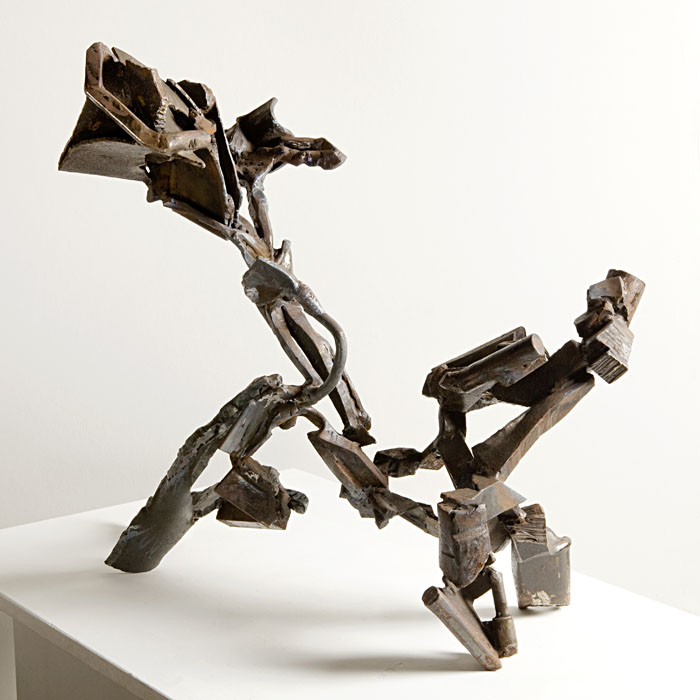
“Vervent III”, 2010, steel, H.63cm
When a potentially free-standing sculpture is in a state of flux while under construction, it can be brought together to coalesce “up in the air”, by means of gantries, chains etc; it exists in open space. But there comes a point when these hanging parts are connected together, and it is then that junctions become crucial. The points of connection may be disguised by being spread or shared (this is how Angouleme works), but in the end it has to convince as a viable structure, however unlike other structures in the world it has become. And the old “magic glue” of welding will not convince, especially if a heavy weight of steel is made to cantilever improbably, putting undue strain on that weld, and in turn on other elements within the work. That is why Gili has evolved a complex web of connections spiralling up through the work.

“Episodes”, 2010, steel, H.80cm
It comes as something of a relief to be faced with these smaller and more modest works. They are part of a continuous chain of forged and torch-cut steel sculptures which began with Aspen, 1985-88, and includes such major successes as Volante, 1998; Vervent 1; 1998, Vervent II, 1999; Flow Free, 2005; Daedal, 2009; Vervent III, 2010; and Episodes, 2010.
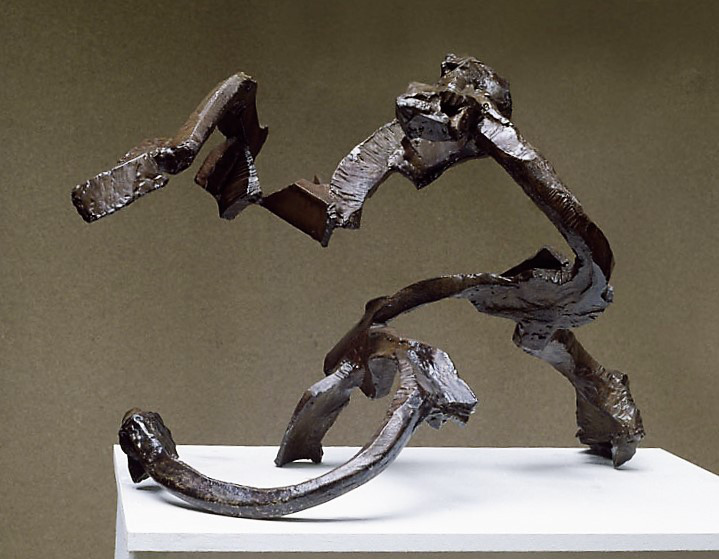
“Llobregat”, 1989-90, steel, H.54cm
Llobregat, in this exhibition, for me, distils the essence of sculpture. Its forged, hammered and torch-cut steel elements have assumed the permanence, the durability one meets in ancient artefacts in bronze or wrought iron. Each steel piece is taut, elastic or cursive, physically compelling, absolutely right in scale, the right note, the right length in the right place. Nothing is overstretched or over-torsioned (not always the case in Gili’s work). And one feels behind its cursive movements through space the weight of experience of how such movements are possible in the real world. And what I like so much in these small sculptures is the expressive force of the steel, as steel, with all the further associations that each formal element brings to the lyrical vitality of each sculpture. The modesty of scale in these small sculptures brings the steel factor even more fully to the fore.
It is as if the steel has become hardened through use and acquired the patina of long serving functional objects, functionless though they may be. Each element has a role in the structure of the sculpture which it fulfils with economy and expressive force. Of how many sculptures today can this be said?
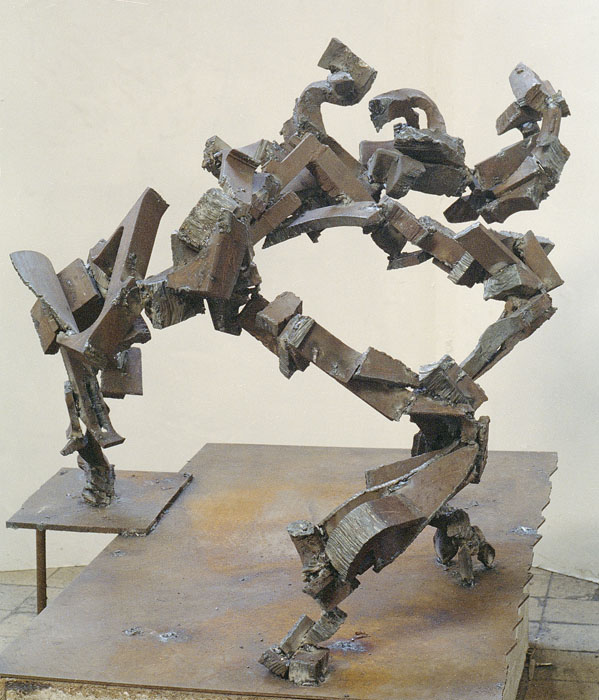
“Towards Aspen”, 1984, steel, H.82cm
It is perfectly possible to hold two contradictory views on the role of steel, or any material, and still to act – the one that it has unique properties that stimulate the imagination of the sculptor, whose sensibility is thus wedded to the material whose properties determine what is physically possible; and the other, that sculptural inspiration comes first, and steel is just a suitable vehicle for their expression. Both are no doubt in play here, but it seems to me that these small sculptures have the power that they have because the former persuasion is dominant, and without Gili getting inside the malleable properties of steel, as it were, in her way of working, they would not quite have the delicacy or the expressive range that they have.
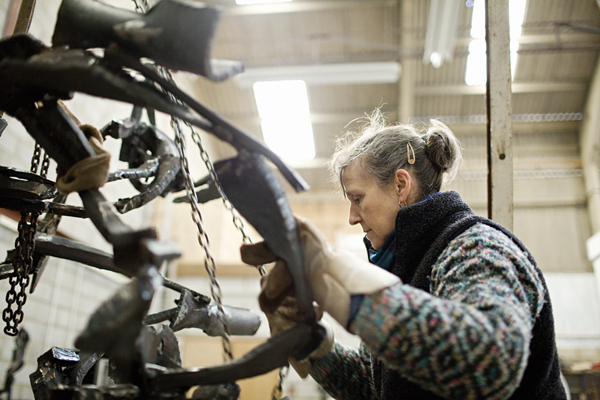
Katherine Gili working on “Ripoll”
It should go without saying that these properties of steel have to be projected into it, arising from the sculptor’s imagination, but there is no material more suited to the kind of plasticity sought here than steel, ductile, malleable, potentially tensile when tempered by the artist. It is like the issue of timbre, Klangfarbe in music; not just pitches and intervals, but the unique resonance of each instrument which colours the motif and projects it in the aural imagination of the listener.
But beside this hard, durable character in Gili’s art, there is a lyrical side. In the development of Gili’s sculpture since the late 1970s there is both a continuity and a dividing line between works which are clearly studies of anatomical movement, and works in which the sculpture has acquired an independent life, a sculptural plasticity, and the elements have been subsumed into this willed plasticity. There is a point at which the demands of the sculpture as sculpture have taken over, and the elements out of which it is built have begun to take on pressures which are to do with resolving the work as sculpture, and not to represent anything outside it. Although direct engagement with the body has receded since the 1980s, what has carried over into this independence from representation are ways of working the steel to draw out of it it’s full plastic potential – extruded elements which take on a three-dimensional life in relation to others in the work and contribute to its overall character as a sculpture, independently of naturalistic forms. There may be an inherent habitual tendency in perceivers to try to read figuration or representation into them, but there is nothing in the most achieved sculptures that would warrant such an interpretation.
However, this does not mean that they are totally non-representational. Plasticity implies that the “movement” represented through the matter of the sculpture as it turns through literal space is more than its literal movement. It implies greater movement, greater “force and counterforce” than is physically, and literally presented. There is therefore an element of illusionism present in all sculpture that is not just a technical demonstration or a mute object.
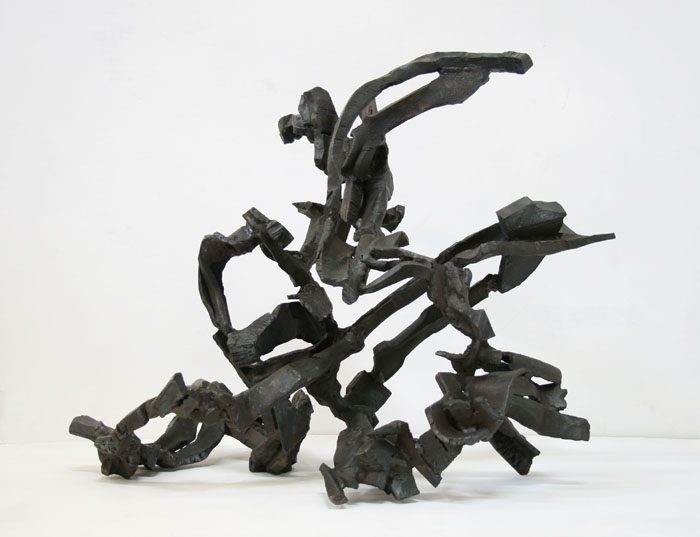
“Meril”, 2014, steel, H.45cm
Quinary (shown at top of page), in this exhibition, a compressed version of the earlier Angouleme, is the sculpture that raises these issues the most. It is a companion piece to a number of other smaller sculptures of recent date, of varying success. The largest sculpture Gili presented at Flowers Central Gallery in 2015, Meril, 2014, seemed to me complex but successful. If I have a criticism of the works on this scale, such as Quaternary, shown at the R.A. last summer, it is that there can be an undue thickening out and twisting of some elements, which acquire a somewhat heavy character, which is answered by or echoed by counter torsions in an over-complex roundalay. Some elements with multiple twists along their length appear to have a load-bearing function that they seem ill-equipped to handle, and this can lead to doubts about the structural logic, or viability of the sculpture as a whole. There is a tension between the actual physical structure and the plastic and spatial structure, and it is not always clearly overcome. I’d like to see them break out of this in some way. This at least was my reaction in front of the sculpture, but the more I look at the photographs of it from different angles, the less these criticisms seem to hold up. I don’t know quite what that says about the sculpture, or about me.
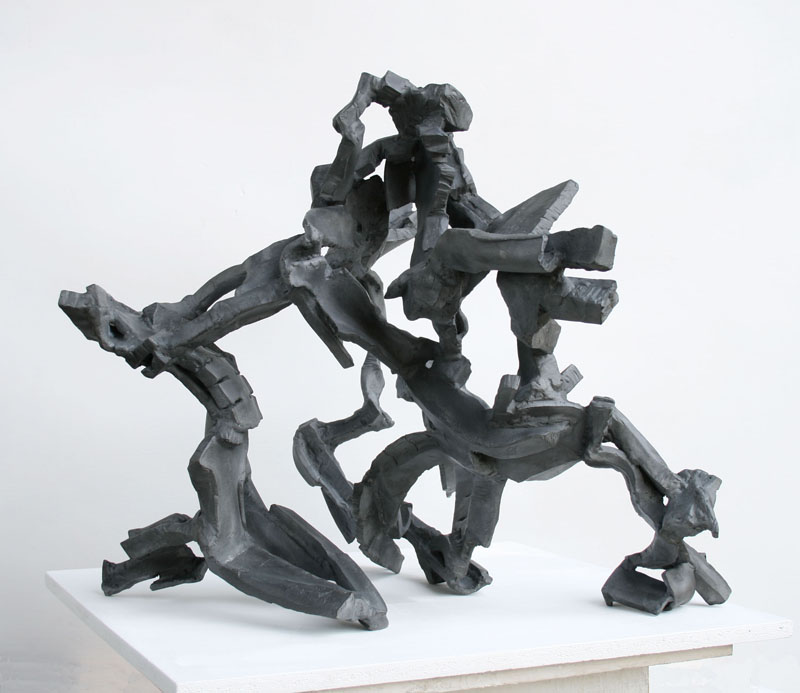
“Quarternary”, 2016, steel, H.75cm
However Quinary does not raise such doubts to anything like the same degree. It arises more as a problem in larger sculptures which approach waist or head-height. Again I repeat, these are problems that are not confined to Gili’s sculptures alone, but are common to the work of others who broadly share her concerns, with allowance for all due differences.
In Quinary there is no feeling that the structural weight is being carried by welds, for instance, or that it is borne hazardously in ways that cast doubt on its credibility as a total “organism”, so successfully is the integration of multi-directional sculptural forms which carry upwards through the piece. Without describing it in detail, a mammoth task, consider one element in the lower centre of the work, the bent wishbone-like form which seguays into a quite different mini-structural element at an oblique angle to it, which in turn supports an upper movement convincingly, i.e. sculpturally, not literally. That “wishbone” form is itself supported by two pincer movements from elements of quite different character, and so on. That I refer to it as wishbone-like does not imply that it is derived from organic form, but just that it is necessary to use some form of simile in order to identify it from other forms in the work. And the simile is much less evident in front of the work than it is in photographs.
This transformation of material in the service of plasticity has become increasingly sophisticated in Gili’s art, from the likes of Llobregat, Bold, 1988, and Sprite, 1989-91. It has become an evolved language of form. However on a larger scale the tendency for the working of the steel to invoke naturalistic form can be distracting. But it is easy, though misconceived, for detractors to characterise this work as “figurative”. The problem for many viewers is that they are not used, and not prepared, to invest enough time to really examine what is going on in these highly concentrated and complex works, which require a certain empathy from the observer if they are to be grasped at all. Quaternary, shown at the Royal Academy last summer, was difficult, though rewarding. The question of the accessibility and visibility of all movement within the sculpture is answered in the affirmative by Quinary.

“Naiant”, 2015, steel, H.29.5cm
Naiant is reminiscent of some of Tim Scott’s small sculptures and should be compared with them in some future exhibition, or in the Musee Imaginaire we are all obliged to live in due to the desuetude of contemporary curatorial attitudes and gallery fixations. It equals them in the variety of its worked steel components and the fluid “language” created from them. Scott’s Moment of Rhythm, 1989, or Feminine for Structure I, 1986, would make interesting comparisons, though I am not for a moment implying that the one derives from the other. Gili is on a trajectory of her own, and has been for a long time. (A Musee Imaginaire that would include Rodin’s Crouching Woman, Leonide , Anthony Smart’s First Figure 1981-82, Tim Scott’s Adele VIII, 1994, and go on to include the more recent and more “abstract” works of these and other sculptors of the same persuasion.)
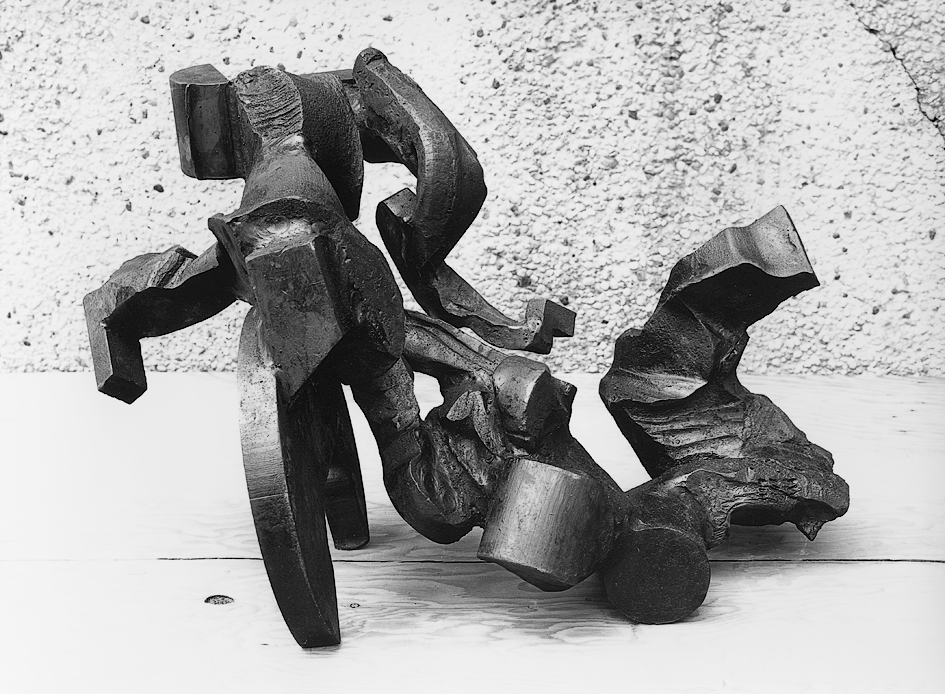
Tim Scott, “Feminine for Structure I”, 1986, steel, H.41cm. © Tim Scott, photo courtesy Galerie von Wentzel, ColognePotsdam
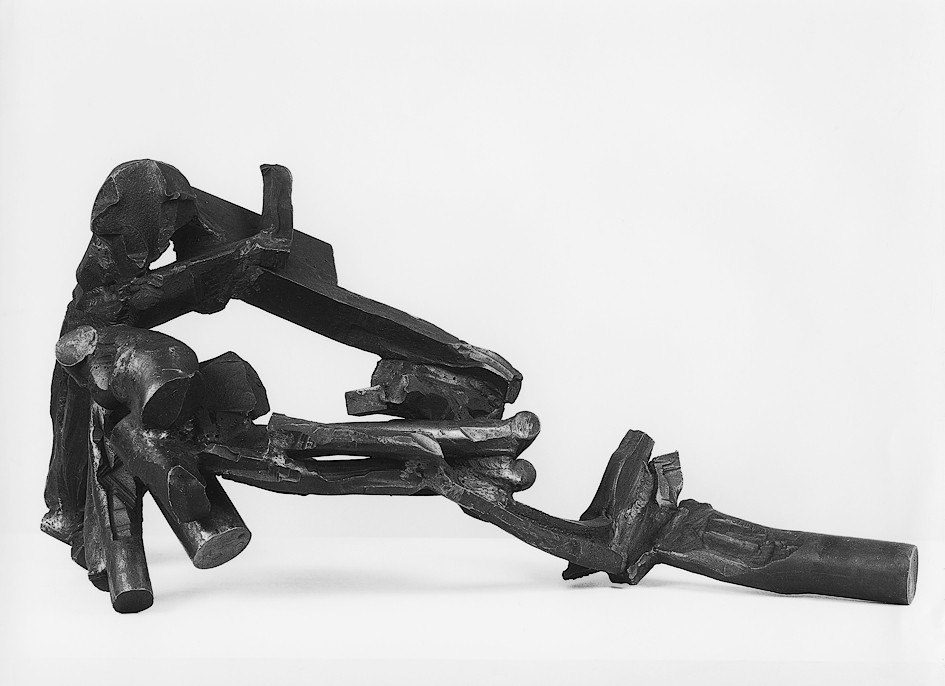
Tim Scott, “Moment of Rhythm”, 1989, steel, H.55cm. © Tim Scott, photo courtesy Galerie von Wentzel, ColognePotsdam
There is no need to analyse the smaller sculptures shown here. They are the felicitous, relaxed and playful offspring of harder won works like Llobregat and Flow Free. Mulled, Quicksap, and Turnsole are simply pure sculpture of a very high order, ampler volumetrically and spatially than they look in reproduction. Each one is a little gem of pure sculptural invention. Mulled is closest in feeling to some of Scott’s smallest table works. And analysing or describing them would not make them any more amenable to the insensitive. It would be like trying to explain a melody, albeit a complex one with many feints and turns.
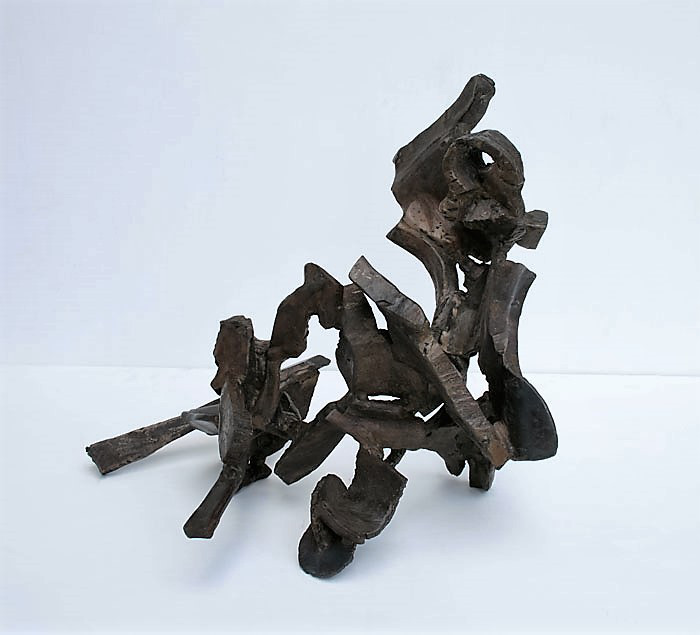
“Mulled”, 2014, steel, H.45cm

“Quicksap”, 2016, steel, H.46cm
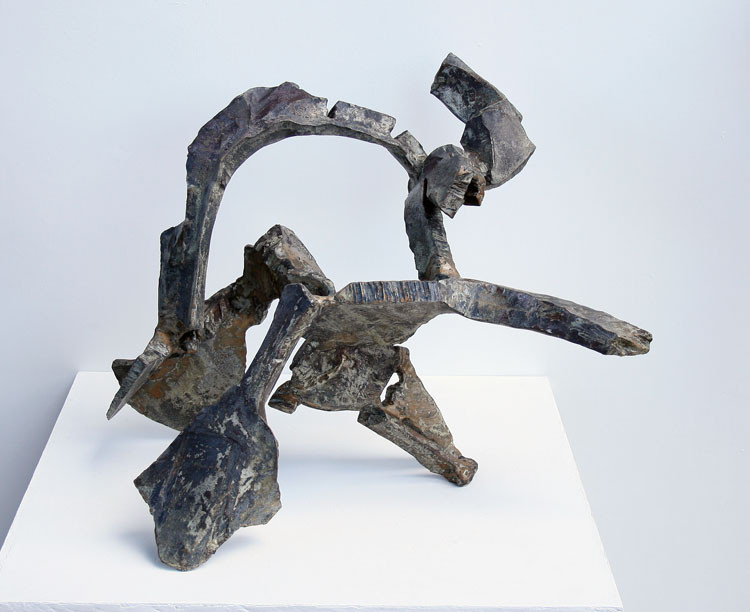
“Turnsole”, 2016, steel, H.39cm
Naiant beats Caro’s table pieces on their own ground, being terser and less decorative, less to do with placement, more interactive in the physical pressure of part on part, and exploiting the expressive properties of steel, as moulded in the artist’s sensibility through her direct making.
Anyone who sees figuration in Quicksap deserves a slap on the wrist. After all, to eliminate all reference to things or structures in the world of the senses, even if it were possible, would leave one with something very arid indeed from a sculptural point of view, like a model of some scientific postulate (behind appearances), or a systems diagram.

David Smith, “Tower 8”, 1957, silver.
This is where a sculpture like David Smith’s Tower Eight, 1957, shown recently at the R.A., scores, albeit with a minimal “physicality”. Although it resembles nothing in nature, its structure is transparent, lucid, if crazy, fully available to sight. We know that it is literally held together by welds, but its structure as sculpture seems entirely plausible, self justifying. One does not question its means of support, so dispersed throughout the work are its points of junction. Irrational, yet amenable to reason, one does not need to use the word “pictorial ” to define it. Within its very narrow range of physicality and three-dimensionality, it none-the-less points the way to a possible resolution of the issues faced by the ambitious among today’s sculptors. Blackburn, Song of an Irish Blacksmith, 1949-50, in the same exhibition, has a richer plasticity and inventiveness with steel. How “pictorial” is it, and by what means is its pictorialism established? – by distancing of parts and abrupt changes of scale relative to one another, establishing a greater visual distance than the literal space between them. Welded to a base these sculptures may be, but this gives them a freedom to operate that totally free-standing sculpture struggles with. Which brings us back to Leonide again. Although one has to say that the eloquent and rich plasticity of the likes of Llobregat, Vervent III, Mulled, Quicksap and Turnsole, and the range of formal elements they employ, are of a physicality and three-dimensionality beyond anything achieved by Smith, or Caro, for that matter – really sculptural, in short.
And there are other sculptures from the past careers of Scott, Smart and Gili herself, pre-Leonide, that are worth another look in this context, but that would be to take one too far away from this modest but intriguing exhibition.

“Umbells”, 2016, steel, H.30cm
Postscript: it should be said that as well as the sculptors already mentioned, Robert Persey, Mark Skilton and Robin Greenwood, to name only the steel sculptors, are engaged with many of these and related issues right now. Who knows what the future will hold? Skilton in particular seems to have evolved a bold and expansive style out of the way of building employed by Gili in her early Towards Aspen, 1984, though it is doubtful that there is a conscious link there.


Good that Abcrit has published Alan’s serious, lucid, and analytical critical appraisal of SCULPTURE(s); (Katharine Gili’s show). But why only Alan ? Are there not other commentators out there who love sculpture and appreciate the complexities and battles that ambitious sculptors have to deal with; and what about sculptors themselves ? there cannot only be the ex St Martin’s group who have something to say; the ‘Brancaster’ type of discussions have of course been amply covered; but they are of a type, spontaneous opinion and value judgement that cannot have been, by their nature, considered and mulled over in time; what one goes to Abcrit for, in fact.
Let us have some commentary on some of the issues in sculpture that Alan raises (and has raised before); not that I am remotely suggesting that they can be predicted or resolved on paper; only the actual sculpture can do that; (we know that anyway), but it IS possible for insights in art to come directly from the mind (and eyes)
LikeLike
I agree, Tim. Hope there will be more comments. Gili’s work isn’t easy to talk about–though it’s great, and Alan has opened a bunch of doors. I’m struggling to say something. Takes a while to get at least some of the idiocy out of my writing. Will “post” shortly. Running off to class now.
LikeLike
Considered as an analogue for a structure…” There’s the rub.
“Each element is clearly defined in character and in its structural role.” There’s another one.
“…sculpture whose aim is to engage one immediately in a spatial way rather than having a predominant viewing point, does not need to do so equally from all points on the compass.”
Needless to say, you can’t legitimately apply any of these phrases to abstract sculpture, in my opinion. OK, so here they are applied to the overtly figurative “Leonide”, a sculpture I like a good deal – in fact it was my favourite work in the show by Gili at Poussin Gallery in 2011. It’s one of the most spatial figurative sculptures by anyone, but the problems of making figurative sculpture even more spatial are one of the contributing factors in my desire, and that of others, to make sculpture more abstract, because it’s so difficult to get out of the continuous return to the torso/pelvis centre, and escape the symmetry/frontality of the body, no matter how far you stretch out. “Leonide” certainly does get out a long way for a figure, but in the end not far enough, not spatial enough, not free enough of constraints, which are, by the way, far, far more confining in figurative sculpture than they are in figurative painting.
And also by the way, “…sculpture whose aim is to engage one immediately in a spatial way” is very similar to my Madrid show (with Gili, Persey and Smart) catalogue commentary, 1988, writing of Degas’ “Dancer looking at the sole of her right foot”, (Rewald XLV): “This object engages you immediately in a spacial [sic] way, it is intrinsically interesting because of the spaces it generates.” As I’ve stated before on Abcrit, Degas best sculpture seems to me to be really striving for and achieving not only physicality, but also a significant degree of spatiality, as in proper three-dimensional articulation, NOT totally obsessed with HOW it stands, but getting away from the ground in order to engage with some other sculptural content in space – albeit with very little room to manoeuvre within and around the figure/body. Degas contribution to this is greater than any previous figurative sculpture, Rodin very much included. I think that’s why, for me, Degas still counts in a way Rodin does not. But even Degas is really peripheral now to ways of advancing abstract sculpture. It’s a whole other thing from his thing. But at least he had the wherewithal to see that sculpture must be as fully three-dimensional as it can be, unlike Smith.
The constraints which Degas was compelled to work within because of the subject of the figure are absolutely on a continuum with the constraints of working three-dimensionally “from all points of the compass”. If you are going to move from body-based sculpture towards genuinely abstract sculpture, as a number of sculptors who were involved with “Sculpture from the Body” in the eighties now have (and continue on that path, without end in sight), then I don’t think you can countenance a part-measure of either spatiality, physicality, or full-on, all-points, top-to-bottom three-dimensionality. Any compromise or falling away on any of those three counts, such as the thing only being three-dimensional in one orientation (which, if you think about it, makes no sense anyway), or being physical without being spatial (if that is possible), or vice-versa, will likely be the result of some kind of figurative idea, or alternatively, will result in such an outcome. The question, as it has been for a while with Gili’s work, is: is it figurative? If so, does Gili then accept the limitations of sculptural figuration? “Leonide” is undoubtedly figurative. I personally think all the sculpture illustrated in this essay, with the possible exception of “Naiant”, but including the work by David Smith (not sure about the Tim Scotts), are, by degrees, figurative, though they differ in the way in which they are figurative.
At the risk of getting my wrist slapped, and indeed to risk this comment being seen as an attack on one particular individual, Gili’s sculptures seem to fall into two kinds of figuration, both of which have their particular limitations. I’d better get out of the way here that, yes, of course, my own work has limitations too, etc. etc… But that’s for another day. The first kind of figuration of Gili’s work reminds me a lot of the “feet” sculptures that students of “Sculpture from the Body” did in the early eighties:
“Mulled”, “Quicksap”, Turnsole”, “Episodes” and “Vervent III” all fall into this category of small works that have three contacts with the ground, each of which behaves slightly differently, in a manner analogous to how the three (somewhat diagrammatic) points of contact of a foot assume different roles as they absorb different movements of the body they support, and so demonstrate different physical tensions or other properties. All well and good. And then there is an upward-moving part that approximates to the lower leg. So within that “set-up” you can have all the differing expressive variations, and how those four or so parts interact with each other as they stand together on a surface; but what you can never do is actually address very much else, in terms of the content of the work. Therein is the limitation – the sculpture can only really speak of its very own particular and very limited responses to being an object under the influence of gravity, albeit a reactive or organic object. As I have written extensively before on Abcrit in an argument with Alan about Tim’s “Song for Chile” about why I think structural determinism in sculpture is in itself a completely figurative idea, and therefore limiting and intolerable in the pursuit of abstract sculpture, I don’t propose to set it all out again unless I have to. Obviously, comments like “Each element is clearly defined in character and in its structural role” and “Considered as an analogue for a structure…” apply to “Leonide” without question, but if they still apply to this further group of works, Alan is outside his rights to describe them as abstract. That may or may not matter to Gili, I don’t know. It matters to me.
The second category of work is also reminiscent of early work from “Sculpture from the Body”, but this time reminding me of works which dealt with the “core” of the body rather than an extremity.
Into this category I would put “Quinary”, “Meril” and “Quarternary” and others. This group of works has more scope – there are more things going on, with a little more room for them to happen. At the same time, it seems much less clear what they are up to. Less clear, even, than these early torsos and pelvises, where the parts more directly followed the comings and goings of muscular and skeletal organisations. So we are left with a kind of musing or mulling around or riffing on semi-bodily structures, using the very physical language of forging, a speculative creativity that at least appears to have a degree of freedom to come and go in different ways, over and above the first group of work. It’s not without its pleasures, and Gili does it well, but it never goes far out of its own orbit. These sculptures are not, and perhaps don’t aspire to be, spatial. And paradoxically, compared to the other group, they have something of a problem with how they stand, or rather “sit”, on the ground – as indeed did the early torsos/pelvises. The interrelated but fragmentary nature of their content, characterised by a singular “knot” of activity, a “roundalay”, to use Alan’s word, from which parts attempt to escape, but then return (as per figurative sculpture), means that they do not easily “address” the space around them, or the floor… or the viewer.
“…these problems are not hers alone, but are raised with varying degrees of success by all the sculptors who may be in pursuit of three-dimensional and spatial richness.” Yes indeed, but the title of the show is “Looking for the Physical”. That to me is a particular but partial answer, just as the sculptures themselves seem to be particular but partial – on the one hand you have work that deals, almost to the exclusion of anything else, with how it stands – and indeed, without putting that “stance” under any great stress or tension by extension, cantilever, off-balance elements, etc., so that in effect the variations on this theme are somewhat aesthetic. On the other hand is work that engages in some internal comings and goings, but really struggles to stand in the world, and to my way of seeing, certainly does not “engage one immediately in a spatial way”.
The other thing to say about my comparisons is that the “Body” stuff is 35 years old. Things have to move on. Things have moved on. I think Alan acknowledges the problems in the work to some degree, particularly with Gili’s larger works. Fair enough, but I have to say I never thought I’d see Alan write this kind of thing:
“Llobregat, in this exhibition, for me, distils the essence of sculpture. Its forged, hammered and torch-cut steel elements have assumed the permanence, the durability one meets in ancient artefacts in bronze or wrought iron.” … “The modesty of scale in these small sculptures brings the steel factor even more fully to the fore. It is as if the steel has become hardened through use and acquired the patina of long serving functional objects.”
All of which is to be resisted by abstract sculptors now, I would have thought. And nobody, not even Alan Gouk, knows what the hell the “essence of sculpture” is.
Forging has its own problems for abstract sculpture-making. It’s all very well to imbue steel with plasticity, but if you are assembling a sculpture out of forged parts, that plasticity does not necessarily or easily transfer to the sculpture itself and how it is organised. If you are then going to slot into a configuration of some sort (there we go again, back to figuration) a string or group of heavily forged parts, already loaded with very specific but small-scale pushes and pulls, then it becomes very difficult to manage the plastic properties of the whole sculpture and be able to freely and spontaneously push and pull the whole thing around. It is, I would suggest, well nigh impossible to make such a construction properly spatial or three-dimensional. Such is my contention, though I would be the first to admit that simply stopping forging (as I did in the late eighties) does not solve these problems of getting to grips with the totality of the work as a plastic, spatial, three-dimensional, fully abstract sculpture.
And then we have: “After all, to eliminate all reference to things or structures in the world of the senses, even if it were possible, would leave one with something very arid indeed from a sculptural point of view, like a model of some scientific postulate (behind appearances), or a systems diagram.” No way is that true. And then, bizarrely, Alan has the temerity to postulate that a very boring and feeble diagrammatic symbolic figurative piece by Smith (Tower Eight) is “a possible resolution of the issues faced by the ambitious among today’s sculptors”. This is a bit fatuous, to say the least. How would Alan feel, I wonder, if I suggested that the problems he and other abstract painters have (and yes, even Alan has problems, like we all do) might be solved by paying attention to (let’s say, for example, plucked from the air) how “The Seer”, 1950, by Adolph Gottlieb, is organised: (http://www.phillipscollection.org/research/american_art/artwork/Gottlieb-The_Seer+.htm).
After all, “…its structure is transparent, lucid, if crazy, fully available to sight…”. Why not go down that route, Alan, and stop all this crashing about with big paint-laden gestures, getting yourself all in a mess?
Apart from the detail in some of his early work, this is possibly Smith’s best effort at full-scale three-dimensionality:
And it’s a shocker. There is nothing in Smith to be taken forward.
Gili is quite within her rights to pursue figurative or semi-figurative sculpture. Alan is not within his rights to claim it is abstract, or that it has bearing upon the sculptural pursuits of those attempting to make such work, or that it makes any kind of new contribution to those issues. It doesn’t. There is the suggestion sneaked into this essay, perhaps with a view to justifying Gili’s disguised figuration, that “illusionism” is inherently, happily and unavoidably figurative:
“However, this does not mean that they are totally non-representational. Plasticity implies that the “movement” represented through the matter of the sculpture as it turns through literal space is more than its literal movement. It implies greater movement, greater “force and counterforce” than is physically, and literally presented. There is therefore an element of illusionism present in all sculpture that is not just a technical demonstration or a mute object.”
Illusion is in fact the meat and drink of completely abstract sculpture. Happy New Year.
LikeLike
As I probably have said before, I have yet to see any sculpture that is not ” a configuration of some sort”. And I have suggested that the word configuration therefore best be dropped as a redundant way of characterising sculpture. Even so, configuration simply semantically does not imply “figurative” as used in art parlance or in fact. Throughout Robin’s comment there is this tendency to think that “structure” ie the way a construction exists and resists gravity, is “figurative” inevitably, whereas it is simply, as Shaun, to my great surprise, points out, a fact of physics. If abstract sculpture is to disobey the facts of physics, then it is a puzzle as to how it can “stand” at all. By trying to tie Gili’s work back to the early experiments “from the body”, and imply that she has not ” moved on”, Robin is simply showing prejudice against a sculpture with markedly different aims from his own.
It was the same with the discussion about Tim Scott’s Song for Chile II. Because it stretches out across space from point A to point B, ( sort of) this does not give it a ” configuration”, and because Tim has described Rodin’s Torso of Adele as a kind of arch, it does not follow that Song has the configuration of an arch, and even if it did, this would not make it therefore ” figurative”.
In parenthesis ….. When I introduced working “from the body” into projects for the Advanced course at St Martins in 1978, it was certainly not to revive figuration in sculpture. It was because so many of the students coming to the school in those years had no experience of making anything, besides strings of plastic bottles or piles of feathers. It was to give them a sense of the physical reality of things in the world. It came as a great surprise to me when these body experiments were taken up by members of staff, chiefly Tony Smart, Kathy Gili, Robin Greenwood, and Mark Skilton, amongst others. An even greater surprise followed when Smart wanted to introduce working from the skeleton. The subsequent sculptures developed far away from anything I could have envisaged. I have not always been happy with the outcomes, and this continues to this day, but I have supported the ambitions throughout. I too want an abstract sculpture, and a plastic and spatial sculpture that ” engages you immediately in a spatial way”, (R. Greenwood). But I do not want a monopoly on the ways and means of achieving it.
And I have not ” sneaked in ” any such suggestion that illusion in sculpture is inevitably ” figurative”. Illusionism simply means that something is being created that is more than the physical components of its constituent parts. That is all.
LikeLike
And by the way, Smith’s Tower Eight , and other of his “crazier ” works come near to disobeying the logic of “ordinary ponderable things”, ( that was left to Caro, allegedly) but they do not disobey the laws of physics. Being attached to a base and employing “magic glue” (even in silver) does give them a certain freedom and a certain illusionism which free -standing sculpture must surely envy, but you wouldn’t want to go back to that, would you? There is indeed the rub. To read figuration into it is an option, but unnecessary. Not always the case in his work, obviously, but that gives it an open ended quality that I for one see as a positive, even now.
LikeLike
The interesting thing about Gili’s development is that Towards Aspen 1984 did not turn into the sorts of thing Mark Skilton is doing, but into Aspen 1985-88, which shows the sort of condensation of sensation that she is after, and which Llobregat so magisterially demonstrates. (as described above).
LikeLike
A work of art is always a representation of something, even if it is only the confused state of mind of the person who conceived it, or in rare cases, the serenity of complete command of the resources of the medium and of the artists feeling.
Even such supposedly “abstract” works as Bach’s The Art of Fugue are built on the mastery of rhythms and harmonic tensions that have their origins in mimetic rhythms, word paintings, symbolic statements of liturgical meanings, depictions of evil, the fall, murky Lutheran stuff, such as repeatedly occur in the Cantatas, tumbling rhythms, representings of a sea of emotion, tension and relaxation, heart beats, regular and irregular. Not so much “figurative” as physically enacted.
When the last unfinished fugue comes to an abrupt end (whatever the reason for the missing page) we are left hanging, mentally confused as the build up and flow of the musical argument is cut off, coitus interruptus ; we are unable to complete it (no-one is) because what we have experienced is not just an edifice of logic, but a logic of feeling the outcome of which only Bach can supply. So a work of art can be representational without being “figurative” in any sense of that word. And the same is true of sculpture.
LikeLike
I think you’re rather stretching a point beyond endurance there. I know of nothing more abstract than Bach’s Toccatas.
As too, with the business about the Physics. Whilst it’s true that everything in the known universe obeys those Laws (barring the odd black hole; and assuming we are in the world of Einsteinian, or even Newtonian Physics, perhaps), well so what? My sculpture, your painting, a chair obeys those Laws. (My sculpture stands up just fine, despite being made of tinsel and fairy lights.)That does not mean that the content of the sculpture must be anything to do with a demonstration of those Laws. And what I have repeatedly said is that sculpture needs to address other things, over and above the literalness of how it stands up. I’m sure you agree with this really.
So too with the business of configuration – yes, every sculpture can be said to have a configuration, depending upon how you define that word. But again, if the content is about the “stance”, the configuration will be to the fore. Think about those Degas sculptures again and you’ll see. It may be a matter of degree, but the more abstract a sculpture can be, the more it will sideline or mask its configuration in favour of something else.
In any case, the search to make things more abstract is a bit of a challenge to the orthodoxies of common sense, rather along the lines of what is happening at the cutting edge of High Energy Physics. Or so my wife says.
LikeLike
Walls,bridges,legs,tripods,platforms,barley twists,clusters,boundedness,horizontality,pictoriality,
objectness ,architecture,reliefs, literalness,organic, gesture, figuration, and figure/body referencing etc etc.
These are just some of the long list of things that have been the bane of the new sculpture over the last 40 years.All the sculptors I know know all this.
The world of the new sculpture has turned and commentators shuffling these negatives will get us nowhere useful.
The door forward is wide open. New exciting things are happening though not always easy to spot. The things on the list will never be settled they can surely though now be left to the individual and the commentators will have the choice as they always have had to look back check the “list” damn the work without proper explanation or step over the line baggage at the door and see what they see without others eyes and prejudice .A new unstuffy and non academic approach is needed now which asks questions of which the answers are not so obvious but that could play the part for this to keep moving forward.
OK so less words will be written. Good.
LikeLike
Why have the photos of the “feet” and the paper studies “from the body” been removed?
LikeLike
It is an amusing coincidence that while this discussion is going on, all this week Radio 3 has been featuring the work of the Second Viennese school, with many parallels with the question of how abstract is abstract. It would appear that Schoenberg’s most successful works, by his own admission were those in which events from his own biographical fate formed the emotional core and even the dramatic content of the work. In the String Trio, for instance, he dramatises in sound the experience of a heart attack and the injection straight into his heart which saved his life. Similarly his Violin Concerto is biographical in character.(his favourite composition). The sustained anger of the Three Satires is fuelled by the critical abuse he had been receiving, and fury at the fashionable propagandising of the other neo-classicists.
Anton Webern would on the face of it appear to be the most “abstract” of the group, and yet his Variations for Piano sounds (if I may be mischievous) not unlike a table-tennis match between unevenly matched partners, and in one movement by two players attempting the game for the first time, unable quite to keep the ball on the table.
So, I repeat, to make something that has no structural connection to anything in the perceivable world is indeed a rather arid prospect. And these composers do not even have the issue of gravity to contend with, as they “breathe the air of another planet”.
LikeLike
Presently speaking it is not wether the piece of work references to the perceivable world but that the piece create a perceivable world of its own wherein the structural relationships are perceivable on their own terms without outside reference.
It is real.
LikeLike
The thing about the “feet” is …… Would we know or guess that they were feet if we hadn’t been alerted to the fact that they were so based ?.
LikeLike
The reason the Toccatas, the Art of Fugue and the Cello Suites have such an appeal for sculptors (and painters) is because the dancing, climbing and tumbling rhythms are physically enacted, simultaneously physical and auditory, as the physical/structural in sculpture is simultaneously visual, hopefully. The velocity of attack and the strongly accented structural element is as near to a physical enactment, ( literally for the performer) as music can give. How important are these qualities in the more physical world of abstract sculpture (and painting)? Very, I’d say.
At the opening of Contrapunctus 9 the attack is propelled like a bullet from a gun, and the propulsive motor rhythm is maintained throughout, which is why jazzers love Bach.
At the closing pages of Contrapunctus 11, there is a pile up of harmonic clashes and crescendos that is almost visceral in effect. No 13 has danceable pizzicato dotted rhythms, foot tappers.
Vyacheslav Gryazonov on YouTube has had a go at completing the last one, unconvincingly. It’s really a coda rather than a culmination, but at least it’s better than a computer would come up with.
But enough from me!!
LikeLike
I have tried, unsuccessfully, to write about my sense that these jazz performances by the second Miles Davis quintet strike me as, on the one hand, highly abstract, and on the other, very visual, corresponding to modernist painting and sculpture at around the same time (mid-60s). To my ear, they provide some intuitive support for your remarks on Bach (“…the dancing, climbing and tumbling rhythms are physically enacted, simultaneously physical and auditory, as the physical/structural in sculpture is simultaneously visual…”) –
All composed by Wayne Shorter
LikeLike
Yes, it is semantics again. My own reading of ‘configuration’. (at any rate as far as sculpture is concerned), would be a collection of parts organised to make a whole and the effect that produces. I agree with Alan that this has nothing to do with ‘figuration’ despite the word root. I would be perfectly happy to abandon its use for sculpture.
Coming to ‘structure’, yes of course its physical role (obeying the laws of physics) is cardinal and immutable.I too cannot see that any structure could be (in this world at any rate) without these facts (scientific) of existence. However, I do use the word loosely in sculpture to also mean a creative ‘AIM’ as well as literal support, connection, elevation against gravity etc. For sculpture to succeed it has to enter a world of made intentions that are more than what is ‘known’, from previous experience or practical laws.A sculptural structure has to be as much the outcome of intuitive feeling, invention and (let’s face it) inspiration, as the handling and construction of materials in space and ‘subject to gravity’. None of this implies or supposes ‘figuration’.In fact I would say that there is no difference applying the above to either figurative or abstract sculpture; the only qualification being how ‘good’ it ends up being ultimately.
Not having been able to see Gili’s show it would be invidious of me to enter into the discussion of individual pieces; but I would like to bring up a quotation from Alan’s original essay (as it happens Robin picked out the same paragraph). “….Plasticity implies that the ” movement” represented through the matter of the sculpture as it turns through literal space is more than its literal movement. It implies greater movement, greater “force and counterforce” than is physically and literally presented. There is therefore an element of illusionism present in all sculpture….”
This is precisely what I mean by ‘sculptural’ structure; it IMPLIES more than it presents in its actual form. I hesitate to use the word ‘illusion’ which smacks of trickery; but I see what Alan means Sculptural structure has to be ‘developed’ from actual structure; it has to simulate the liveness of an inspired underlying idea about physical form as well as exist in its literal construction; to become a ‘poem’ in the actuality of its physical decisions. Yes, it ‘represents’ something, usually many things (in the mind of the artist), Spectators have to arrive at heir own conclusions Incidentally, I wonder what J.S. Bach would have to say about being called ‘abstract’ ? Or Degas for that matter?
I agree that orthodoxy is the death knell of advancing the scope and nature of what abstract sculpture can attempt to do. I have seen some small Inca clay sculptures (Jaime Coaque) that knock the spots off us for ‘abstraction’ !
LikeLike
So great to have Giacometti welcomed to Abcrit!
I bet there were times of the day when Giacometti might have agreed that beside Katherine Gili’s sculpture his looked feeble. I expect more often than not, though, he would have been incensed by the suggestion. I’ve heard at least some of Picasso’s sculpture pissed Giacometti off. At an opening for one of Picasso’s shows Giacometti told Picasso that a specific piece simply wasn’t sculpture—one of Picasso’s still life sculptures I think it was. (Didn’t Caro early on make some Picasso-esque still life sculptures? I seem to remember a vase of flowers in bronze.) (Back in the ‘70s George Spaventa, a great, Giacometti-esque, Studio School sculptor/teacher, told Lee Tribe that what Lee was doing simply wasn’t sculpture.) Giacometti left Picasso’s opening disgusted, and went to some brothel or other. When Giacometti got back to his studio/home at 5 in the morning, Picasso was there waiting for him. Picasso wanted to know why his sculpture wasn’t sculpture—and he thought Giacometti could tell him.
Giacometti’s sculptures (many anyway) are physically/literally fragile/feeble. Bruce Gagnier’s are by and large more robust (more robust than Giacometti’s, more robust than Gili’s), but Bruce has made very, very fragile/flimsy sculptures. People sometimes respond to Bruce’s figure paintings and drawings by saying Bruce can’t do arms: Bruce’s arms are often, in his drawings and paintings, fragile/feeble (in his sculpture his arms are often as far from feeble as you can get)—but at the same time they have a kind of steely strength. Giacometti’s “line” in his drawings—in his sculptures and paintings too—is often very steely.
Where am I going with this? I’m not sure, but maybe this is an opportunity to open things up some, to get out of the good guys vs bad guys box, the figure sculpture vs “abstract” sculpture trap.
Also it’s an opportunity to suggest that to be “feeble” is not all bad. Yves Bonnefoy, the late, great, French poet (and author of a 10,000 page book on Giacometti (I’ve read it cover to cover at least twice)), talks about his “desire to confront our world in those aspects that are most fleeting, that seem least charged with being, and to give sacred meaning to them so that I might be saved with them.” Xmas decorations, “tinsel and fairy lights” might be taken seriously, Bonnefoy seems to suggest.
I should and shall say I think Katherine Gili’s sculpture is great—and Alan’s writing about it is great too. I should also say I’ve never seen Gili’s sculpture except in reproductions. And I don’t really know (or care too much) what “great” means. I just have lots of questions—I guess because I find the sculpture—and the writing—so exciting. I have questions: I don’t have answers.
Besides Giacometti, isn’t there, in a strange kind of way, a lot of Ancient Greece in Gili’s sculpture—and in the sculpture of many of the other sculptors Alan refers to—even in Alan’s writing?
It would be silly to suggest that Plato—not Roger Fry, not Clement Greenberg—invented Formalism. But what is physicality? What is spatiality? Ideas? Platonic “forms”? What is the essence of sculpture? There is some kind of “philosophy” behind this kind of “thinking.” And it’s something more than just NOT—decisively or hopelessly vaguely—“Existentialism.”
Here’s Yves Bonnefoy again, this time writing about a Byzantine church, but touching on Ancient Greece (his (Bonnefoy’s) Ancient Greece anyway) too:
“But nothing can replace the most majestic of the paintings (The Dormition of the Virgin, c. 1260. Church of the Trinity, Sopocani, Serbia). And when one turns toward it, in the October light, it is the true speech, so long sought after, that all at once resounds. How close he is to us, the man-god offered in this room that hereafter will remain empty! And in how pure a way he brings together, following the deepest wishes of our hearts, the two discordant intuitions of Western thought: what perishes—and is our fate—and what is eternal! There is the beautiful and pensive face, grave as though wounded in the light of the nimbus, and yet all around him the army of this conqueror of the world is deployed—weapons, clouds, the clarified powers of what is human—and thus are effaced those excessive simplifications in which the dialectical ambitions of the Western mind have so often come close to ruin. The god of Sopocani does not mutilate. He is not that Apollo of the Hellenistic sixth century who, in all the brilliance of his force, remains like the unswerving trunk of a tree, like some pure and blind form of plant life, so strongly did Greece want to identify humanity with life, with its impersonal forms and with its harmonies, unaware of that other realm which is the finite existence of the human person who is conscious of himself.”
In Tony Smart’s most recent Brancaster, Helga Joergens-Lendrum suggested there was something “organic” (I think that was her word) about Tony’s new sculptures. Helga was immediately dismissed from the Brancaster, tortured, and then shot. I think Helga was taken to be asking does the sculpture look like this or that kind of plant—but maybe she was sensing a plant-like “life”/vitality, a plant-like lack of awareness of death in Tony’s sculpture. Maybe there’s an animal-like lack of awareness of death in some of Mark Skilton’s sculptures. Alan seems to have picked up his infectious enthusiasm for “ancient artefacts [often based on animals] in bronze and wrought iron” from David Smith.
But what about Gili’s sculpture? The title of her show was “Looking for the Physical.” Bonnefoy: “Accordingly, the finest statues of the Hellenic period seem steeped in the flow of nature: the eyes half-open, half-closed like those of animals, the mind, free of all aims, worries, or concern for the future, free to participate in an unbroken inner communion with the eternal. Who of us is not fascinated by this physical time in which the pulse of the timeless seems perceptible in human gestures, like sap universally present in each plant? Death seems dissolved in nature; and the human image, which is elsewhere scattered or incomplete or inaccessible, seems mysteriously whole. This is the secret need of great anthropomorphic art.”
Bonnefoy goes on: “If the true nature of the human being is to be encompassed in an image of physical presence and find complete expression within the limits of this form, and in spatial terms, it is a precondition that our inner sense of the human should be experienced as an essence; it must be free from that inner abyss, that sense of division and fracture which accompanies the aberrant and troubled temporality, aspiring to transcend its limits but incapable of reaching outside itself, to which the early centuries of Christianity made a decisive contribution.”
Gili’s work is very “physical.” Alan is great at describing this “physicality”—but he doesn’t really ask what it means. The “physicality” is anti-Giacometti, anti-“spiritual”—maybe anti-“modern” in different ways. Gili’s work is unsettled. It’s challenging, as Alan says, very challenging.
If Tim Scott’s sculpture had eyes, they’d be “half-open, half-closed like those of animals”—Classical animals! Gili’s a Romantic. The eyes of her sculptures are wide open.
Alan writes very intelligently about stance and movement and gravity in Gili’s work. He helpfully spots a “wishbone-like form” in Quinary—and then is very careful about underlining that all he’s saying is the form is just wishbone-like—it’s not derived from organic form, etc. I’m very comfortable saying I see a lot of Paul Taylor, the great American choreographer, in Gili’s work. I have no idea whether or not Gili has ever seen the Taylor company dance. I do know she’s had some serious contact with dancers though. A modern dancer has a very different sense of gravity from a ballet dancer. I can’t describe the differences with any real authority. I can say I’ve seen modern dancers walk into a studio and just joyfully slap their bare feet on the floor. Everybody knows ballet dancers never touch the ground. And this little bit of knowledge adds to my experience of Gili’s work. It doesn’t violate its “abstract” purity. And I can go a little further and say there’s a sense of strain in Taylor’s lifts that’s close to the sense of strain in Gili’s Angouleme or her Serrata. Again, Gili’s work—and Taylor’s work—and my life, my experience—it’s all richer because of this association.
Merce Cunningham is another great American choreographer. He’s thought to be a super “abstract” guy—but he wasn’t “abstract” enough to make dances without dancers, without “figures.” And he kind of never said, No. He did once that I know of. He’d asked Richard Serra to design a set for a dance. A tilted floor was part of Serra’s set. The dancers would have ended up either crippled or dead after performing. Merce said, No. But otherwise he let just about everything into his work. There’s a lot to learn from choreographers.
“Isn’t that right?—what you’re really imitating in human bodies is the frame drawn up or down, compressed and expanded by their posture, by the tensed and relaxed parts, and that is how you edge closer and more believably toward their reality.” That was Xenophon, not Bonnefoy. Bonnefoy’s isn’t the only take there is on Ancient Greek sculpture. Gertrud Kantorowicz had her own take. She quotes Xenophon at the beginning of her wonderful little book, The Inner Nature of Greek Art. The book is kind of all about contrapposto, Alan’s favorite topic. I should quote the whole book now, but I’ll just mention there’s lots of talk about “in-the-body movement,” “in-the-body laws,” etc. in her book—lots to interest “Body” sculptors. Xenophon wrote his Memorabila about 2,500 years ago. Things have NOT moved on.
Alan didn’t mention the drawings in Gili’s show—in the online catalog anyway. I get the feeling drawing was never a thing at St. Martins. I think the drawings are terrific. I think it’s great that Gili showed them. I don’t know why she showed them, but I kind of see them as a special challenge for Robin. Not long ago Robin stuck some great hands and fists in his sculpture. Gili might be trying to get Robin to take his hands seriously.
Gili’s work is full of challenges. I don’t think the Museum of Modern Art is up for her challenges, but maybe one day they’ll put Angouleme out in their sculpture garden. It’d look great beside Rodin’s Balzac. We’d be able to ask, which is more feeble? And we’d ask what’s the other side, the “contrapposto,” of feebleness? We’d learn something about life—good students that we are.
LikeLike
I wrote this in 2010:
“…looking back into history, figurative painters… only had to open the door and step outside their studios to see a whole world of particular and varied possibilities – to say nothing of all the human stories and dramas with which to populate their worlds. What do abstract artists have? It looks dolefully meagre by comparison, and initially discouraging of any aspirations to match in abstract art the plastic and spatial achievements of the greatest figurative painting. Yet, though it may be difficult to see how such ambitious desires can be fulfilled, it is only in the deepest darkest mystery of such difficulty that one might find the freedom to invent something truly original. It is in that very void that the promise lies, the outrageous possibility of working towards an abstract painting [or sculpture] without an idea or a conceit or any other kind of false agency, free from all constraining configuration. I know it invites ridicule in the current climate of literalism to suggest that the artist might work without ideas or concepts of what the work will be “about”, might shed all pre-conceived formats or images (even “abstract” ones) for the finished work – but I stand by it. This freedom, this openness, this desire for discovery, is the key to unlocking the big, wide-open spaces of new abstract art…”
And from a slightly earlier essay:
“The business of making complex abstract painting or sculpture now… is a long way removed from the spontaneous abandon and carefree self-expression which constituted the popular myth about being an abstract artist in the second half of the 20th century. That idea still has romantic appeal, but it will no longer suffice to produce progressive results. Having tip-toed all around the edges of abstract art, we now have to plumb its depths. Our modern abyss which we must face up to is the amorphous and vast complexity of possibilities, the endless potential, of empty abstract space… We must enter the abyss…”
As I said to Emyr the other day, if you know what you are doing, you’re not making abstract art. If you are not engaging with the black hole that is in front of you all the time, then you are probably “representing” something or other. I recall a rather telling moment in my studio, perhaps six or seven years ago, when in the rather dark despair of being unable for a long time to finish work or be satisfied with anything that was happening (which seemed to last years), I chanced upon a part in a sculpture that stood out from the rest; it looked strong and clear and very physical. For an hour or so I was elated, only to soon realise that the power of the form resided in its resemblance to a human arm and hand. Once I’d seen that, I was completely flummoxed – and back facing the black hole. Was it true, I wondered, (and I wondered for a long time) that content in sculpture just HAD to be some kind of figurative metaphor from the literal world in order to gain any kind of reality?
A very similar occasion arose a couple of years back in Mark Skilton’s studio when we were discussing a supporting part that held up a large weight under compression and all sorts of other forces. Did it look like the hind leg of an animal? Is that how it worked? Was it a metaphorical leg, an analogous physical structure, an artful and abstracted demonstration of the laws of physics?
It’s real easy to fall away from what is real, to fall back into figuration in all its guises; making properly abstract work is really hard, and it’s a work in progress, but it is possible. Take a look now at the best of last year’s sculpture in Brancaster – say Tony Smart’s “Sidney Series No.9,”, Mark Skilton’s “Brian the Boa Constrictor” and my “Habia Rubica”. See if you can identify in any of them a metaphorical content based upon a structure from the literal world (Jock, you’re not allowed to do this, you can see anything in anything!). I think you would be hard pressed also to identify a configuration, at least in terms of how I define the word. This is more than semantics. There has been over the last few years a sea-change in sculpture and how it operates. For example, Tony has described his work as a “spatial continuum”. That’s an excellent approach. That is progress. It’s not the only way, of course, but there is no analogy involved, no relation to literal structure, no identifiable structure from the real world at all, and most definitely no metaphors. Not even a poetic one. Lots of abstract illusion, though. In abstract art, nothing is “represented”. Tim, Alan and of course Jock do not seem able to recognise this.
By the way, I think Alan’s description of “Llobregat” is pretty good, and I agree with it (apart from the “essence of sculpture” thing), more or less, and I quite like the sculpture, always did – but it is a work that is very reliant on figurative allusion and suggestion, not to mention its shared properties with figurative sculpture of the past. Comments suggest that the differentiation between abstract and figurative is not too important. I think otherwise. It really is.
LikeLiked by 1 person
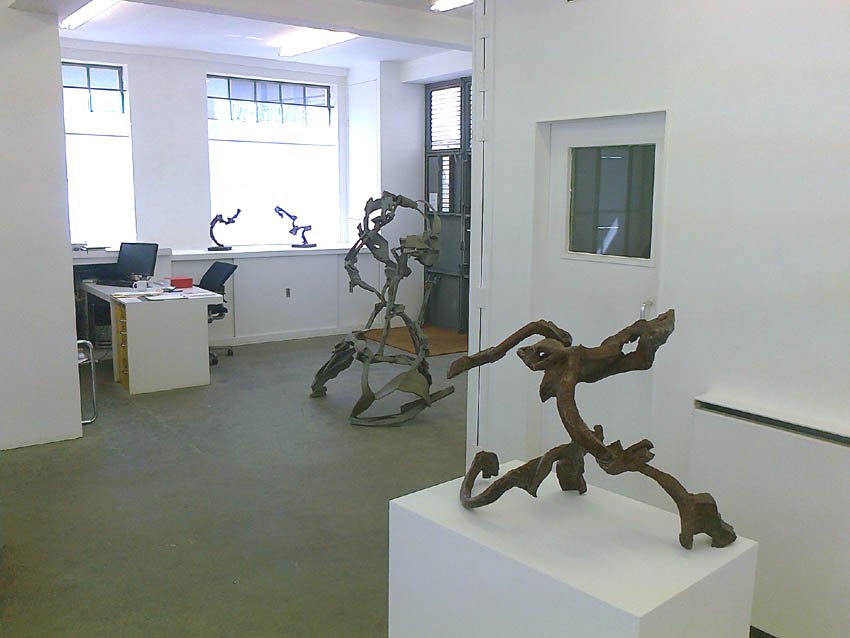
Another view of Llobregat and Angouleme
LikeLike
I’m sure it is very hard to make abstract sculpture—but, Robin, you must admit: it’s 10 times harder to write about it. It’s essentially impossible for me. I sincerely apologize for the pain and suffering my “sentences” must cause.
Katherine Gili seems to be quite relaxed about words, specifically the words “abstract” and “no.” Maybe that’s why I like her work so much. There’s a kind of fullness to her work that’s not constrained by words/ideas—or, it seems to me, “the subject of the figure.” Robin, you see old classroom assignments—the “feet” sculptures, the “core” sculptures—limiting Gili’s work. I think I understand what you’re talking about. I see that kind of thing happening at the Studio School a lot when students are given “assignments.” Students complete assignments—they do what the teacher tells them to do—but they don’t begin to make sculpture, to project “themselves” (or some “other,” or space between themselves and an other) into the work. What seems to me to be the marvelous thing about the Sculpture from the Body project is that that kind of thing (the “assignment” thing) seems (to me (from reproductions)) NOT to have happened at all.
I’ve been looking at one of the drawings of Achille Emperaire that Cezanne made as studies for that great early portrait of Emperaire. The drawing’s great—especially great for a guy we’re told couldn’t draw. You might say the drawing’s “figurative”—limited by what Emperaire looked like, even by what Cezanne thought a drawing should look like (at the time maybe he thought drawings should look like drawings made by Rubens). I might agree that the drawing’s “figurative” (I’m trying to be as relaxed about words as Katherine Gili is)—but I’d say there’s an “abstract” dimension to the drawing (the way the “form” is handled, the way the “space” is handled) that is FULL of Cezanne. How crazy am I to see some of Cezanne’s drawing in Gili’s sculpture?
LikeLike
I certainly don’t want to imply that Gili is doing basic classroom exercises, because hers are in many ways very sophisticated sculptures. In fact, I don’t imply any criticism, other than to note the similarity to certain things done in the past, which is why, I think, that Alan is able to write about them in the way that he does – somewhat conventionally.
As I recall, there are two very contrasting drawings by Cezanne of Achille Emperaire, both brilliant in very different ways. Cezanne is undoubtedly a master of drawing as well as painting, and he does, like all great artists, point the way forward to the inevitability of an art that is wholly abstract. That might make you even more crazy than you are.
LikeLike
Musical analysts are forever talking about the “structure” of say a sonata first movement by Beethoven, without in the least suggesting that it is based on a structure from the literal world. The very notion of “structure” in this context is an acknowledgement of the abstract nature of the music, (even allowing for the representational connotations I’ve mentioned in Bach). And this is the way Tim is correctly using and defining the word in relation to sculpture. Sculptural structure and literal physical structure are not co-terminus. I think we all agree on that. But this does not mean that a sculpture can convince by stretching its physical structure to the point of total implausibility, because this will be detected by observers even if they are unable to pinpoint why they are uneasy.
Tower Eight by Smith, and Tower 1 is an even better example, meets all your criteria for a structure that has no metaphorical content and is not a literal demonstration of the laws of physics. Indeed these works are crazily free of all that, and yet you seem to be unable to grant them the property of opening up possibilities for the sort of abstraction you require, (allowing for their minimal three-Dimensionality of course). Marry them up with John Panting’s surviving sculpture in New Zealand, and further possibilities open up, perhaps. But this is taking us far away from Gili’s sculpture.
I would also take issue with your use of “metaphorical” liberally applied to any work in which the steel parts lose their literal identity as pieces . Does a spanner become metaphorical because it suggests the possibility of torsion? Does a forged bow shape become “metaphorical” because it implies forces not literally present?
LikeLike
Again I’d say — would we think that those “feet” we’re figurative if we hadn’t been alerted to the fact that they were based on feet?
LikeLike
Also, there’s an anomaly here with your views on painting. When I say that figurative painting and abstraction are on a continuum but with a clear dividing line which cannot be crossed with impunity, and give reasons and examples (Matisse’s Moroccans being borderline, Hofmann’s Pre-Dawn just making it over to abstraction), you read figuration into it and yet still refer us to Cezanne and Constable for the missing ingredient.
Whereas in sculpture you say that they can have no truck with one another, are on totally divergent paths, never the twain shall meet, “figuration” tainting the very possibility of abstraction, even though you all got to where you presently are by way of an engagement with the structural element in key figurative sculptures of the past. Can someone please square that circle for us?
LikeLike
Which is not to say that I don’t admire the ambition for a radical abstraction such as you seek.
LikeLike
Ah! Well, there’s bound to be a few contradictions knocking about, but I would say, confirmed by a few mutual friends, that, good though they are, your articles and comments on the whole contain more than mine, not to mention the odd volte-face.
I don’t look to Cezanne and Constable etc. for any “ingredients”, but as examples of high visual ambition achieved. Like we all do. I don’t look to Smith for that. There is absolutely no getting around the fact, no matter what you say, that Smith is not three-dimensional. Nor, in fact, is he spatial. Why would I want to be influenced by him? Allow for his minimal three-dimensionality? No way. Give. Him. Up.
I do think – perhaps we agree on this – that painting appears to be more of a continuum, but there are big differences in sculpture. Spatiality is one very big difference, as I have comprehensively explained above. I’d also say I’m not at all sure that painting should be quite the continuum that it is. When’s the revolution?
I don’t think Tim does use the term “structure” correctly, because both you and he relate it closely with “standing” in the world, albeit a “poetic” interpretation of that standing. Whereas, I don’t think we know that much about abstract sculpture to really say. We have yet to find out what “structure” really means in abstract sculpture, if it is indeed even relevant in the terms we currently understand it. For me, the jury is out on that. Like I say, we are staring into a hole, and we don’t know the answers. We’re all about asking the questions at the moment, and if as a sculptor you are not doing that, you’re probably out of it. Sculpture from the Body solved nothing, that just asked questions too. I think that the way both you and Tim write about sculpture sounds rather like you do know the answers.
LikeLike
Don’t be silly. How could I , non-sculptor, possibly know the answers to your questions as a practicing sculptor. All I do is respond to what I see in front of me as best I can. But I do not take the messianic revolutionary tone, and I think you are greatly exaggerating the “abyss” that confronts the abstract sculptor. I bring in musical analogies only to try to show that ” total abstraction” is something of a myth. As Tim says — how do you think Bach would respond to his music being designated abstract? And how do you think Cezanne would have responded to the comment that ” his painting …. points the way to the inevitability of total abstraction”. I hear shades of Clement Greenberg in that, or am I just being mischievous again?
LikeLike
“How could I, non-sculptor, possibly know the answers to your questions as a practicing sculptor.”
Indeed, but if you think you know what is the “essence of sculpture”, there is no telling what you are capable of writing. Or was it just the essence of figurative sculpture?
I never, ever talk about “total abstraction” – what would that mean? Starting from a figurative source, but getting rid of it completely? Hmm. I only talk about making things more abstract. I’m sure Bach would agree.
LikeLike
Plus you’ve told us twice now that we should be looking at Smith’s “Towers” for a way forward.
LikeLike
Just glanced through my book of paintings. I don’t think there is a single one that could be termed totally abstract. It has never been a priority of mine, for good or ill. Whenever any kind of animation, implied movement, optical or physical, creeps into a work of art, as it inevitably must if one is after a vibrant and substantial art, there occurs a rhyming with happenings in the real world, like it or not, and there’s no need to call this metaphorical. It is a physical fact of human activity. Get -over-it!
LikeLike
So, when is the revolution?
LikeLike
Actually, I can’t let you off that easily. Are you saying that any kind of movement is figurative? What is this rhyming thing? Creeping in? Blimey.
(And this, note, shortly after: “Which is not to say that I don’t admire the ambition for a radical abstraction such as you seek.”)
LikeLike
Tony Smart’s “Sidney Series No.9,”, Mark Skilton’s “Brian the Boa Constrictor” and my “Habia Rubica”. Lots and lots of movement. Figurative? Semi-figurative? Just a bit figurative? Content based upon a structure from the literal world?
LikeLike
Here another contradiction: “Musical analysts are forever talking about the “structure” of say a sonata first movement by Beethoven, without in the least suggesting that it is based on a structure from the literal world.” So it’s abstract? When they talk about the structure in music, that is surely talking about movement… and it’s abstract. Yes? No?
LikeLike
“Whenever any kind of animation, implied movement, optical or physical, creeps into a work of art, as it inevitably must if one is after a vibrant and substantial art, there occurs a rhyming with happenings in the real world, like it or not, and there’s no need to call this metaphorical. It is a physical fact of human activity.”
Perhaps it would help to pin down the meaning of “animation” and “implied movement” by specifying that a painting (in order to amount to a painting in lieu of an object of some kind) must make sense; it must say something, and to say something, it must have a point. The “rhyming with happenings in the real world” would then consist in the fact that making a painting is a human action – something that a human being DOES. (If I ask a question, I am doing something – something other than making some noises or some marks on a piece of paper or computer screen; if I point out to you the road to Boston, I am doing more than raising my arm and extending my index finger, etc.)
The fact that a painting (like any other human action, including other kinds of human utterance) must make sense doesn’t mean that the painting is “figurative” or “metaphorical” in any way, although a non-abstract painting is (i.e., it makes sense by way of figuration or metaphor).
Abstract painting or sculpture is required when certain inherited ways of making sense (e.g., using physical materials like paint and canvas to represent things in the world) no longer produce things that are more than trivially paintings; they are no longer capable of satisfying the kind of intimate relationship to reality and to self that we crave from art. So then the artist is forced to explore – or more accurately, to discover for him- or herself – what it is that makes something a painting. But that is a personal and not a scientific question, as all human expression is personal rather than scientific.
LikeLike
I think we’ve done that point to death. So everything obeys the laws of physics. So do Alan’s paintings. They have to hang on a wall. Does he have to think about that?
How do you know, why should you care, and what is the point, of knowing what is the “first and foremost consideration in the sculptors mind.” Mind your own business – tell us specifically what you think of the three sculptures, given that you are only forming opinions from photographs.
LikeLike
No — when musical analysts point out , say, motivic relationships in a work , they are “abstracting” salient features from the matrix and tracing connections. This does not make the work itself abstract. I’ve tried to show that even the most apparently “abstract” of Bach’s works have a grounding in physical, bodily rhythms, dance rhythms, amongst other sources , and require an athleticism on the part of the performer that reflects these origins. And movement is only one of the elements separated out for analysis, and I’d say that rhythmic movement, ie sequential movement in time, is the least abstract element in music. Structural relationships could be described as a kind of movement at a stretch, but that is a different kind of movement.
When it comes to sculpture, movement has to be conjured out of stasis, by the constructed transition from one nexus of parts to another, and is therefore inherently illusionistic, in that these parts remain static in themselves. In a sense the perception of movement has to be projected into the work by observers. But this does not make the transition “figurative”. I repeat that I have never said that movement in any of these senses is inevitably “figurative”, in the sense that we use it in visual art.
LikeLike
I used to tend to think that paintings could be “wholly abstract” , ( although not an absolutist myself in practice) until one day Hans Keller the music analyst and critic, champion of Schoenberg and the 2nd Viennese School came into St. Martins and said that all art is a representation of something. He was using the word representation with its German connotation, ( as in Shopenhauer’s “The World as Will and Representation) I.e. A vision forming in the artist’s mind and projected, as if on a stage, into reality. Just as Schoenberg said that what mattered was the “musical idea”, and Rothko said that his paintings were a ” portrait of an idea”. ( the only quarrel with that is that the idea is something being groped towards rather than pre- existing). With that reservation, the sculptures under discussion are classically representational, in that what is being represented is the idea of a plastic and spatial three-dimensionality.
On the other hand what I for one abhor is a painting which begs to be seen as figurative by playing up illusionistic effects which encourage the viewer to “see things “in it, and talking about the epiphanal moments that sparked it, (Supply your own examples), when to all intents and purposes it is just a bumbling attempt at an ” abstract” picture.
LikeLike
Those are big reservations, no? We can’t make use of horrid things like “portrait of an idea” now, can we? And these semantic rigmaroles only have a point if they are useful.
As far as I am concerned, plastic and spatial three-dimensionality are the things being looked for, to be discovered. How would I represent them? For a start, I don’t know what they are until I make something that I might recognise has those qualities.
If I am not representing an idea or anything else, and it doesn’t by chance end up looking like something else, then as far as I am concerned, what I’m making is abstract. I don’t think that is a difficult definition, and all the stuff about rhyming and chiming are natural consequences of being human, and so imbuing the work with humanity. I don’t think we need to split any more hairs over this.
I have always railed against the idea of “pure” abstraction, which is anathema to my desire for abstract art of richness and complexity. And although the business of making something “wholly abstract” may well be an aim that is never quite fully realised, and may even be somewhat intellectually simplistic, it is a useful and coherent ambition which will (and is) resulting in original work.
LikeLike
We’re out of time sequence again. My “No–” was a reply to a question of Robin’s, not to Carl!
LikeLike
Wholly abstract –” pure” abstraction , totally abstract ? — if only these they were only semantic questions I say again. As so often on Abcrit we have moved ineluctably from the concrete to the theoretical/semantic, and when attempts are made to clarify , we have now moved to a utilitarian definition of theory, — only if it is useful?
On David Smith’s Towers, — if instead of being a vertical 23 feet high narrowly 3D work, Tower 1, (which I wouldn’t like to see in a high wind either) were turned horizontally, stretched out three dimensionally, and married to the sort of structuring in Panting’s space frame sculpture in New Zealand, it would satisfy all your requirements for a plastic and spatial three Dimensionality, would it not ? Or would it? But would it satisfy the Brancastrians? Probably not, because there are unspoken prohibitions in the Brancastrian mind-set that Gili seems to have fallen foul of.
LikeLike
There is no “Brancastrian mind-set”, evidenced by the many serious disagreements between individuals during the discussions. Indeed the fact that there is no single mind-set is one of its attractions.
LikeLike
Nonsense – the “Brancastrians” are an open-minded and mixed bunch.
LikeLike
The only paintings that off the cuff would appear to be wholly abstract that I can think of are Ad Reinhardt’s black paintings, Frank Stella’s black paintings, Noland’s Chevrons, or Ben Nicholson’s White reliefs, though even they………? This quest for the non-referential, the non- representational, was an obsession of the 1960s. The idea of a three dimensional richness that is full of stuff is a far cry from that, fortunately, but to add the stricture of “wholly abstract” could be a bit of a straight jacket, though I’d love to be proved wrong.
At the risk of boring you all to death, here is one final comment.
For instance in a Bach chorale or the Mass, when a human voice rises from low to high in the register in a rhythm of ascending triplets, or such, — this is a physical enactment of a plain human expressive utterance, which rhymes with other movements in nature. Just as in sculpture a chain of elements, parts, rising from low to high will rhyme with other objects or events or movements outside sculpture. This does not make them “figurative”. It is not metaphorical or even an analogy. It is a rhyming similarity. When associated with a text, it can also acquire a metaphorical dimension, but this is a secondary aspect to the physical realities behind it, and which find their way into the ostensibly more abstract concerns of The Art of Fugue.
To deprive music of its physicality would be to neuter it ( there are many examples) . Why then should sculpture, the most physical of the arts, be any different?
LikeLike
If this rhyming doesn’t make a work metaphorical or figurative, then we agree, it’s abstract.
LikeLike
I don’t actually think your examples are abstract. Geometry doesn’t make a thing abstract, does it?
The quest for “more abstract” has been, and continues to be, liberating…
LikeLike
So now you are going to say, what makes a thing abstract if it is not the purist strictures of geometry? To which I would answer, it’s when all the richness and variety and impurity and complex clarity is right there in front of your eyes.
LikeLike
I never said anything about geometry being abstract, ( why if so would I praise Smith’s Tower1).The examples I gave were because of a virtually complete absence of reference to visual experience outside the painting. I thought that’s what you wanted for abstract sculpture. The bottom line is I don’t think an art that strives for richness and variety is ever going to be “wholly abstract”.
LikeLike
I don’t understand Alan’s use of the word “rhyming”. It seems to be a metaphor and for that reason imprecise. One word rhymes with another when there is a similarity in phonetic form and structure. How does “movement” or “action” in sculpture or painting “rhyme” with something and what exactly is that something?
LikeLike
I thought we were on the same page, Carl. Take climbing and tumbling in a Bach Toccata. An ascending sequence of phrases will rhyme with say a mountaineer scaling a cliff face, and hopefully not tumbling. Or any number of similar physical actions or movements that a body can make. Or even mental states, a mounting excitement, which a singer will convey by inflections of the voice, though that is too close to the tensions involved in actually composing. The important thing is to keep it physical, and not just a cerebral excitation, which some music can all too easily become. My point is that the similarities are more than just metaphorical. They are actual. See my other comments on Bach ,above.
As to sculpture, the same applies, only more so, for the most physical of the arts. But we would have to be virtually standing in front of the sculpture to be specific, and talking about its structure, it’s sculptural structure, though I am as reluctant as anyone else to digress from the work to point up resemblances with other kinds of structure, even though they may obviously be there, and some people can see them. Creating torsion, or rather an implied torsion, as we can see it in Gili’s Quinary at the top of the article, will rhyme with real torsion, such as in the twisting of a rope. This seems to be what bothers Robin, who sees it as “figurative”, whereas it is simply a resemblance. Such illusions of movement in sculpture are created from parts which in themselves are static.
LikeLike
I’ve listened to the Toccatas for years without realising they were written half up a mountain.
I think you’re up the proverbial, without a whatsit. Creating the illusion of torsion I have no problem with. Creating something that looks a bit like a torso which might be in torsion, and therefore suggests that the sculpture is in torsion, I have a problem with.
LikeLike
OK, I see that you’re talking about the physicality (or rhythm) of the artwork in parallel to bodily activity. I agree with that understanding of the experience of compelling artworks. For me, the 3 Miles Davis recordings cited above make the point rather strongly – for example the way in which the tempo in “Footprints” gathers speed and then relaxes and gathers again behind the solos. I wonder what you think of my alternative take on the parallel (posted earlier on 1/12 above) – the parallel consists in the fact that an art work is an expressive action, an utterance.
LikeLike
To bring it closer to home, take the track Agitation from Miles’ ESP album. The agitation engendered by the music is not just metaphorical. It is actual. It works aurally, but engages the nervous system directly. Or take Japckson Pollock’s Lucifer. It is not a metaphor or a “sign” for spontaneously organised chaos (speaking superficially). It is an embodiment of some such state of mind and matter.
LikeLike
“engages the nervous system directly” – yep, we can most definitely agree on that. No intermediate figuration/metaphor/whatever.
LikeLike
All of which means that you have to invent new ways to engage the nervous system directly – et Voila! – abstract content.
LikeLike
Better still,have a look at the live version of Agitation in 1967 on YouTube 6.55 minutes. The dialogue between Tony Williams and Wayne Shorter — physicality, perturbation of spirit or what?
LikeLike
Yes, physicality there. I wish there were video tapes of the Plugged Nickel shows a few years earlier which to me are more intense and visceral.
LikeLike
It only looks like a torso because you know the history of it. But enough of this Tom-foolery. Haven’t you guys got work to do. I’m only doing this because I’m holed up with a virus. Goodbye.
LikeLike
Goodbye. But just to recap: I’m OK to listen to a Bach Toccata and imagine myself lost up some alpen mountainside; but NOT OK to look at something that looks a a bit like a torso and then to think it looks a bit like a torso.
I need a drink.
LikeLike
I hope you enjoyed your drink Robin and that you won’t feel driven to reach for another after the following. For me there must be a connection between the way the way that people (those fortunate to have the full range of senses that it is possible for humans to enjoy) experience the world, and our making of abstract art. Otherwise I see absolutely no point in aspiring to make abstract art at all. I would exclude nothing from providing origins for abstract art as long as the end product achieves, if I may paraphrase Tony Smart, a perceivable world of its own on its own terms without reference (I would add also without representation). In this exhibition it would seem to be impossible to conclude that Katherine Gili has met Tony’s criteria as she has so clearly embraced the possibility that aspects of her figurative drawings might (indirectly) have found their way in some new form into her sculpture. But when we look for example at a wooden table we perceive an object that is far enough removed from its visual and material origin to have lost all sense of ‘tree-ness’ and conversely a tree has nothing of ‘table-ness’ about it. Tree and table are of course inextricably linked but in visually perceptive terms are completely independent from each other. Another scotch perhaps!
LikeLike
P.S. A more obvious example is the way a guitar is made to rhyme with a woman’s body in Picasso. This is conscious rhyming, everywhere in Picasso (but you wouldn’t want that, and neither would I) but it also occurs unconsciously in certain Cezanne still lives, which we needn’t go into.
Carl, I agree with you about the Plugged Nickel sessions. But those Shorter solos were worked up to (rehearsed) over that year. There’s one somewhere else on YouTube live in 1967, but I can’t find it .
LikeLike
By contrast, according to Hancock, the band’s approach on the Plugged Nickel sessions was concocted on the airplane to Chicago (without Miles’ knowledge).
Also, I feel like some of Anthony Caro’s early sculptures present a slight variation on rhyming in the way you are using that idea. For example, the low-lying pieces made in Bennington (Shaftsbury, Titan, etc.), in the way they sprawl and reach and angle laterally (and vertically somewhat) relate to one’s bodily experience in viewing them, which is a directional bodily experience, walking around so that the sculpture can be taken in from various angles and distances. This relating is not a figurative or a literal relationship (like creating an environment); it is entirely abstract.
Then there are sculptures like “Deep Body Blue” – which Fried described as an “abstract door”. The concept of an abstract door also invokes “rhyming”, although the relationship between the work and bodily activity is not (as it were) “linear” by in a way thematic (without being metaphorical, figurative or literal). To the extent it can be seen as a door, the sculpture implies that the essence of doorness is to be found in its physical grammar – that is, the fact that doors are things that are openings and these openings allow us to pass through, go out, come in, enter, leave, and so on, all modalities of bodily experience that are relevant to the experience of the sculpture itself.
LikeLike
Couldn’t sleep, wouldn’t sleep, shouldn’t sleep!
Alright, mountaineering is not a perfect example, more of an analogy , I suppose, but it was the first thing to come to mind. To describe Gili’s Angouleme as a kind of “climbing” is an analogy I suppose, though not as inappropriate as some I’ve heard recently.
Tony Williams drumming is more interesting. Some approaches to painting, (mine) could be seen as a slow motion drumming, at times even percussive. However the flurries of brushwork add up to sequences which have mimetic connotations, so care has to be taken if they are to give Robin his “abstract content”. And the same occurs with piles up of connected parts in sculpture, as in Gili’s Towards Aspen 1984.(above). But here we are on the edge of the big questions of how psychic energy, actions, physical movements, bits of stuff joined together, are able to express human feeling, as they so obviously are in that video of Agitation.
LikeLike
Or Milford Graves’ drumming: https://www.youtube.com/watch?v=n25yZoTyMtU
LikeLike
Unless you are clever enough, Robin, to NOT have ANY emotions or feelings or experiences which are of and to do with the real world or its contents, or how you live in it; in short, your BEING; how can you not ‘represent’ it or them ? I’m sorry, but it is a fantasy, a pipedream.
In the sculpture you mention, I can detect plenty of analogies, plenty of relations to literal and/or identifiable structure, and yes, even metaphor. They may not have been intentional, and you may try to avoid them, but they appear nonetheless because the mind that created them is FORMED by them.
LikeLike
Under the onslaught of all this great pile of theoretical baggage, Gili’s Quinary has not been getting worse, but looking better, even if only in a photograph.
LikeLike
“Don’t ask what the work is. Rather, see what the work does”, a quote from, surprisingly, Eva Hesse. Or, don’t think about what it may or may not look like, think about the activity that goes on within. Looking at abstract art might need a bit of training for some people.
It’s tiresomely true that anyone can see just about anything in anything, and there’s no accounting for it. Tim allies himself with Jock in pointing that out, but we don’t really need to go there, do we? Then we have the mountaineering/rhyming debate, and the more Alan says about this, the less I like it. I would have thought that composers and visual artists alike would want to stay well clear of any obvious and clichéd “rhythmical” stuff – that’s for amateurs, isn’t it? You know, terrible abstract paintings that are all rhythmic brushwork… Or jazz instrumentalists perhaps? Having watched through gritted teeth Miles Davis and his buddies doing the “Agitation”, I can only say that it looks a rather concocted spontaneity to me, resulting in some rather tedious music (OK, it has its moments), and I can think of a great deal of classical music that, intrinsically, sounds more unpredictable and spontaneous to the ear. No doubt I’ll never be forgiven for not liking Miles much.
And “doorness”! The essence of it! To state that “doorness” is abstract is crazy. It looks like a door. There is some kind of debate, perhaps, about how we relate to sculpture, and whether that rather tired old canard that we must relate to it through our bodies still has any viability. But I think at the heart of this debate is something even more interesting and important, and which takes that on board anyway.
The big question here, it seems to me, is whether abstract sculpture can or cannot go beyond not only literal structure (e.g. a crude “prop” holding something up), but also transcend metaphorical structure (e.g. a “leg” type of structure holding something up, with analogies of compression, tension, stress etc.). Both these types of structure are known things, things that we recognise, things that are inherently figurative. Can we go beyond these things and invent for abstract sculpture new structures that don’t come so laden with baggage? And in so doing, make some original sculpture; something that smashes apart all known notions about “essences”, etc.
I’d say yes.
LikeLike
“The big question here, it seems to me, is whether abstract sculpture can or cannot go beyond not only literal structure (e.g. a crude “prop” holding something up), but also transcend metaphorical structure (e.g. a “leg” type of structure holding something up, with analogies of compression, tension, stress etc.). Both these types of structure are known things, things that we recognise, things that are inherently figurative. Can we go beyond these things and invent for abstract sculpture new structures that don’t come so laden with baggage? And in so doing, make some original sculpture; something that smashes apart all known notions about “essences”, etc.”
“Deep Body Blue” is an abstract sculpture that “goes beyond” not only literal structure but also “transcends” metaphorical structure”, and it does this by being an “abstract door”. Insofar at is seen as a door, it goes beyond literal structure, and insofar as it is abstract, it is not metaphorical. (Metaphor means one thing standing for another; Deep Body Blue does not “stand for” or represent a door. It does NOT look like a door.) In this sense, the sculpture achieves abstractness. It does not look like any known thing and (philosophically speaking), to the extent it succeeds in being an abstract door, it reveals that the essence of “doorness” is not a Platonic form or idea (of which actual things are copies) but rather something that is what it is because it allows certain kinds of human experience (going through, entering, exiting, being open to or closed off, etc.). In other words, it shows that we don’t really know what a door is, or that what it is is a matter of why doors are important for us human beings.
So what? Who cares about doors anyway? Well, these modalities of human experience (going through, entering, exiting, etc.) are also ways in which we experience art works, why artworks are important for us human beings.
I don’t pretend that sculptors ought to repeat what Caro did. I know that the 1960s have been left behind and that you are looking to the future. But Deep Body Blue does provide an example of a sculpture that as far as I can tell does meet your own criteria of abstract sculpture and its achievement of abstraction has nothing to do with empty formalism. Its abstractness has to do with how it engages the viewer physically. It has content in other words. Isn’t that more or less what you’re looking for?
LikeLike
Carl, I see your point in the paragraph beginning ‘so what….’ and I suppose in a very minimalist, conceptual way Deep Body Blue demonstrates the point that you are making. It’s just that I.expect more than that level of engagement from sculpture.. It looks like a conceptual exercise to me with little of sculptural interest to be detained by.
LikeLiked by 1 person
“Things that are inherently figurative” —— you never take anything on board, do you. You just repeat the same old mantra, even when everyone is telling you you’ve got it wrong. It’s hopeless. I give up.
LikeLike
You know as well as I do, Alan, that we can’t really debate Gili’s sculpture without being in front of it, and so the broadening out into related issues is only to be expected.
With regards to Carl’s Caro stuff, I recall something from somewhere (can’t recall what or where) about “dancing” a Tony Caro… here’s some people doing “Orangerie” https://www.youtube.com/watch?v=xALTUfGPpPs with the added bonus of “Rhythm”… oh no sorry, “Eurhythmy”.
LikeLike
Just a couple of comments from the touchline: What ‘space’ is to painting, ‘animation’ is to sculpture. With painting, people seek spatial sensations in the last place they are likely to be found, a de facto two-dimensional format. With sculpture, they look for signs of life in an object they are absolutely certain is made of dead material.
For obvious reasons, the figure has always been a good starting point for the pursuit of animation. But the body’s gestalt imposes certain limitations on sculptural decisions. Picasso and Henry Moore overrode these constraints by reorganising human anatomy, which disrupted the gestalt but retained animation. The ‘surrealist’ figure, which for many years and for many audiences defined not just modern sculpture but modern art, seems to be out of favour. The ‘figure’ that haunts this discussion is the naturalistic figure, but the body as proposed in surrealism may have more possibilities. Moore’s plaster model of ‘Reclining Figure’ 1951 in the Tate would be where I’d start looking.
The other way of disrupting the gestalt is by turning inward to the experience of the figure’s owner, the self, or yourself. From this privileged perspective the body dissolves as a ‘whole’ into a field of complex interactions, forever adjusting to sensory feedback. One’s sense of one’s own body is of course the default position of consciousness to which we believe we have direct access. This brings us to Anthony Caro. Caro’s abstraction promotes a relationship with the sculpture that is continuous with the viewers’ experience of themselves as an embodied being. (This may be an old canard, but it’s preferable to a dead duck.) Instead of presenting themselves as statues or ‘presences’, with the ‘distancing’ effect literalist objects produce, works like ‘Early One Morning’ operate on the basis of what might be called non-representational figuration. The figure isn’t represented but the beholder’s own body plays a key role in the work’s intelligibility, orientating itself to the external world. In Caro, animation is not illustrated or depicted but generated through the sculpture’s structure or ‘syntax’. It’s this that gives the work ‘life’, or presentness, perhaps.
What’s interesting is that Moore and Caro are part of the tradition of British sculpture. If the renewal of sculpture is the present aim of a community of British based practitioners, and they succeed, their success will be understood in terms of this tradition. The problem maybe that their artistic identity and methodology, are predicated on a rejection of Moore’s and Caro’s achievements. One of course wishes them luck.
LikeLike
“an abstract door”. “non-representational figuration” Things are not getting any simpler.
Terry has this right. Let’s suppose, Carl, that we can think more about “going-through-ness” rather than about “doorness”. I can see that being an abstract thing to go for – but I can think of a million better and more abstract ways of doing it than setting up a pair of gateposts (Deep Body Blue) and wafting a couple of elements up behind them. This sculpture has nothing to offer that I can see. I don’t even think it’s a good Caro.
Again, as with the rhyming business, the more I think about the sculpture/body perception thing, the less I like it. It’s all about me, me, me, how I perceive, how I relate to, how I etc… rather than focusing on what the sculpture does. Get over yourself, look at the bloody work. David’s idea (which is very similar to Carl’s) about how you relate to the space in a Caro confirms in my mind that his spaces in this kind of early work are almost always architectural, not sculptural. Pick that one apart.
LikeLike
“Carl, I see your point in the paragraph beginning ‘so what….’ and I suppose in a very minimalist, conceptual way Deep Body Blue demonstrates the point that you are making. It’s just that I.expect more than that level of engagement from sculpture.. It looks like a conceptual exercise to me with little of sculptural interest to be detained by.”
Terry – Again, I mentioned Deep Body Blue as a concrete example of abstraction in sculpture, an example that shows one way in which “abstractness” can mean something fairly specific. (More particularly, it demonstrates the error of confusing “abstract” with “purely formal” or “content free”.) This in itself does not imply that it is a great work of art, although I think that it, like a lot of Caro’s works from that period, is very beautiful and accomplished. (I definitely don’t see it as a “conceptual exercise” because it’s sculptural meaning depends crucially on bodily experience, which is always specific rather than general.)
I am curious about what level of engagement you do expect from sculpture.
LikeLike
Carl,I expect a level of engagement in abstract sculpture that actually challenges or perhaps even better subverts the sort of commonly-sensed literal readings of physicality and identity that Deep body Blue exploits..I like it to be complex too.
LikeLike
Seems to me Carl is a human being (not a goddamn sculptor) engaged with the reality of human experience. I can’t explain what a human being is, what reality is, etc. I do want to note, though, that my buddy Yves Bonnefoy has written about doors/thresholds/crossroads in ways not too different from Carl’s. Also: Bonnefoy’s collection of essays on art is called The Lure and the Truth of Painting. You can find truth in painting (even in sculpture, even in abstract sculpture), but there’s danger there too: you can be lured away from truth, from reality, by dreams, by unreality.
LikeLike
…or by the words of fools, perhaps. What care I what a poet has written about goddam doors? It won’t be relevant to sculpture, will it Jock?
LikeLike
Are you suggesting I’m a fool? Or Bonnefoy? Bonnefoy’s not a fool. Maybe I am. Maybe Carl and I have been fooled by words—the fancy, “literary” words of Bonnefoy or Michael Fried. Maybe the words have fooled us into seeing something in Caro’s sculpture that’s not really there. Maybe, but maybe not.
When I was in college, I managed to get some figure drawings made by students in the art department published in the college literary magazine. The editor of the magazine (without my knowledge) titled the drawings “Femmes damnees.” The art teacher had a fit. I learned “literary” is bad. Baudelaire is baloney.
I still think it’s healthy to be suspicious of “literature”—but I also think it’s unwise to cut yourself off from all human experience in order to live in an “abstract” dream world. I’m pretty sure you agree—even without having read Bonnefoy. I can read “more abstract” as “more human reality.” It’s not necessary to read Bonnefoy, but poetry can be fun. Here’s a pretty “physical” poem by Yeats (Yeats was a favorite of Bonnefoy’s):
THOSE IMAGES
What if I bade you leave
The cavern of the mind?
There’s better exercise
In the sunlight and wind.
I never bade you go
To Moscow or to Rome.
Renounce that drudgery,
Call the muses home.
Seek those images
That constitute the wild,
The lion and the virgin,
The harlot and the child.
Find in the middle air
An eagle on the wing,
Recognize the five
That make the Muses sing.
LikeLike
“It’s all about me, me, me, how I perceive, how I relate to, how I etc… rather than focusing on what the sculpture does.”
As far as I know (as part of the audience, not a maker), art only matters at all to the extent it matters to the person looking at, listening to or otherwise experiencing it. Otherwise, it’s academic. If what a sculpture does is something other than provide me with a valuable experience (e.g., by enabling me to pay attention to it and savor its richness), then as far as I’m concerned, it’s not art (although it may be art to you).
LikeLike
I often see people doing all the work in how they experience a work of art and the meaning it has. People will talk about all kinds of things about an art work, and the poor art work itself, there in front of us, falls away into the background drowned by the preoccupations of the person. We can all fall into this trap.
LikeLike
There you go again – you, you, you. What about other people who are not you? What about that person in fifty years time, who might possibly have a very different conception of art?
But no, if you don’t get it now, it’s not art! But all bets are off as to what comes out good.
LikeLike
Robin, regarding people who are not me, my post says: “If what a sculpture does is something other than provide me with a valuable experience (e.g., by enabling me to pay attention to it and savor its richness), then as far as I’m concerned, it’s not art (although it may be art to you).” Notice the parenthetical phrase.
If a thing doesn’t have any aesthetic value to me, then how can I think of it as a work of art. Let’s use an example – famous sculptor Jeff Koons.
For me, this thing is just a literal object. It has no aesthetic significance or meaning. It doesn’t move me in any way, it doesn’t even interest me as a curiosity, and it certainly doesn’t alter my experience of the world in any way, even momentarily.
It is apparently true that the Tweetie Bird thingy has great value for people who are not me because it’s undoubtedly worth more money than someone like me can imagine, people who claim an interest and involvement in art.
So I am happy to say that as far as I’m concerned, it’s not art because it doesn’t affect me as do things that I am absolutely certain are art. But that doesn’t rule out the possibility that other people, including you, think it’s a wonderful sculpture, or that in 50 years time it will be considered a masterpiece. I have no more interest in denying that possibility than I have in speaking for someone who is not me or letting that someone speak for me.
When people say that only experience, not theory, can form the basis for judging an artwork, they mean “one’s own experience”. It would serve no purpose to say of the Koons thing, “This is a work of art but I don’t like it, although other people may love it” when I can simply say, “This is not art” and let other people speak for themselves.
Works of art are not like other objects in this sense: To say (in the modernist context) that something is a work of art is to say that it’s a successful work of art, that it achieves real quality, and to say that a work of art succeeds or fails, has quality or not, is to necessarily speak of one’s own experience of the thing.
LikeLike
Carl
This would seem to deny any basis for human conviction in a non-objective, non-scientific reality.
Subjective experience may be hard to talk or write about – it’s not what language is really made for – but that doesn’t make it arbitrary or exclude it from being interpersonal in a non-objective way.
That is what art does. That is what art proves. That is why art is necessary.
As you have already remarked in another thread, we can go to nature for our epiphanies.
Art is about communication, it is about artist and viewer. Its success or failure depends on both, but if the artwork (the utterance) is vague, deceitful, incoherent or shallow then that communication will be hampered from the start.
LikeLike
“Milford Graves is just taking the piss, you have got to be joking Carl.”
if I get around to joking, I’ll preface it for clarity with “This is a joke…” Unless and until that happens, I’m serious.
LikeLike
Not bloody Bowie! At least he doesn’t sing in this.
LikeLiked by 1 person
Jock, I only intended to intimate that you are a fool to exactly the same extent that you implied I was somehow less than human for not being interested in “doorness”.
Perhaps, as we have sunk so low as David Bowie, I can interest you and Carl in Bob Dylan’s sculpture of metal gates: http://www.halcyongallery.com/exhibitions/bob-dylan-mood-swings
“They can shut you out or shut you in” apparently. Who knew?
Oh and by the way, doors, gates, whatever are NOT three-dimensional, are they? They are flat. They are of as much relevance to sculpture as welding is to writing folk songs… er…
LikeLiked by 1 person
Robin, I wasn’t trying to imply you were less than human because you’re not interested in “doorness.” I was trying to joke about a distinction between sculptors and “humans”/everybody who’s not a sculptor, a distinction I can only joke about because I’m not really sure it’s worth making. Maybe it’s a question I can’t answer: Do sculptors make sculpture just for themselves—or do they make it for other people? Certainly my short answer is that sculptors make sculpture for other people. I bet that’s your short answer too. But we do live in a strange world. Why do sculptors make sculpture for other people? To make other people more human? Do sculptors know more about humanity than other people? (My short answer: no.) Does sculpture “know” something about humanity that humans might learn from? (My short answer: maybe.) Maybe I do qualify as a fool just for asking all these questions.
LikeLike
In criticism as in life, Robin, accuracy is important. I have not sunk so low as David Bowie; therefore your reference to Bob Dylan with respect to me is a misrepresentation and I don’t like it.
Regarding doors, Deep Body Blue is three-dimensional, obviously, and not flat. Doors are relevant to sculpture exactly to the extent they are made relevant to sculpture in particular successful sculptures, like Deep Body Blue for example. Nothing is relevant to sculpture unless and until it becomes relevant to a specific work that is accepted (by a particular person) as sculpture.
You wrote: “Let’s suppose, Carl, that we can think more about “going-through-ness” rather than about “doorness”. I can see that being an abstract thing to go for – but I can think of a million better and more abstract ways of doing it than setting up a pair of gateposts (Deep Body Blue) and wafting a couple of elements up behind them. This sculpture has nothing to offer that I can see. I don’t even think it’s a good Caro.”
“Doorness”, simply means the criteria of what makes something a door. One of the things that makes something a door is the fact that we go through it. “Going-through-ness” is a meaningless nonsense phrase. Caro’s sculpture suggests that those criteria have to do less with ideas (e.g., Platonic forms) than with specific human bodily experiences like going through, entering and leaving. It also by suggests – by embodying the idea – that what makes something a sculpture are less ideal forms than specific human bodily experiences of space. This is exactly how the work achieves abstraction (when compared to, for instance, Gili’s sculptures, based on the photos reproduced in Alan’s article).
You also wrote: “David’s idea (which is very similar to Carl’s) about how you relate to the space in a Caro confirms in my mind that his spaces in this kind of early work are almost always architectural, not sculptural. Pick that one apart.”
Your assertion that Caro’s early work is “architectural” is inconsistent with your assertion that Caro’s early work is “flat”. Pick one and stick with it. Your compulsion to deride the achievements of others is distorting your judgment, perhaps even your perception.
LikeLike
Carl, you are correct when you say that Deep Body Blue is three dimensional but its sculptural function (and I have seen the piece)) is in my view extremely limited. The argument put forward by its champions seems to be that its achievement lies in its ability to instill in the viewer a sense of passing through an opening. However that sense or evocation can only be fully experienced by standing in front of the piece. In other words the viewer completes or experiences the concept only or predominantly from one position. What happens when the viewer moves away from that frontal position and proceeds to walk around the work is that that central idea melts away in a visual sense and very little else if anything comes into play. I’m not by the way seeking to persuade you from your (or anybody else’s) conviction about the piece rather to suggest that that conviction springs from something other than its sculptural achievement.
LikeLike
I am not aware of any rule that requires limits sculptural achievement to works that require equal access from all positions and angles. Were there such a rule, most of Caro’s early table sculptures (i.e., those that include elements dropping below the level of the table, which require a frontal view) would not be the sculptural achievements they evidently are. What this tells me is that the rules for sculptural achievement are not set in advance but always remain to be discovered in works that somehow manage to convey sculptural meaning despite what we all thought we knew but didn’t.
LikeLike
“The argument put forward by its champions seems to be that its achievement lies in its ability to instill in the viewer a sense of passing through an opening.”
I’d just like to expand on that a little, Terry. I’d say Deep Body Blue is not just about a sense of passing through an opening: it’s also about NOT passing through an opening: it’s about hesitating there: it’s about going through this opening and not that opening. And it’s able to be “about” all these things because it’s NOT flat. It’s not flat NOT because there’s a rule that says good sculpture is not flat—but because it has to be not flat/“deep” in order to accommodate all it has to “say.”
I think Carl’s right about the “equal access” rule too. Not only would Caro’s table sculptures get into trouble if such a rule existed—so would most sculpture that’s ever been made. I think I’m beginning to understand your aspiration (and Robin’s) for “equal access”/“three dimensionality”/”spatiality”/not flatness/etc. I have trouble with it because I see it as an aspiration for an ideal world, maybe a dream world. But now when I hear/read Robin say “more abstract,” I think he’s just asking for more room for more content. I’m OK—very OK—with that. I can’t say I understand “abstract content” yet, but Deep Body Blue is a sculpture that’s full of terrifically complex “content”—though “full” is not the right word: I bet it was one little miracle that delivered Deep Body Blue’s form and content at exactly the same time.
LikeLike
Richard Ward wrote:
“This would seem to deny any basis for human conviction in a non-objective, non-scientific reality.
Subjective experience may be hard to talk or write about – it’s not what language is really made for – but that doesn’t make it arbitrary or exclude it from being interpersonal in a non-objective way.
That is what art does. That is what art proves. That is why art is necessary.”
My comment was that all judgments of artistic merit are judgments based on experience, and all experience is experience of a particular person.
Your criticism of my comment (that it denies any basis for human conviction in a non-scientific reality) is wrong because to say that a judgment is personal is not to deny the basis for the judgment. It is to say that what we are judging is not a empirical fact. Scientific judgments concern empirical facts (which remain the same facts regardless of who is interpreting them) whereas artistic judgments concern works of art. To say that we judge a work or art differently than we judge an empirical fact is just to notice that a work of art is not an object like the objects studied in science.
Noticing that a work of art is not an object is not to find it inadequate or lacking some attribute that it really ought to possess; it is just to notice what sort of thing it is.
People make judgments all the time that lack the kind of certainty that is associated with scientific investigation, and that fact doesn’t imply that our judgments are inadequate or incomplete or otherwise faulty. Moral judgments are like this for example: We may hope to reach consensus on moral questions but our failure to do so does not vitiate the judgment and the same is true of aesthetic judgment.
This is roughly what Kant meant when he described beauty as “purposefulness without purpose” (Zweckgemassigkeit ohne Zweck). Aesthetic judgments have this peculiar quality that we WANT to communicate our judgments (e.g., our preferences or dislikes) to others and to persuade others to agree, and we may even be disappointed when they don’t. This distinguishes aesthetic judgments from purely sensual judgments. If I like the taste of a particular wine, I don’t really care if you do. But I do care if you don’t like Morris Louis’s paintings, and I am moved to convince you that I am right, even if I know that at the end of the day you won’t agree. None of this diminishes my conviction that I am right.
LikeLike
Yes, but I think that we are concerned that others should agree with our aesthetic judgment because of our conviction that there is something IN THE ARTWORK rather than solely in our experience of it that justifies that judgment. Agreement is then an indicator for our common humanity, our common experience of being.
In that way, when people say that only experience can form the basis for judging an artwork, they do not necessarily mean just “one’s own experience” but also the reported experience of others.
And then it would make sense to say: “This is a work of art but I don’t like it, although other people may love it” particularly if I have reason to believe that those other people like other stuff that I also like.
For instance I would be quite prepared to acknowledge that Louis’ paintings are art and that I should maybe look more closely at them on the basis of your own reported experience.
LikeLiked by 1 person
Yes, I think great works of art, which are recognised as great by most people, have been judged by people with knowledge and experience as well as ‘the test of time’ and so there has been a build up of currency attached to the appreciation of such art. There could also be a certain intellectual conceit attached to wanting to have an unchallenged and revered opinion. Carl makes a good point demonstrating the difference between sensory and aesthetic distinctions, but sometimes appreciating a piece of art could be more of a sensory activity?
LikeLike
Carl says: “I am not aware of any rule that limits sculptural achievement to works that require equal access from all positions and angles. Were there such a rule, most of Caro’s early table sculptures (i.e., those that include elements dropping below the level of the table, which require a frontal view) would not be the sculptural achievements they evidently are. What this tells me is that the rules for sculptural achievement are not set in advance but always remain to be discovered in works that somehow manage to convey sculptural meaning despite what we all thought we knew but didn’t.”
Jock says: “I think Carl’s right about the “equal access” rule too. Not only would Caro’s table sculptures get into trouble if such a rule existed—so would most sculpture that’s ever been made. I think I’m beginning to understand your aspiration (and Robin’s) for “equal access”/“three dimensionality”/”spatiality”/not flatness/etc. I have trouble with it because I see it as an aspiration for an ideal world, maybe a dream world. But now when I hear/read Robin say “more abstract,” I think he’s just asking for more room for more content.”
In a way, Jock, that’s as close as you have ever been to “getting” the more abstract/more three-dimensional thing, yes. More room, more abstract content. More, more, more (better than me, me, me!). I was looking at some Samuel Palmer etchings yesterday, and the best of them were “more, more, more” – endlessly interwoven complexity; you could just carry on looking and get more, more, more. Bloody brilliant. They pulled you in and moved you about, and kept you going, and didn’t trip you up.
But to say “Deep Body Blue is a sculpture that’s full of terrifically complex “content” is just not true – FACT! Point to it! It is not IN THE WORK, it’s in your head!!! Any complexity is in the metaphor of the “essence” of “doorness” and all its concomitant associations. Bollocks. We are back to “me, me, me” again. My point, over and over, is, if it’s not in the work, it’s NOT IN THE BLOODY WORK! “Deep Body Blue” is simple and simplistic, borderline minimal. Like a lot of this kind of stuff, it allows you to read into it all sorts of crap, anything you like really, because it does so little in itself to be specific. Complexity? In your dreams!
And there is nothing dreamy or idealistic about my aspiration – it’s real practical. Put more in. Do it in the work, so we can see it. If we can’t see it, the complexity must be metaphorical. If we can see it – I mean really see it – and it works, it’s probably abstract.
In my book, most of Caro’s table sculptures are absolutely “in trouble”. Yes, most sculpture that’s ever been made is in trouble – from the point of view of making sculpture that is properly three-dimensional. That’s why I want to move on. But Caro’s table stuff is in really deep shit.
Carl’s adamant claims for the modernist art that he personally likes is almost charming in its devotion, but his philosophy really doesn’t hold water as a way of making even the most personal judgements about sculpture, never mind a more objective attempt at assessing quality. And three-dimensionality is a most reasonable condition – not a “rule”, but a reasonable expectation – for abstract sculpture to aspire to. Just what is the evidence that Caro’s table pieces are sculptural achievements? I can think of quite a few I have seen that are complete non-starters, even judged by modernist “rules”. Are ALL Caro’s table pieces Art with a capital “A”, Carl? Do none of them fail in your eyes, and thus stop being art?
Carl seems to make a deficiency into a benefit by suggesting its some kind of new discovery on Caro’s part to make sculpture you only view from one side. In fact, it is the case with most of sculpture throughout history. Most figurative sculpture is to be viewed from the front, and of course was often on a building or in a niche. It seems very reasonable to me – not an extreme position at all – to expect abstract sculpture not to have a front and a back, but to exist fully in the round. Is that not reasonable? Caro is on record as admitting he makes sculpture with a front and back. Why is that good? It’s a figurative trait. Abstract sculpture need not stick there, it can improve on that, and should. Would it be equally innovative, Carl, if someone made sculpture that was in a box and you could only see it through a peephole?
LikeLike
“Carl seems to make a deficiency into a benefit by suggesting its some kind of new discovery on Caro’s part to make sculpture you only view from one side. In fact, it is the case with most of sculpture throughout history. Most figurative sculpture is to be viewed from the front, and of course was often on a building or in a niche. It seems very reasonable to me – not an extreme position at all – to expect abstract sculpture not to have a front and a back, but to exist fully in the round. Is that not reasonable? Caro is on record as admitting he makes sculpture with a front and back. Why is that good? It’s a figurative trait. Abstract sculpture need not stick there, it can improve on that, and should. Would it be equally innovative, Carl, if someone made sculpture that was in a box and you could only see it through a peephole?”
I apologize in advance for pursuing this tangent not related to Gili’s work.
Speaking of the early table sculptures, the discovery was not in making works that must be viewed from a particular angle. The discovery occurred in making works that sit on table edges with elements that drop down below the table’s surface level. The table pieces are related to Caro’s interest in grounding in larger sculptures during the same period, which imply that what we think of as the ground need not be taken for granted as the foundation from which everything rises but as a level that itself lacks foundation. This way of conceiving of the ground alters the way in which scale and size are experienced – normally in relation to the erect human body, which is to say, literally rather than abstractly. The early table sculptures explore our ideas of size and scale – like Deep Body Blue, they allow what we think of as literal facts to be experienced abstractly, as ways of human being in the world. I think that this is a quintessentially sculptural ambition.
Anyway, the fact that the early table sculptures are accessed from a frontal position is not the point of the project but a fact that facilitates communication of the point as described above. The overhanging elements can only be properly seen from a frontal position. “Properly seen” means seen in their full significance. Perhaps this fact may be viewed as a limitation of the work but only if we explicitly or implicitly impose rules on what a sculpture must be in lieu of allowing the work itself to teach us how a sculpture can be.
LikeLike
[ed’s note: Tim is still on a time-lag due to technical difficulties]
I did NOT say that one can see “just about anything in anything”. What I did try to say was that the mind is formed by all the experiences of the real world and what is in it, and since the mind is what initiates anything that goes on eventually to make a sculpture, therefore its ‘content’ is bound to affect and be transferred to the work (consciously or unconsciously); i.e. you will be ‘representing’ something; not anything, something.
Philosophically, I fear we may be going up a blind alley, a sort of ‘John Cage syndrome’, music (sculpture) as silence (nothingness) – and we don’t want to go down that road do we !! Eliminate every conceivable known factor in the creating of sculpture, and we will be left with a clean slate and can start all over again from scratch on virgin territory. But it doesn’t necessarily work like that; the next great sculpture might well be ‘traditional’ or, dare I say it, ‘figurative’.
I share all the aspirations for abstract sculpture that are voiced on Abcrit, and I hope to make a contribution because I too think that the future lies in finding ‘abstract’ means to the creating of a new sculpture. But we cannot evade or bypass individual experience as the generator of art.
No, I don’t know all the answers, I am sorry if my comments gave that impression, (unintentioned). However,I DO know what I have experienced, and the only way I can think of sculpture is from my experience of what it does. If it is going to do something radically different in some unknown future, so be it, it will probably be outside any possibility of my input. What I can do for the moment is attempt tp push on from where we are at and struggle to make a few changes from that. Whatever, unforeseen at present, meanings there may be for the word structure in sculpture, we can only deal with what IS.
What is, is as I have said, an amalgam between the physical reality of making; (physics as has been pointed out); and the (hopefully) demands of inspiration. I cannot see how the denial of any existing interpretation as being ‘known’ disqualifies it from any further use. Sometimes, ‘known’ factors produce surprising results which stand existing conceptions on their head. So by all means let us search for new and unforeseen ‘structures’ in relation to sculpture, but I would bank on their not being, in the end, out of this world.
LikeLike
Anything with the word “Essence” in puts my back up at the moment. “Essence of sculpture”, “Essence of doorness”, and now “Rodin and Dance: The Essence of Movement” is a show at the Courtauld Institute which finishes next Sunday 22nd.
In the show are a large group of the small fugure sculptures that Rodin made towards the end of his life, together with drawings/watercolours of dancers/models.
Of course I’ve seen lots of these over the years, but I’ve never been quite so impressed with how bad they are. I found the whole show borderline objectionable, not because of the semi-pornographic nature of some of the drawings, but because of the casualness with which Rodin treated his subject, and the crudeness with which he assembled his bodies. These little dancers throw poses right, left and centre, make shapes, demonstrate contortions, without in the least convincing of their structure or their three-dimensionality.
If you go downstairs a floor you get to see Degas’ sculpture:
And what a cracker it is. And what an excellent point of comparison to the Rodins. Here we have specificness, coherence, articulation, spatiality and physicality, and as full-on a three-dimensional ambition as figuration will allow. Here is real movement; not the image-based essence of it, but the sculptural specifics of it; doing this, this and this.
LikeLike
“Anything with the word “Essence” in puts my back up at the moment.”
The word and concept of “essence” is not needed for understanding the abstractness of Deep Body Blue or any other sculpture (or painting). So if it bothers you, ignore it.
I cited this particular work as an example of what I understand to be “abstract sculpture”. The example shows:
It is as an “abstract door” that the sculpture achieves abstractness as sculpture. The point is that abstractness has nothing to do with pure form or formality or disconnection from the world we actually live in. Quite the opposite: the sculpture overcomes literalness by evoking various familiar ways of being in the physical world, such as entering, exiting, being shut out or invited in, and so on. It evokes these ways of being in the world without “representing” any of them and without requiring that the viewer ACTUALLY engage in any of them.
(It is very interesting philosophically that our shared criteria for something being a “door” – and therefore “doorness” – consists in our ability to enter, pass through, exit, be closed off by or invited in by, etc. In other words, the essence has to do with the way in which we engage with the thing in the actual world. But this is a side remark about the sculpture and not essential to understanding it.)
A sculpture that had no relationship to anything in the physical world would not be of any interest to normal human beings; therefore it could not be an abstract sculpture. (Abstraction is an artistic value, a mode in which works of art can attract and engage our interest. Otherwise, it’s just academic.) It would be entirely literal and thus the opposite of abstract. (Geometrical paintings and minimalist sculptures prove this point.)
LikeLike
“A sculpture that had no relationship to anything in the physical world would not be of any interest to normal human beings; therefore it could not be an abstract sculpture.”
I think this is completely wrong, at least in the sense that I understand it. The physical world is the world interpreted through the methods, values and objectives of science. It is interesting to normal human beings because it is the domain in which we can actively pursue physical goals ensuring our comfort and survival. Science caters for this interest supremely well – it doesn´t need sculpture to help it.
The experience of being in the world doesn´t necessitate a scientific approach to that world. Art (as I see it) communicates subjective experience in manifold ways independent of science. It doesn´t start with tables and doors and then abstract them. It deals directly with experience. And the part of any artwork that is of aesthetic interest to normal human beings will be precisely the part that communicates experience in a way that is unrelated to science (including linguistic science) and the physical world. The normal human interest catered to by art is not survival or effectiveness or theoretical understanding of the world, but something more existential, like our interest in being at home in the world (embedded in it, not an outside observer and manipulator of it), or in being reminded of the utter mysteriousness of existence, or simply in not being alone.
The ideal promise of completely abstract art (whether or not it can be fulfilled) is a promise of the extra depth and clarity that direct communication might bring without the mediation of concepts from the physical world (doors, tables or whatever).
LikeLiked by 2 people
Here we have another of Robin’s hobby horses pulled in without regard to the subject of all this commenting, ie the nature and quality of Katherine Gili’s sculptures. How about comparing Gili’s Leonide with that Degas. That would take us back to the origins of the whole three-Dimensionality/ from the body enterprise in the first place, which Robin has already declared to have led nowhere, except more questions. I haven’t seen the Courtauld show, as I’m laid up, but it seems on the face of it that Rodin’s purposes in these dancer studies is very different from Degas’ purposes, ie that Degas’ is a kind of realism, which Rodin has rejected. Are we trying to say that within the limits of “figurative” sculpture, Rodin has never achieved three-Dimensionality? (or realism?). The John the Baptist, the Walking Man etc etc.? Or has Rodin “moved on” to consider different ways in which the “figure” can be represented in sculpture, and different aspects of the body than sheer realism? Are they really “figurative” in the same sense as the Degas? It is absurd to be berating Rodin for not foregrounding aspirations for sculpture which are the result of late,late modernism, aspirations which would never have even been thought of were it not for the wide ranging invention of Rodin’s art.
And as to “pornographic” — define pornography!
LikeLike
Oh I see! It’s because they are assembled out of disjunct body parts without regard for anatomical veracity, and made to take up rhythms that express the voluptuousness and eroticism of the body in movement. He hadn’t thought of pulling them out into a three-D spatial armature, which might have been more “sculptural”, but would certainly have been more ” pornographic” (as in the marvellous Iris, Messenger of the Gods). Of course she isn’t three -D enough for you either. I suppose this is where the idea of “configuration” being inevitably figurative comes from. And from there that “structure” is inevitably figurative too. The Degas is just as much a configuration as the Rodin , only different.
But what has any of it got to do with Gili’s sculpture? In her most achieved works the parts have taken on a sculptural life, an identity and reciprocal influence which has to do with the organisation of the “structure” of the work, independently of figurative representation, (though not of any form of representation) (see all of the above discussion). That is as abstract as they need to be, short of a ” wholly abstract” fantasy land where sculptures have no relationship to anything in the visible world .
LikeLike
I can sort of visualise such a thing. It would be like ” frozen music”, hanging in the air, but without rhythmic movement, since that would suggest an imitation of something real.
LikeLike
You don’t know what you are talking about. Get out of bed and get over to the Courtauld. See if you can tell me when you come back that any of the Rodin’s on show here are anywhere near as good as the Degas. Whilst you’re at it, read my comment again.
As to keeping to topic, I suppose you think Miles Davis is more relevant?
LikeLike
When you come back, we can compare the Gili with the Degas (and the Rodins, if you like).
LikeLike
Actually, I think of Degas sculpture as having very little to do with realism (as to what he or Rodin intended, we are not party to that). In this photo of work at the RA (I think this show was “Degas and the Danse”, but no essences were involved) you can see examples of realism in the top left of picture. They bear no relation to Degas achievement.
You seem inordinately keen to stamp on my views at every opportunity, Alan, without careful reading or consideration of my comments. That’s your prerogative, I guess, but maybe you should chill out a bit. I shall be visiting the Rodin Museum in a week or so, and with an open mind (though admittedly, as an abstract sculptor and not a connoisseur). When did you last visit? Perhaps you don’t need to, having made up your mind some while back. But do try to make the Courtauld. I’d be genuinely interested to know your views on that show, and if it might alter your view of Rodin.
LikeLike
I’m sorry if you feel that I’m stamping on your views. All that is bothering me is the extent to which the whole chain of comments has strayed from any practical bearing on the starting point, which is Gili’s sculpture, it’s merits, qualities or otherwise. Whether Degas’ dancers are better than Rodin’s , and why, if they are, tells us little or nothing about the issues raised by the non- figurative aims of Gili. Or does it? You’re the sculptor, I’m the “connoisseur” apparently, after forty odd years of trying to understand what you’re all doing.
LikeLike
Actually, you’re probably right, that as far as spatiality is concerned, the Degas’ have more to say to us now than the Rodin dancers, but there are other respects in which Rodin scores heavily in other areas of his work. OK. Goodnight.
LikeLike
Actually that’s a bit rich. You certainly jumped on that harmless little word “essence” , by which I simply meant boiled down to its essentials, and then went on to list some of them. I did not mean that they were the only way to make sculpture. One slip and you came down on it like a ton of bricks.
By the way, the last time I saw Rodin in depth was at the Hayward, Catherine Lampert’s retrospective. I wrote ” Una Donna M’Apparve”. – Rodin at the Hayward, in 1987? Sometime after. But I did see St. John the Baptist at the Musee D’ Orsay three years ago, and felt it to be perhaps the most three dimensional figurative sculpture I have ever seen.
LikeLike
Actually, I was thinking Gili’s sculptures reminded me of music but didn’t really know how to express it in words, and Alan Gouk saying he could imagine abstract sculpture as ‘frozen music’ was perfect.
LikeLike
I think Alan meant it in a derogatory way, Noela, about my idea of “abstract”. And maybe we should just drop all the musical analogies? Come to think of it, we could drop analogies…
Alan, I know I pick on you too, but I was just a bit narked that you shouted “define pornography!” at me, as if I had prudishly condemned the little figures as pornographic. I was saying the opposite: “I found the whole show borderline objectionable, NOT because of the semi-pornographic nature of some of the drawings…” I don’t care about the pornographic aspect one way or the other, only in so far as it might demonstrate Rodin’s distracted lack of care and real sculptural engagement in both drawings and sculptures.
LikeLike
Ah sorry about that, I should have guessed it was derogatory! I shall have to pay more attention!
LikeLike
“I think this is completely wrong, at least in the sense that I understand it. The physical world is the world interpreted through the methods, values and objectives of science. It is interesting to normal human beings because it is the domain in which we can actively pursue physical goals ensuring our comfort and survival. Science caters for this interest supremely well – it doesn´t need sculpture to help it.”
The physical world is interpreted by the way we live in it as embodied beings, occupying space, constructing and living in homes, placing things, moving from one place to another, walking, sitting, lying, grasping things, letting them go, approaching, retreating, getting next to things and other people, and so on. Humans have been doing that long, long before science was invented.
LikeLike
It may not have been called “science”, but a broadly scientific / objective approach to the world is implied in deliberately doing all the things you mention. “If I do this then that will happen”.
LikeLike
I think science has a distinctly different way of interacting with objects in the world. It has certain methods as well as goals. Your last paragraph (Carl) is in keeping with a phenomenological/existential way of ‘describing’ the everyday meaningful world we find ourselves embodied and embedded in. We can think about how a painting or sculpture shows itself to us. If we want to we can start interpreting it with various theories or analogies, or what else it may look like, but we can try and resist this and bring ourselves back to the art work in front of us. While it is not the only way to try and look at art it is an interesting way and makes sense when looking at abstract work.
We can check out all our baggage which I realise we cannot simply throw away (we cannot choose out of nothing), but we can question our influences and perhaps mitigate about making inauthentic decisions in terms value and meaning. I like the phenomenological aim to go ‘back to the things themselves’ which helps us to focus on what the work of art brings to us (‘unconcealment’). I don’t think we can get over the difficulties inherent in judging the vale of an art work but we can question all sorts of meanings we ‘give’ to the work. Sometimes it seems we forget we are talking about ‘visual’ art.
I would go along with most of Richard’s last paragraph:
“The ideal promise of completely abstract art (whether or not it can be fulfilled) is a promise of the extra depth and clarity that direct communication might bring without the mediation of concepts from the physical world (doors, tables or whatever).”
LikeLike
“It may not have been called “science”, but a broadly scientific / objective approach to the world is implied in deliberately doing all the things you mention. “If I do this then that will happen”.”
Actually, most of those things are not done “deliberately”. Unless there’s some reason why it would be strange to walk, we don’t walk deliberately. We walk. The point is that the modern scientific worldview is recent and in many ways impoverishing, and certainly contributed heavily to the crisis that produced modernism in the arts. Science views the world as a collection of objects; our access to the world is therefore one of knowing objects. “Objecthood” (and literalism) did not become a threat to art-making until recently. But art permits a mode of access to the world that is not one of knowing, which is why art has had to find ways to affirm its continued existence.
“The ideal promise of completely abstract art (whether or not it can be fulfilled) is a promise of the extra depth and clarity that direct communication might bring without the mediation of concepts from the physical world (doors, tables or whatever).”
When we have mathematics and geometry, who needs art? I completely disagree with your concept of “abstract”.
LikeLike
Well, I can agree more or less with what you say from “The point is…” up to “…continued existence.” I don’t think we’re so far apart.
But if (as I would also agree) “art permits a mode of access to the world that is not one of knowing”, then why does it have to relate to the physical world – the world of objects and knowledge? Or if you mean by “physical world” just “world” then how could an artwork (or anything else) NOT relate to it?
I’m not sure I understand yout comment about geometry and mathematics.
LikeLike
In response to Jock and Carl (bear with me Alan, I will come to Katherine Gili) and the question of ‘rules’ I don’t think, having re-read them, that my comments on Deep Body Blue
were driven by checking its qualities against a set of sculptural rules so to speak. When considering other peoples’ work with a viewer’s mind-set as opposed to that of a maker (and I realise Carl that I should have made this distinction when responding to your question about my expectations of sculpture) I try to see what something is in terms of what it presents visually and how it functions in space. This process might well reveal aspects that, with my maker’s hat on, I would regard as weaknesses to be avoided when making sculpture in the here and now, or conversely see strengths and positives that I might wish to emulate. This doesn’t mean that (with my viewers hat on) I won’t be able to see the positives even in work that I believe not to be seeking to exploit the full possibilities that sculpture is capable of.. For example I do think that David Smith’s ‘Australia’ is a great piece of work, it’s visually and physically exciting,albeit mostly so looking from one side or the other straight at its longest dimension, but yes it is, in my view, also what sculpture can be.Its achievement is neither rule-bound or theoretical but lies solely in its visual and physical identity being both compelling and independent.
I haven’t seen the Katherine Gili exhibition but given the way that she and others make sculpture, building with small elements to form a whole there is bound to be a focus on the structural nature of the work. Other contributors have focused on the question of the relationship between the practicality of the engineering and the way in which such works grapple with spatiality throughout the making process before arriving at a free-standing conclusion. More important I think than the question of physics is the question of identity-that which is beyond the common grounds of material and the desire to make spatial sculpture and which differentiates a Gili from the steel sculptures that we see in the Brancaster Chronicles and elsewhere and those, different from each other. Possibly Katherine Gili’s history of figuration is underpinning her non-figurative work but works like’ Naiant’ seem to me to have reached a point whereby they are perceivable on their own terms. Re-presenting rather than representing, maybe?
LikeLike
I think that Robin and Terry’s expectation for abstract sculpture to exist in the round, operating in a distinct, crucial and stimulating way from any vantage point is pretty reasonable. I have been reading Patrick Heron, and it would seem that this is an expectation for modern sculpture that has been about in some form amongst the critically engaged well before Deep Body Blue was made. Heron writes the following in regard to Henry Moore. Whatever other’s thoughts about Moore’s sculpture may be, the following still seems relevant to a wider discussion about abstract sculpture and “greater three-dimensionality”.
“What the French sculptors (Laurens, Lipchitz, Zadkine) I have mentioned lack can be reduced to two qualities – or groups of qualities. They all lack, by comparison with Moore, the sense of sculptural absoluteness: and secondly, they lack profundity of invention, or discovery. The first is more difficult than the second to describe: in a word, it is the quality which distinguishes sculpture from painting. Nothing in Moore’s figures is exempt from the necessity to exist in the round: no graphic image is here superimposed upon, or there extracted from, the mass. The mass itself is the image you register from any of the infinite number of viewpoints. As you move in relation to the work, the work itself moves in your eye, expanding, contracting into a different shape, into a new variation of itself. Thus a truly sculptural image is not static, or restricted to a given viewpoint. It is perpetual; it is permanently mobile, so to speak. You only get it by circling about the sculpture many times: and even so, somewhere in between the ‘front’ and a ‘side’ view are numerous others which will at first have escaped you. Months of familiarity may still leave many significant aspects of a figure by Moore undiscovered: and this is where the French sculptors just named are so much less subtle – because completely less sculptural… ”
Commentators here may care to expand upon this, or challenge it. There’s certainly been a lot of water under the bridge since the late 50s for sculpture. I don’t think it sets down any sorts of rules, but does propose that some sculpture is not fully sculptural, and maybe this should be a serious concern. Why would a sculptor want to make a work that was not “fully sculptural”? I have not seen Deep Body Blue so I do not direct my comment at that work (though I can very much imagine the shortcomings that Terry identified being present in the work).
I don’t know how much this has to do with Gili’s sculpture, but I don’t think that matters too much to be honest. The tangents are one of Abcrit’s strengths, and I’m sure there is enough there for someone who has seen her work to bring the discussion back there, if necessary.
LikeLike
Quickly:
I guess Heron does propose that Lipchitz, Laurens, and Zadkine make sculpture that is not “fully sculptural.” I might object: I think Laurens has made sculpture that is every bit as “fully sculptural” as Moore’s—but I think maybe there’s some Anglo-American vs. Continental thing going on in Heron’s piece. Anyway I’m happy to read about Heron’s enthusiasm for “voluminosity”/mass.
And I don’t want to suggest that Terry and Robin are unreasonable/crazy/“formalist”/whatever. The fascination with what’s “sculptural” and what’s not “sculptural” is natural/healthy/“good”/whatever. Even my friend Bruce Gagnier cares about it—though it’s interesting that every now and then he’ll say he doesn’t care at all about “sculpture:” he only cares about “the figure.”
I just want to fuss over these words of yours, Harry, for a moment: “[the] expectation for abstract sculpture to exist in the round, operating in a distinct, crucial and stimulating way from any vantage point is pretty reasonable.” Is the expectation “reasonable”/“pretty reasonable”—or is it somehow confused? Have the times we live in—more specifically: all the technology associated with cameras—messed up our priorities when looking at sculpture. Donatello’s Judith and Holofernes exists in the round. Donatello’s Pumpkin Head (Zuccone) kind of has just one preferred view. Do we see the Judith and Holofernes as more “advanced”—more “cinemagraphic” maybe—than the Pumpkin Head? The Pumpkin Head is just “a photograph” after all. Seems to me we just don’t look at Donatello this way. Why should we look at “abstract” sculpture this way?
My two cents for this morning. Now I’m going back to thinking about Gili’s great sculpture!
LikeLike
I have now been to see the Rodin show at the Courtauld, finishing on Sunday. The first thing to say is that for the first time in a long time, there is a scholarly, well researched catalogue with lots of new information about how and with what intent these little terra cottas were made, and essential reading, I’d think for anyone who wants to pronounce on them.
But even before reading it the following paradoxes arose. Degas the painter, his graphic skills honed in representing the figure three-dimensionally in painting and drawing, none -the-less when it comes to sculpture is about the articulation of the body, its stance in gravity, and the tensions involved in maintaining a difficult posture, the compensatory movements to sustain balance etc.
Whereas Rodin the sculptor, although well aware of these factors ( in The Cathedrals of France he says — “Everyone knows that the human body, in movement, is cantilevered and that equilibrium is re-established through compensations. The bearing leg, directly under the body, is the only pivot for the whole body, and during that instant, it alone makes all the effort… etc) none-the -less is concerned with something much more elusive in these works, a rhythmic movement of the body at its most extreme. He is after a continuous, stable and at times simplified object character, not a highly differentiated spatial articulation, not in extension, but in continuity of form and even of silhouette at times.
Paradox 2 . Although Western Ballet is concerned as nearly as possible to escape from gravity, although finally confirming it, Degas plants his figures firmly on the ground and chooses poses which require stability. Although Cambodian, Indian and modern dance techniques emphasise the grounded nature of bodily movement, Rodin is after the extreme limits of movement, and turns his figures from prone to upright, to upside down inverted, the internal coherence of the sculpture mattering more than its stance.
We have been told that Rodin is a modeller par excellence, and he certainly has been. John the Baptist and The Walking Man, are not only superb acts of modelling, but also absolute declarations of the act of standing, broken down and reasserted. In the latter “Rodin brought together two halves of the same sculpture but positioned them slightly off axis to each other, creating a work that expresses the essence (sorry), rather than the physiology of walking”. It is from works like these that we have acquired our sense of what a modern sculptor/maker/creator is.
But the more we know about Rodin’s actual working methods in these late, very late works, the more we see that there is less modelling and more what can only be described as a kind of constructing/assembling than we could have imagined. He is using a kit of some nine parts to conjoin a series of propositions about bodily movement. “Construction” as such, as a working method, had not been thought of, and one would have thought that the concern for a continuous flow of one element into another was antithetical to it, but here Rodin is experimenting way beyond anything Degas was capable of, disjoint parts reworked to create clearly differentiated yet continuous groupings, “highly experimental and open-ended”, “to breach the given limits of sculpture” as then known.
The constructional mode as we now know it makes it possible to unite both articulation(Degas) and movement (Rodin) not seamlessly, perhaps, but convincingly. Rodin is interested in a simplification at this juncture in his life, as well as an opening out. He is influenced by Indian sculpture, the Chola Natarajas, and especially the not fully three-dimensional wall reliefs with their somewhat tubular limbs, but with their voluptuous plasticity. Maybe one cannot have everything at once.He wants to take that further into rhythmic movement off the wall surface or niche. Movement I and Mouvement I +, 1911 are examples of that. But without that openness, none of us would be where we are now.
Degas’ Grande Arabesque 1882- 95 is a very fine example of the qualities mentioned at the top of this comment and of the best of figurative sculpture. Great oaks from little acorns…… How does it compare with Gili’s Leonide? And the Walking Man? Can non – figurative sculpture learn anything from them? That’s where we all came in.
LikeLike
“I just want to fuss over these words of yours, Harry, for a moment: “[the] expectation for abstract sculpture to exist in the round, operating in a distinct, crucial and stimulating way from any vantage point is pretty reasonable.””
It may be reasonable, but to the extent it limits an artist’s options in advance, by critical decree, or causes people to reject highly accomplished works that violate its requirements, it’s also stupid and short-sighted in ways that the history of painting and sculpture show to be familiar and reactionary. As far as I know, art doesn’t have much to do with being reasonable.
LikeLike
In fact Carl, it does the exact opposite – of freeing the sculptor from unnecessary constraints and presenting a world of new possibilities. It is the narrow-minded modernist trope that sculpture can be frontal or flat that limits the sculptors options in advance.
LikeLike
So requiring that a sculpture be equally accessible from all perspectives – a critical fiat which rules out in advance Caro’s early table pieces and Deep Body Blue among many others – “frees the sculptor from unnecessary constraints and presents a world of new possibilities”, whereas allowing one’s experience of particular works to determine what is sculptural (which doesn’t rule anything out in advance) amounts to a “narrow-minded modernist trope”?
While there may not be rules for what counts as a sculpture, there are rules for what counts as a sensible thought.
LikeLike
What I’d like to know from Alan, in the light of the statement: “…here Rodin is experimenting way beyond anything Degas was capable of…”, exactly which of the small Rodin sculptures (all of them?) he thinks surpasses in achievement the Courtauld’s “Dancer Looking at the Sole of Her Right Foot” by Degas?
LikeLike
Regarding Harry’s Heron quote on Henry Moore:
The biggest problem I had at both the 2010 Tate retrospective of Moore’s work, and the 2012 Gagosian show of monstrously large late works was – pace Heron – how difficult it was to believe in any sense of a sculptural three-dimensionality, or get beyond a very obvious and inflated literal space-filling. With Moore, as you move round the work, “view” (or image, as Heron uncritically says) follows “view”, indeed, but unrelatedly. “The mass itself is the image you register from any of the infinite number of viewpoints. As you move in relation to the work, the work itself moves in your eye, expanding, contracting into a different shape, into a new variation of itself” writes Heron. But what does he mean by mass? One had better substitute the word “bulk”; the bulk changes its outline as one moves around it, but there is seldom an intimation of coherent, dense, structured mass running through the work, or mass under pressure or movement, that might perhaps provide a sense of how one image/view connects to another. And despite the mannerism of the holes, there is little or nothing which is spatial about them.
I’m not sure I can think of anything from Moore’s oeuvre, even including early work, that is as strong and concise as Gili’s “Leonine”, and I prefer her work to Moore’s in every way, not least the much greater measure of three-dimensionality and open transparency that steel can allow for, and the consequent avoidance of an outline imagery to the work. I would also say I prefer all of Caro’s sixties work to any of Moore’s.
But I agree with this as an aim for sculpture: “As you move in relation to the work, the work itself moves in your eye, expanding, contracting … into a new variation of itself”. The thing is, it has to somehow remain “itself” from all views by virtue of more than its recognisable figurative or semi-figurative image. Moore has no chance of getting beyond this image-thing, being stuck as he is with an un-anatomical, fantasised, abstracted and vague shapelessness. Even when he carves into solid wood, where you think the material itself might exert some rigour, there is a copious amount of redundancy, where the material is really doing next to nothing, other than acting as an infill, the inside of the shaped surface.
LikeLike
Sometimes Caro seems just as image-based as Moore, albeit with a very different kind of image (“Sunfeast” springs to mind, a very poor structure in real life). As recently tweeted by Sam Cornish:
The Gilis are above and beyond that, and ”Llobregat” is indeed a pared-back work, but for me there remains some figurative analogy involved in how it reads, and in how the material behaves – how it is purposefully shaped. As we can see, even in Caro, figuration creeps in perniciously.
LikeLike
Robin’s a prior prescriptions for what counts as sculptural – prescriptions that amount to rules because they follow from theory rather than experience – cause him to dismiss Caro’s table pieces as well as Sun Feast, an acknowledged masterpiece of modernist art. By the way, concerning Sun Feast, who cares if “figuration creeps in”? What does that have to do with artistic quality?
LikeLike
I think there are quite a few “acknowledged masterpiece[s] of modernist art” that will prove to be otherwise, and that even you would balk at. Or do you like and endorse everything that has been so designated? I’ve asked you before, are all Caro’s table pieces good/great Art?
LikeLike
Though you may not believe it, Carl, all my theories, such as they are, are based upon experience – 50 years of it. I have myself made work in the past that is flat and frontal. I have rejected those ways of working as inadequate, because of my own experience of looking. So my experience of looking at ‘Sunfeast’ is compromised by its sculptural limitations; when I walk round the end of it, the view I get denies what I have seen from the front. (Have you seen the end view?) There is a reason why Caro’s works are only every photographed from a few select views – because other views are destructive of the very thing Heron is attempting to descibe in his notes about sculptural continuity in Henry Moore.
LikeLike
Some of the positions taken up by Rodin’s models can only be maintained long enough to be drawn by having the model lying on the ground. He then reorients the drawing so that she seems to be upright, or even turns it upside down so that she seems to be standing on her hands. This relative spatial shallowness has influenced some of the terra cottas, such as Mouvement I and I +, which is why they recall the Indian reliefs, but Rodin has tried to get around this by disposing his body parts in anatomically impossible ways. He is not concerned with gravitational probity. Almost all the figures require a metal support to give them an upright orientation.
Rodin is not stupid. Many of his statements about movement and other aspects of sculpture are very acute, and still have relevance today. I think I have already described the experimental constructional working methods, which he had already used in the Crouching Woman (V and A Museum), the freedom from anatomical veracity and the kinds of continuously supple movement that he is after, and which make a comparison with the very different character of the Degas unnecessary.
One of the most stimulating passages in the catalogue concerns the suppleness of one particular young acrobat. —- “Rodin told us he saw them as something like the early stages of an evolution, transitions leading from the animal world to woman, — insects, varieties of frog, a creature resembling a sphinx — from which the woman crawls out as though from a cocoon. ‘Some people find all this obscene, but it’s almost pure mathematics. It’s not driven by passion, or rather it looks like the movements of unknown passions, which we can’t imagine but might be possible — passions that are not human'”. One cannot imagine Degas thinking or feeling along these lines. And it sounds a little like Robin’s rhetoric for an unknown future. Got a problem with that?
LikeLike
Yep
LikeLike
Degas is concerned with what is, Rodin with what could be.
LikeLike
The stuff about the model is “too much information”. As to what was in Degas’ mind, who’s to even guess?
Don’t those rather rubbery little upside-down can’t-stand-up Rodins go against all your structural theories? They certainly don’t chime with me. Whereas the Degas “project” of hoiking up that leg seems very adventurous and very original, and that particular iteration of the “pose” very successful. As to the relevance of either sculptors’ work now, for abstract sculpture, I am doubtful.
LikeLike
There is more than one way to skin a cat. Since you don’t agree with the need for gravitational probity, I’d have thought you would be more open to see the potential of these little terra cottas. I have just been hunting for my 1987 Rodin article, but it seems the only copy is in the Tate archive. I seem to remember saying something to the effect that Rodin is at his best , and his modelling at its most sensuous and physical, when the sculpture he is making is small enough to be held in his two hands, and it seems that Leo Steinberg agrees on that. But these terra cottas are just too small to allow his modelling strengths to emerge. Hence the rather tubular feel of the limbs.
But what I did find was the dialogue Pastic and Spatial 1983 constructed out of an exchange between Tony Smart and myself. What leaps out of it is that Tony’s advocacy of an interactive open-ended collaboration between sculptor and model with no pre-set ideas or precedents, parallels Rodin’s own practices almost to the letter, and suggests that Rodin has still much to say to today about freedom from constraint in all aspects of sculptural pursuits.
LikeLike
And I did say I’d love to be proved wrong. I am not an absolutist in any department. I’d have thought that was obvious by now.
LikeLike
I sent a couple of Alan’s comments about Rodin to friends this morning. One response: “It is amazing how Alan Gouk can look and(obviously) understand and verbalize with such erudition a perfectly reasoned and insightful essay. What he starts to think about at the end is what takes Rodin beyond Gilli . It is the secret force that drives the forms. The fact that he can form, take apart, move around and reform in the direction of these inner voices is skill and technique in the service of. Thanks, it was something good to start the day off with.”
Sorry about this kind of tiresome, certainly “off topic,” adulation—but Alan’s 1987 Rodin essay and the 1983 dialogue with Tony Smart are among what seems to be a growing number of UNPUBLISHED writings by Alan. Publishers, please wake up!
LikeLike
“I think there are quite a few “acknowledged masterpiece[s] of modernist art” that will prove to be otherwise, and that even you would balk at. Or do you like and endorse everything that has been so designated? I’ve asked you before, are all Caro’s table pieces good/great Art?”
The answer to the first question is obviously no. However, seeing Sun Feast in person (along with a number of other Caro works from the 60s) was among the most exhilarating experiences of my life insofar as art is concerned and I believe that my opinion is shared by a large number of people who care deeply about modernist art. I think that characterizing Sun Feast as an “acknowledged masterpiece of modernist art” is more or less accurate.
My answer to the second question is: No not all Caro’s table pieces are great art. I think the early ones are for the most part really strong and enlightening and clearly stated. Just about all of them are consistent with the extraordinarily high standards maintained by Caro throughout an incredibly prolific career. My understanding of abstraction (as a mode of artistic beauty) in art is most clearly and forcefully demonstrated in Caro’s work from start to finish (which doesn’t imply that it’s above criticism).
LikeLike
Can’t argue with that.
LikeLike
The article “Plastic and Spatial is a quite extraordinary paean to the power of the body as source for sculpture, with strong implications for an improvisatory approach to making in any genre. If Robin now thinks the “from the body” episode led nowhere, and that abstract sculpture has nothing to learn from figurative sculpture, then why bring the Rodin and Degas comparison into a conversation about Gili’s work?
LikeLike
By the way, I did offer the Rodin article to Peter Fuller, editor of “Modern Painters”. I still have the rejection slip. He disagreed with it, obviously, since it lobbed a grenade through the sort of sculpture he was promoting at the time.
Accompanying the article, I gave a talk in the Hayward in front of the sculptures, and we took a model along to demonstrate the impossibility of the female body to carry out the pose of the Crouching Woman, that it was a composite of conjoined parts and a truncation of them. It is that aspect of Rodin’s inventiveness that leads me to say that he goes way beyond anything that Degas could imagine, great though the Grande Arabesque is in its own way. “Construction” hadn’t been thought of, and neither had “spatiality”, but these sculptures augur them in.
LikeLike
I have not said “Sculpture from the Body” led nowhere – it obviously led somewhere very positive for me and other people. What I have said is that it didn’t answer any questions, but only asked more by dismantling some previous assumptions about abstract sculpture.
In the context of Gili’s figurative sculpture it is perfectly relevant to discuss Rodin and Degas.
LikeLike
…and of course, SFTB turned up a few questionable ideas of its own, which I think perhaps are at the root of our disagreements here. Like, for example, what constitutes a relevant physical structure as the work becomes more abstract…
LikeLike
as you have brought the subject SFTB up Alan ………for me ,in retrospect as in intention at the time the two figure sculptures shown at the Sainsbury Centre were both disappointing because they both looked like figures.In terms of what certainly I was trying to “do” they fell short. All through that period it was a question of how things “felt” not how things “looked” .
The biggest influence upon this change was the dialogue with the model. the previous idea of stepping back to see what things looked like was not the way in.
The “feet” were better perhaps benefitting from being just “of a foot” and more could be “felt” of what was happening without the image of the foot getting in the way. This was a fundamental change as compared to Caro’s approach as I understood it.
Is that relevant today?
I would say yes, even if it was for only the idea that the “look” of something is pictorial. How
something “feels “as a basis for sculpture is I think central to three dimensional thinking.In the Chronicles it has been noted that it can be necessary to look at a sculpture from close up and walking around the piece dealing with different changing “feelings” more than just looking is needed to get with the meaning that is the physicality/space etc. etc. of today”s sculpture.
LikeLike
I don’t know which two figure sculptures of yours were shown at Sainsbury Center, Tony—but I have seen photographs of what seem to me to be figure sculptures of yours in the Have you seen sculpture from the body? catalog. There’s a bunch of steel figure sculptures in that catalog, including Gili’s Leonide and her Dendres-Figure II. I think I understand what you’re talking about when you say you were disappointed in your figures because they looked like figures. In figure sculpture classes at the Studio School I’m often disappointed by clay figures that look like figures. Looking like a figure is just not the point. Gili’s Leonide stands out though. Why? I don’t think the answer is just that it FEELS more like a figure. (Of course, I have no business talking about this: I’ve never seen Leonide, etc.) I think there is a connection between Leonide and Degas’s figure sculptures—but I don’t think the connection has to do with spatiality and that kind of thing. I think the connection is that both Leonide and Degas’s figure sculptures are sketches. Bruce Gagnier has a great definition of a sketch. Really it’s the basis for all his work—and, as he sees things, for most good painting and sculpture of the last 100 odd years. Unfortunately, I don’t remember Bruce’s definition. But when Alan talks about “Plastic and Spatial” having “strong implications for an improvisatory approach to making in any genre,” I recognize Bruce’s “thinking.” The sketch “idea”/an improvisatory approach—this is important “thinking.” There’s some sense in which it seems Gili really didn’t know what she was doing when she made Leonide. She “sketched”/“improvised” until she just began to understand something. Then she stopped. When she made Dendres-Figure II, she kind of knew—or thought she knew—what she was doing, and that kind of screwed things up. I guess all I’m saying is “Plastic and Spatial” sounds like a very, very important text.
LikeLike
Re: Degas. This is how it all ends. 100 years later, after half a lifetime of effort to add something real and outstandingly intelligent to the discipline of sculpture, some idiot with their pathetic little neuroses – who bizarrely has recently been appointed the RA Schools Head of Sculpture – appropriates your work for their no-account sleazeball project:
https://www.royalacademy.org.uk/exhibition/project-cathie-pilkington-anatomy-of-a-doll
LikeLiked by 1 person
Careful there Robin. The fact that she’s “appropriating” stuff indicates here seriousness. Furthermore: “Her figures are often doll-like, approaching the immediacy of ordinary figurative playthings, and thereby challenging the art-world’s customary and mediated relationship between the viewer and the artwork.”
LikeLike
I thought you Americans didn’t do irony.
Lots of commentators – I won’t call them critics – like to celebrate the ambiguity and subtlety of artworks made ‘in the gap between art and life’. If that is where the best art of today operates, it leaves us second-raters to make the art which maintains the gap. And as more life is appropriated to the cause of art, this gets more difficult as the gap disappears up its own Miroslaw Balka.
LikeLike
i saw that ‘Anatomy of a Doll’ image on the RA website the other day and couldn’t go any further. How is this ‘sculpture’? There is no semblance of drawing skill in these 3D ‘illustrations’ of…. (I know not what).
LikeLike
The “gap between art and life” is closed when art ceases to exist.
LikeLike
“Mind the gap” (wise words).
LikeLike
I wonder sometimes when artists create work as a conscious ‘challenge’ to the art world, rather than from a personal need or expression, whether this is perhaps sometimes more to do with gimmicky attention seeking?
LikeLike
As a result of technical diffculties I have only just been able to read the comments and responses to Alan’s review of Katharine’s show. It was hard going, but since I feel that there are several important issues raised (on sculpture in general), I would like to persue one or two of them, albeit belatedly.
Firstly, the issue of ‘figuration’ or the use of the human (or other) body as subject in sculpture.
Since 99% of sculptural history centres around describing it in one way or another, it should not be a contentious issue despite the advent of abstraction’s rejection of it. Though it maybe (and has been) abandoned in its descriptive illustrative role; (it was interesting to note that Tony Smart worried about his sculpture ‘looking’ like a figure); nevertheless, in my view, it remains in our consciousness as a result of our fundamental mental psychology concerning our ‘physical’ being, dictated by the fact of recognition of ‘physicality’ being something that the brain recognises through the body, our bodies – us.
It is not surprising therefore, that abstract sculpture battles to eliminate ‘references’ that are recognisably to do with bodily feeling and (ultimately) form. It battles on behalf of what?
In Abcrit we have had many responses to this question: truly plastic three dimensionality, a truly spatial (anti configuration-banned word-) arrangement of parts, an achieved disregard for gravitational limitation, a non subservience to the dictat of a material or technique and so on.
All of these aspects and others are germaine to the quest for making a new sort of sculpture, a truly abstract sculpture which, hopefully, will escape the limitations of past efforts, improve on them by recognising their limitations.
Our history is very short; but that is what I and other sculptors are seeking through abstraction. What I think, has not, and will not, change, is our will to place our emotional responses, conditioned by our personal experiences, into made plastic responses (sculpture) that depend initially on our body’s (transmitted through our brains) physical reactions, its ‘interpretation’ of physicality.
Since sculpture is THE art of physical sensation and reaction, its form in terms of quality and achievement is unpredictable. It may, or may not, be ‘abstract’, ‘figurative’, or any other epithet; we can only fight on the familiar ground that we know; the unknown remains the unknown at any particular moment.
Secondly, the comments, largely between Alan and Robin concerning the relative merits of the Rodin small sculptures and those of Degas.
I have not, unfortunately seen the show at the Courtauld , however I am familiar with the Degas and share all the admiration expressed for their spatial and three dimensional qualities, (quite apart from their intense understanding of our familiarity with our bodies). Rodin ar his best, as Alan mentions, in my view, operates on a completely different level, that of the reinvention of the body through ‘construction’. If you go to Meudon and see the huge collection of ‘parts’ that Rodin used in his extraordinary will to remake the body into something far more powerfully expressive, movemented and, to our eyes, ‘abstract’, than in its natural formation, his enterprise in this direction gave to some of his sculptures an inventiveness and power beyond that of the Degas. I am sure Rodin himself would not understand the term ‘abstraction’ as applied to his work; he would have seen his reinvention of the body as more ‘realistic’, just as his idea of sculptural ‘movement’ was perceived as more ‘real’ than a recorded one (photography). Unfortunately Rilke does not seem to record anything of that order in his quotations from the master.
Though I am the first to admire the ‘spatial structure’ of the Degas pieces, I feel that they are in fact very much articulated from the surface (as in a painting or drawing), rather than from internally as is super apparent in the best Rodins (look at the melding of the arm gripping the leg in utter stress in the ‘Iris’ for example; Degas often skimps detailed articulation of this sort and fudges it a bit. There is however, an example of Degas genius which matches Rodin’s ‘invention’ of form for expressive purposes, and that is in some of his monotypes. Here Degas sheer mastery of graphic art, as with Rodin’s handling of clay, rises above the level of ‘recording’ to a height of supreme originality. I would say that some of these monotypes have the plastic power and three dimensionality of the sculptures themselves.
LikeLike