#27. Alan Gouk writes on Matisse’s “Baroness Gourgaud”

Henri Matisse, "Baroness Gourgaud", 1924, Musee National D'Art Moderne, Paris.

Henri Matisse, “Baroness Gourgaud”, 1924, Musee National D’Art Moderne, Paris.

Matisse’s oeuvre can be divided into numerous periods, (and not just for curatorial convenience), too many to list here, but each stylistically distinct from the previous (though not so obviously as with Picasso), and with a different set of priorities both formal and expressive, much more so than might appear to the casual observer.

I choose to write about this particular picture, The Baroness Gourgaud, almost certainly a commissioned portrait from the wealthy Baron, partly because it is one of Matisse’s finest portraits, utterly different in character from the great Madame Matisse in Rouge Madras 1907, (Barnes Foundation), or Auguste Pellerin, 1916, or Woman in a Turban, (Laurette) 1917, (Cone Collection, Baltimore), but also because it reveals many of the devices he had learned from Persian and Indian miniatures, by which Matisse ordered his spaces in the more relaxed setting afforded by the early Nice years, after the intensity of his engagement with Picasso’s and Braque’s cubism, to which the Pellerin portrait attests, during the first world war, the so-called “Radical Years”. But Matisse was always “radical” in ways which escaped most commentators then and now, who tend to downgrade the Nice years for reasons which amount to no more than Puritanism and philistinism. Renoir’s sensuality accrues similar opprobrium, quite unjustly.

John Golding writes: ”But basically for him [Matisse] the decorative came to mean an allegiance to the totality of the painted surface and to the overall spiritual and emotional aura that radiated from it… Matisse is one of the very few Western artists who have been able to invest pattern, normally associated with flatness, with spatial properties”. (Matisse and Picasso, Tate Modern 2002). [Braque in the 1930’s is another]. And Matisse himself said: “Persian miniatures… through their accessories… suggest larger spaces, a more truly plastic space. That helped me to go beyond the painting of intimacy”. (Dominique Fourcade ed. Matisse – Ecrits et propos sur l’art. Paris 1972 page 203). The intimacy would return with paintings like that of The Baroness, however.
(more…)

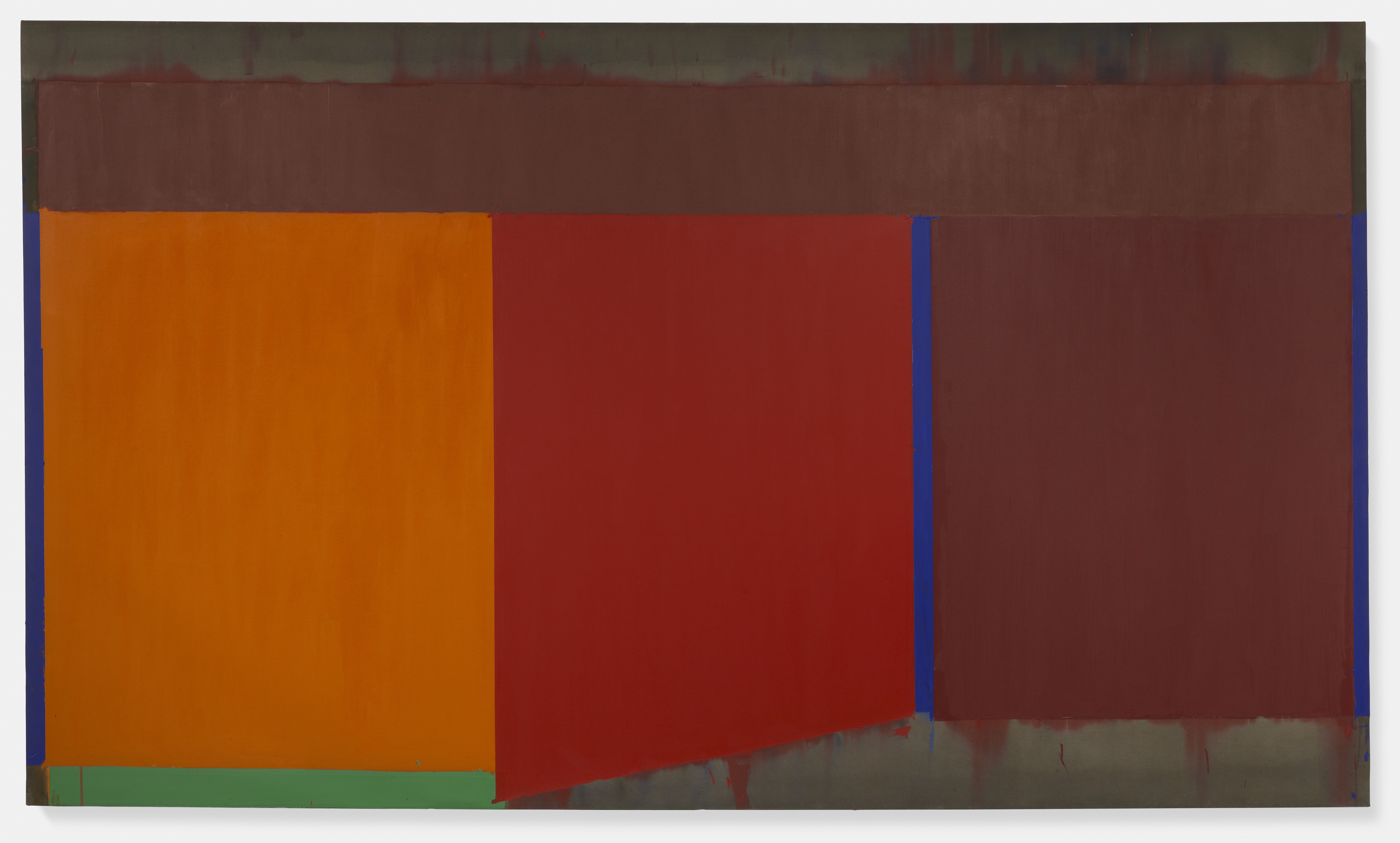
#26. John Bunker writes on Hoyland at Newport Street: Another Perspective

John Hoyland, 12.6.66.

John Hoyland, “12.6.66”.

It is somewhat taken for granted that the art of painting allows us to engage intimately with the work of another’s hand and eye. Some might even suggest through the marks and traces locked in the gestures and dispersal of paint on canvas, we are witness to some special marriage of spirit and matter. As makers and viewers of paintings, artists have always exploited these contrary sensations of the public and private at work in the mind during the act of looking. Are you a voyeur or co-conspirator? Lover or fellow member of the dispossessed? Intrigue, desire for narrative and the visual unravelling of secrets all elicit deep fascination, bound up as they are in the articulation of the medium itself. Figurative painting’s power, to a lesser or greater degree, hinges on the frisson of implied intimacy or its denial. But what about abstract painting? It was these sorts of questions that kept coming to mind as I walked round Power Stations, the show of mostly large scale abstract paintings by John Hoyland spanning the period 1964 to the very early 80s.

The tension between the public and private roles of art intensified in the debates around abstract painting in the post-war period. In fact there is something faintly absurd about the size of Hoyland’s paintings in at least the first 4 rooms of the Newport St. gallery. They portend to the dimensions of great history paintings, yet give us such little detail or sniff of a narrative of any kind. ‘Handling’ is reduced to a minimum, either locked into a deep staining of the canvas or in the masking-off of flat, high-keyed ‘blocks’ of colour. Their size is institutional, municipal, dare I say it, communal. Overtly public in their forthrightness and seeming simplicity, they ask to be shared as visual experiences by the many rather than owned by the one or the very few (unless you are a millionaire artist-come-collector-come-property-developer with mansions of large dimensions – but more on that later).

(more…)

#25. Carl Kandutsch writes on “Kenneth Noland’s Discovery”

Kenneth Noland, "That", 1958-59, acrylic resin on canvas, 81.75 x 81.75 inches. © 1997 Kenneth Noland, licensed by VAGA, New York, N.Y.

Kenneth Noland, “That”, 1958-59, acrylic resin on canvas, 81.75 x 81.75 inches. © 1997 Kenneth Noland, licensed by VAGA, New York, N.Y.

Kenneth Noland’s Discovery

Kenneth Noland famously declared that his breakthrough as a painter occurred when he “discovered the center of the canvas”[i] in the late 1950s. Noland’s “discovery” produced a series of well-known paintings executed between 1958 and 1962 based on the placement of concentric circles of various colors in varying widths radiating out from the exact center toward but never reaching the four edges of the picture, usually comprising a six-foot square.

This essay addresses the question of what exactly Noland can be said to have “discovered” and why the concept of “discovery” is crucial in understanding the nature of modernist painting and sculpture.

Background: The Modernist Situation

In 1962 Clement Greenberg wrote:

“Under the testing of modernism, more and more of the conventions of the art of painting have shown themselves to be dispensable, unessential. By now it has been established, it would seem, that the irreducible essence of pictorial art consists in but two constitutive conventions or norms: flatness and the delimitation of flatness; and that the observance of merely these two norms is enough to create an object which can be experienced as a picture: thus, a stretched or tacked-up canvas already exists as a picture – though not necessarily a successful one. (The paradoxical outcome of this reduction has been not to contract, but actually to expand the possibilities of the pictorial: much more than before now lends itself to being experienced pictorially or in meaningful relation to the pictorial: all sorts of large and small items that used to belong entirely to the realm of the arbitrary and the visually meaningless.)”[ii]

However, what Greenberg refers to as a “paradoxical outcome” may not be paradoxical at all: the search for the “irreducible essence of pictorial art” revealed that pictorial art has no irreducible essence at all. This would imply that the distinction between art and non-art is really arbitrary; there is ultimately no meaningful distinction between objects that are considered “art” (for example, in the political economy of a particular market sector) and ordinary objects in the world.

(more…)

#24. Jeremy Gilbert-Rolfe writes on “Marginalized but not Demystified”

Frank Stella, “Die Fahne Hoch!”, 1959, enamel paint on canvas

Frank Stella, “Die Fahne Hoch!”, 1959, enamel paint on canvas

Marginalized but not Demystified

It is years since someone curated a show called “Greenberg’s Dilemma” and an old man came in and looked around attentively before approaching the desk to ask “What’s the dilemma?” The person there was Amy Lipton, who was a partner in the gallery, and the old man was Clement Greenberg. He left dissatisfied and while I don’t know what Amy might have said I’ll make two guesses. I expect Clem was ready to dismiss any thought of abstract painting being without a purpose or of uncertain historical usefulness. He was probably expecting something about irony, given the date of the story (1986,) and may have pointed out that abstraction can no more be ironic than can music. The extent to which either could conceivably be ironic would be the extent to which you were recognizing an interpretation of a reference, a critical comment on a quote. You would be reading the work rather than letting it be there more like a person than a page, an active phenomenal presence as opposed to a written message.

That is, however, what those in power in the museums and elsewhere want. Painting as a dead surface with signs on it, Warhol’s rather than Pollock’s or Cézanne’s version of the pictorial field, where the surface is itself alive. It seems to be only by treating the medium in this way that abstract painting is considered a feasible enterprise by the establishment at the moment, a confirmation that things have not changed but rather consolidated over the past quarter-century or so. The claim is that painting is now “demystified,” but this turns out to mean only that it has been stopped. One may do something with the idea of abstract painting, defined as a utopian project whose teleology has been exposed but which lives on as a dead reminder of itself with which people may do things of art historical significance, which however means that it may only consist of illustrations of a version of history which it may not undermine or criticize. Isabel Graw, by far the liveliest of the writers associated with the approach to art known as institutional critique, which now appears to be in charge of all the institutions, is quite explicit about this although she does not put it that way. Critical of Greenberg for not thinking that sheets of paper with writing on them are as flat as any painting, she sees painting as having been demystified by institutional critique and it is in those terms that she herself has to insist that the surface of painting is as inactive as a page, and like one activated only by what goes on it.[1] She has written by far the most useful account of how intellectual and commercial value combine and are mutually supportive in the contemporary art world, or market. I am in particular very interested in what she has to say about the relationship between the painting and its viewer given that we see paintings as beings rather than things. To share a space with them is more like being with a person than with a table or a rug. However, I think she is prevented from acknowledging the complexity of this aspect of abstract painting because of her insistence on limiting it to being what institutional critique insists it must be, a dead medium for which new uses must be found and they will be about writing and reading not about painting and seeing. Painting may not be active, but must instead be activated, its innate capacities considered unsuitable for contemporary requirements.

(more…)

#23. Robin Greenwood writes on Flatness at Pace and Plastic Space

Installation shot at Pace London, works by Caro and Noland.

Installation shot at Pace London, works by Caro (Stainless Piece C, 1974/5) and Noland.

Hoyland, Caro, Noland at Pace Gallery, London.

In the mid-20th Century shared unreality that was ‘Caroland’ it was somehow viable, with intentions that were quite probably on the right side of honest, to make a sculpture – in this case, Stainless Piece C, 1974/5 – that sat flat on the floor and rose up no more than a couple of inches, so you looked down upon it like a relief laid horizontally (I made a few like this myself); and to make it out of a few scattered (or were they artfully composed?) pieces of stainless steel plate and other bits and pieces (David Smith’s steel?) that had been scoured with an angle-grinder to give an optical illusion of depth to its surface when it had none at all to its structure (again, like Smith?). In the Pace Gallery, London, this work is shown on a plinth that is a good three inches taller than the sculpture itself (didn’t Caro do away with plinths? Did the gallery decide the work’s lack of status required one?), making a combined height, sculpture and plinth, of oh… all of eight inches or so. And because it’s by Caro, and because he’s now dead (R.I.P.), and because it’s a piece of art history merchandising already, and because it’s the prestigious Pace Gallery; because of all this and more, and for no reason due to its inherent value, since it transparently has none, unless you view it through a thick haze of sentimental regret for simpler and more certain times in abstract art; this pathetic little piece of twaddle has become a luxury commodity, imbued with all the myths of modernism, reflecting back at us our own ‘good-housekeeping-modern-but-weren’t-we-ever-so-radical-back-in-the-sixties’ taste.

(more…)

#22. Alan Gouk writes a critique of T.J. Clark’s “Farewell to an Idea”

Jacques-Louis David, “The Death of Marat”, 1793.

Jacques-Louis David, “The Death of Marat”, 1793.

“An institutionalised counterculture condemns individuality as archaic and depreciates intellectual values, even in the universities.” Harold Bloom “The Anarchy of Influence”, 2011.

“Literature is always personal, always one man’s vision of the world, one man’s experience, and it can only be popular when men are ready to welcome the visions of others. A community that is opinion-ridden, even when these opinions are in themselves noble, is likely to put its creative minds into some sort of prison….” W.B. Yeats, 1904.

“Only that which does not teach, which does not cry out, which does not persuade, which does not condescend, which does not explain, is irresistible.” W.B. Yeats, 1910.

In one of the last “crits” I took part in before quitting St. Martins in 1990, a hapless student, when asked what he thought he was doing in presenting a large blown-up photograph of the Royal Family on the balcony of Buckingham Palace underneath which there ran a Silk-Cut purple band with some trite non-sequitur of a written slogan, rather like the tapestries partially glimpsable behind the chair of committee hearings at Portcullis House, said student in his defence offered the banal: “I want to manipulate, seduce, and control”. I was quite unaware at the time (why should I have been?) that in doing so he was quoting verbatim the sayings of one Jeff Koons, who was becoming – had already become – one of the reference points for any aspirant fashionista of the day.

“Manipulate, seduce, and control”… there’s a lot of it about; indeed for a Marxist or lapsed neo-marxist or pseudo-marxist critic, that’s all there is. For Terry Eagleton, whose book “Literary Theory” I stumbled across in my local Oxfam shop, there is no such thing as literature, only what many readers feel inclined in their delusional subjectivity to read; literary criticism has therefore no reason to be, and should be replaced by the study of rhetoric, or the diabolic arts of persuasion, the strategies by which writers dupe the reader into the illusion that their fantasies of coherence and “liberal-humanist” epiphanies offer consolation from the brute realities of power.

Here the paranoidal suspicion so beloved of the perpetual adolescent that all utterances are irremediably riven with endorsements of the prevailing world order, complicit in the structures of mind control which support it, and that all art is a policing of experience, corralling it in ways supportive of the oppressive ”father”, is given the seductive lure of an outré cult of transgression, with sexual-political undertones backed up by an assumption of intellectual pedigree that goes all the way back to G.W.F. Hegel, and K. Marx in his Hegel influenced period.

It is always best to read such books as Eagleton’s and T.J. Clark’s (I’ll come to him soon) backwards from conclusion to introduction, to reveal just how fatuously inadequate are their solutions to the problems they claim to have discerned through their critiques.

(more…)

#21. Geoff Hands writes on Dennis Loesch

Dennis Loesch, installation at PM/AM Gallery, photo Erik Saeter Joergensen.

Dennis Loesch, installation at PM/AM Gallery, photo Erik Saeter Joergensen.

Merge Visible: New Digital Paintings by Dennis Loesch was at PM/AM Gallery, London, 24th September – 26th October 2015

“Are you still looking for a Cézanne?”

Despite the variety of media and means available for artists to make their mark upon the world, or add another object to it, painting will not go away. In recent weeks, for the London-centric art viewer-visitor, ‘must see’ lists would surely have included the extremely painterly and mightily abstract, John Hoyland: Power Stations Paintings 1964-1982 (Newport Street Gallery) and the supreme and breathtaking Frank Auerbach (Tate Britain) exhibitions; and of course Frieze and Frieze Masters in Regent’s Park. Just before the recent spate of shows, the Sonia Delaunay and Agnes Martin exhibits at Tate Modern, in contrasting ways, would have revived (if needed) a battery re-charging of the potentials, and achievements, of abstract painting. With such major events filling the diary of necessary distractions (especially from the daily routines of studio practice, if you are an artist) smaller shows, or venues less well known, can be overlooked.

So, at the start of four days of consecutive gallery visiting, culminating at Frieze Masters, I headed for the mid-show breakfast event of Merge Visible: New Digital Paintings by Dennis Loesch at the PM/AM gallery, a newly renovated space located on the Old Marylebone Road, where the artist would be present. This venture, to introduce mostly German based artists to the UK, has been set up by Patrick Barstow (London) and Lee Colwill (Berlin), handily coinciding with many critics and collectors being in town for the Frieze events.

(more…)

#20. Jeremy Gilbert-Rolfe interviews Todd Cronan

Henri Matisse, 'Studio Under the Eaves', c.1903

Henri Matisse, ‘Studio Under the Eaves’, c.1903

This article was first published online by Bomb Magazine on 5th May 2015, and is re-published here with their kind permission. http://bombmagazine.org/article/044448/todd-cronan

[Editor’s note: we have already linked to this article and commented on it on this site, but thought it of sufficient interest to merit republishing here, where we can comment upon it directly. With many thanks to the author and Bomb editors.]

“Here are some marks, what do they mean?”

I don’t write book reviews very often, and I think it may be the case that the only other comparable in length to my review of Todd Cronan’s Against Affective Formalism: Matisse, Bergson, Modernism may have been on Derrida’s Truth in Painting, back in the seventies. I think this is a very important work, for artists as well as art theorists, and I hope it will be widely and carefully read. Cronan is an associate professor of art history at Emory University, and in addition to Against Affective Formalism, he’s written a book about Matisse for Phaidon, and articles on Brecht, Adorno, Merleau-Ponty, Santayana, Georg Simmel, Paul Scheerbart, Paul Valéry, and Richard Neutra. Brecht and Valéry are especially important to what he has to say, i.e., the political as well as the poetic are simultaneously of concern.

Cronan’s book, in my view, is most important for what he says about Matisse, but its argument also goes far beyond the specifics discussing that particular artist might involve. Cronan has revived the idea of intention, in response—at least in part—to what he shows to be a final, or at least extreme, eruption of what a determined anti-intentionalism can cause. He shows that this has led the most well-known followers of Deleuze—and Deleuze himself, at least in respect to what he has to say directly about art—to see movement and other qualities in Matisse and others to be neither more nor less than an opportunity for missing the point altogether. Philosophers are notorious for skimping on description in order to use what they’ve got to get to what they really care about as quickly as possible, Hegel’s impatience with Kant’s “ratiocination” about the sublime being a notorious example, and T.J. Clark’s lovely description of two paintings by Poussin a monumental and convincing argument against being too eager to take refuge in generalities rather than seeking to fully grasp specifics. This has caused a fuss amongst the eminent about which those who care may have more to say. I am more excited by how, as an alternative to leaving the work as soon as possible, Cronan gives us a thorough treatment of Matisse’s context, large as well as local, and the best approach to what Matisse gets painting to do that I have read. Also, it’s by far the best treatment of what difficult art might involve that I’ve seen his generation produce. This is an approach to art—especially but not only to painting—that includes how the work acts in the world. This is how and why it involves Brecht and the political, and questions that follow from, and accompany, those sorts of questions are among the ones that we thought we might pursue here.

(more…)

#19. Emyr Williams writes on John Hoyland at Newport Street Gallery

John Hoyland, 9.11.68, © The John Hoyland Estate, Courtesy Murderme Collection

John Hoyland, ‘9.11.68’, © The John Hoyland Estate, Courtesy Murderme Collection

John Hoyland, Power Stations, Paintings 1964-1982 is at Newport Street Gallery, London SE11, 8th October 2015 – 3rd April 2016

Damien Hirst’s new gallery is open for business and, surprisingly perhaps, he has chosen to showcase a particular period of the work of John Hoyland. Power Stations 1964-1982 launches the Newport Street Art Gallery in Vauxhall, London. Although Hirst has mentioned his deliberate challenge to those who say you can’t make and curate at the same time, I would have thought his way of making was very much in tune with the approaches of a curator. Get something interesting into a box, just on this occasion make it a bloody big box. Good for him to do this, though. I’m sure there is a sense of intrigue as to what will come next, but for now we can enjoy the wonderful spaces that this former scene-painting studio houses and get a meaty glimpse of the work of a significant British abstract painter to boot.

(more…)

#18. David Sweet writes on “Palaces, Pollock and Pixar”.

Jackson Pollock, "Out of the Web", 1949

Jackson Pollock, “Out of the Web”, 1949

Palaces, Pollock and Pixar

Inside Out, the recent Pixar movie, contains a scene I found overwhelmingly, hysterically funny. The action is set mainly inside the mind of Riley, an eleven year old girl, which is occupied by five figures personifying her emotions – ‘Joy’, ‘Anger’, ‘Sadness’, ‘Disgust’ and ‘Fear’. In the scene, two characters, Joy and Riley’s ‘Imaginary Friend’, take a short cut through a region called ‘Abstract Thought’, despite clear warnings that they are entering a dangerous zone. As they travel through it, the processes of visual abstraction transform them. First their anatomy is fragmented and re-organised in a non-naturalistic formation, they lose volume and depth, their outline is simplified, they become flatter and flatter. Just at the point of extinction they reach the exit and their figurative integrity is restored.

The scene is a highly edited and compressed account of pictorial abstraction’s evolution, familiar from university art history modules on the subject. What’s interesting is the panic that overtakes the two characters as they approach pure abstraction, and the relief they feel when they return to their familiar pixel-based environment. Even as an abstract painter, I felt it difficult not to share this sense of relief.

(more…)