#7. Ken Carpenter writes on Jack Bush and Jock Macdonald

Jack Bush, “Tight Sash”, July 1963, oil on canvas, 108.6 × 176.5 cm (42.75 × 69.5 in.), Collection of Elizabeth A. and Richard J. Currie, © Estate of Jack Bush / SODRAC (2014), Photo: Michael Cullen, TPG Digital Art Services

Jack Bush, “Tight Sash”, July 1963, oil on canvas, 108.6 × 176.5 cm (42.75 × 69.5 in.), Collection of Elizabeth A. and Richard J. Currie, © Estate of Jack Bush / SODRAC (2014), Photo: Michael Cullen, TPG Digital Art Services

A Celebration of Two Canadian Abstractionists: Jack Bush and Jock Macdonald.

“Jack Bush” was at the National Gallery of Canada in Ottawa up to 22nd February 2015, and will be at the Art Gallery of Alberta, Edmonton, 30th May to 23rd August 2015.

“Jock Macdonald: Evolving Form” was at the Vancouver Art Gallery, October 2014 to January 2015; is at the Robert McLaughlin Gallery, Oshawa, Ontario, 3rd February until 24th May 2015; and will be at the Art Gallery of Greater Victoria, 12th June to 7th September 2015.

Two senior members of Painters Eleven are currently the subject of enormous, traveling retrospective exhibitions in Canada. Painters Eleven, who were active as a group from 1953 to 1960, marked a key turning point in the history of art in English-speaking Canada – a pronounced shift away from Europe towards New York and from figuration towards abstraction. Bush is the one most familiar to a British audience. His work is in the Tate Modern and he regularly exhibited with the Waddington Galleries in London. In 1980, three years after his death at the age of 68, the Arts Council of Great Britain circulated an exhibition of 87 works to venues in London, Edinburgh and Birmingham. Macdonald was born in Thurso, Scotland, in 1897 and studied design at the Edinburgh College of Art, but after his emigration to Canada in 1926 to teach design at the Vancouver School of Decorative and Applied Arts, he regrettably had scant presence in the United Kingdom.
(more…)

#6. Robin Greenwood writes on Richard Diebenkorn and the Hollowing-out of Painting.

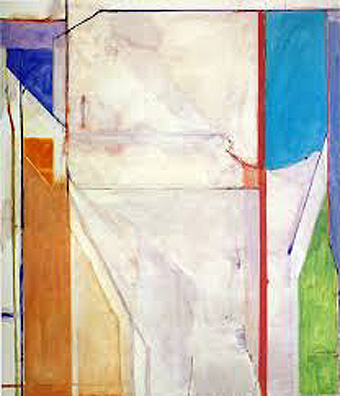
Ocean Park #43, 1971

‘Ocean Park #43’, 1971

Richard Diebenkorn at the Royal Academy, London, 14 March – 7 June, 2015

If I’ve read one 5-star review of the RA’s Diebenkorn show by now, I’ve read at least ten, most of them little more than P.R. exercises repeating the same blandishments to the gallery-going public, to recognise and acknowledge a masterly evocation of the lambent light and open spaces of his native Californian west coast. Spoiler alert: this will not be another piece of positive flannel. OK, Diebenkorn was by all accounts a fine fellow and a much-respected artist, and his reputation has grown considerably over the past two decades as he has entered the collective art-school consciousness of recent generations as the straight-up kind of painter’s painter in an age of conceptual art. More and more young abstract and semi-abstract painters have become familiar with the three phases of his work, and it now chimes in with something that has recently happened in abstract painting, whereby it has become the acceptable, non-scary version of modern art in general; safe to feature in sofa catalogues, a safe occupation for the younger amateur painter, decidedly unthreatening; in fact, not too radically abstract. And Diebenkorn is a kind of flagship painter for the confident employment and enjoyment of these ubiquitous modern aesthetic tropes. He now, reputedly, has clout and charisma, where he once seemed a peripheral and minor contributor. He undoubtedly had a degree of talent, and his paintings have the sniff of sincerity and ‘authenticity’; they look superficially like the ‘real deal’. But, as some clever wag pointed out recently, authenticity is a content-free zone. If you think Diebenkorn’s art has anything to do with, say, a continuation of Matisse’s lifelong core project, you’re wrong; if you think Diebenkorn is anything of a colourist, you’re wrong; and if you think Diebenkorn is exciting, you are living a very sheltered life. He raises the mediocre to fantastic levels of significance. More on all this later.

(more…)

#5. Monochrome/Duochrome – thoughts on colour materiality and dependency – Part 1. Organised by Katrina Blannin

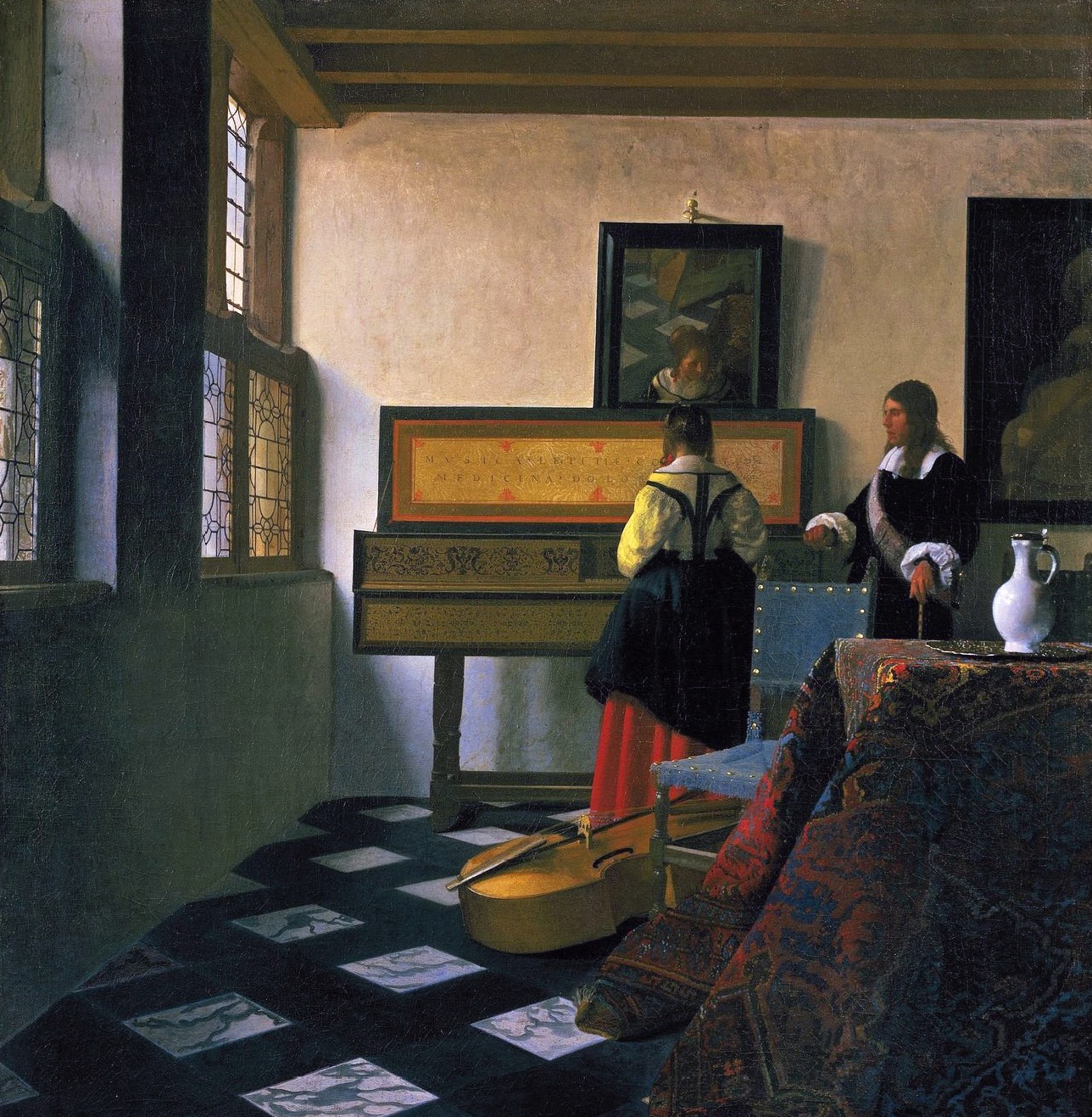
Johannes Vermeer, The Music Lesson, 1662-65, oil on canvas

Johannes Vermeer, The Music Lesson, 1662-65, oil on canvas

In her fascinating essay Color, Facture, Art and Design[i] Iona Singh argues that, in a world saturated with industrially produced synthetic colours: dyes made from coal tar, a by-product of oil production, we are losing touch with any meaningful connection with the materiality and facture of colour and our sensory perception. ‘Use of these strong, lightfast and inexpensive synthetic colors are at the expense of nuance, tincture and the plenitude of natural formation.’ She suggests that the ubiquity of coal tar colours in the built environment has contributed to the alienation of the senses and our estrangement of colour on an aesthetic level – colour is divorced from structure and does not appeal to the body in any real material sense anymore: relationships are lost and thereby the ‘sensual ground of related cognitive processes’. I would add to this the finite range of back lit colours that we are faced with on a daily basis on the computer or the TV – every colour starkly saturated and smoothed out: unmixed and de-materialised.

(more…)

#4. Charley Peters writes on ‘Adventures of the Black Square’

Kazimir Malevich, 'Black Quadrilateral', c. 1915. Greek State Museum of Contemporary Art - Costakis Collection, Thessaloniki

Kazimir Malevich, ‘Black Quadrilateral’, c.1915. Greek State Museum of Contemporary Art – Costakis Collection, Thessaloniki

Adventures of the Black Square, Abstract Art and Society 1915–2015, at the Whitechapel Gallery, London

It was only a few months ago that Malevich’s monochromes were last in London, venerating his radical contribution to the end of pictorial painting and some proclaimed, to the end of art itself. Tate Modern’s Malevich, Revolutionary of Russian Art (16 July – 26 October 2014) was very much a historical survey; looking back at the long shadow Malevich’s Black Square – a headstone for representational painting – cast over the history of modern art. Adventures of the Black Square, Abstract Art and Society 1915–2015 at Whitechapel Gallery until 6 April clearly and alternatively positions the work’s reductive form (in this exhibition it is Malevich’s diminutive undated Black Quadrilateral that is featured) as the beginning of a new art starting in Russia and Northern Europe in the early twentieth century. The spread of geometric abstraction is then documented chronologically as it travels internationally throughout the next hundred years. Rather than Black Square being revered as merely a portrait of an idea, it is shown as the initiator of geometric works that connect with, reflect or challenge society. Adventures of the Black Square presents abstraction as not being estranged from social reality, that its concern with form, shape and colour throughout its history are intrinsically linked to politics and expressions of modern living.

(more…)

#3. Emyr Williams: ‘Homage Limitations’

Helen Frankenthaler, 'For E.M.', 1981

Helen Frankenthaler, ‘For E.M.’, 1981, 71″x115″, acrylic on canvas.

Many years ago I was in a dinner party in California given by my cousin. She is an actor and producer and the company she invited was charming and witty and the conversation easy and friendly. I enjoyed it, and it exuded a slightly glamorous atmosphere too, being in a villa overlooking the Pacific Ocean. One comment though has stuck with me to this day: It was when I was asked “Where are you from?” I answered without thinking, “Wales.” One highly impressed person leaned over to me and in almost hushed tones said: “Wow, that is the spiritual centre of the universe.” Now, I am a proud Welshman and I am always pleased if another nationality knows that Wales exists, let alone passes any kind of familiar comment about it, yet this comment was something I did not see coming at all. I smiled and nodded and thought about this statement… we clearly had very different experiences and ideas of Wales. I assumed he pictured a group of Druids, solemnly striding around a circle of stones, in touch with the forces of nature and the general turning of the universe; whereas I suddenly thought of my home town on a Friday night, when a fellow I was in school with burst into one of the pubs and offloaded two blasts of his shotgun into the ceiling. I won’t name names for legal reasons, though I doubt if he is reading this (and that is a sentence with one word too many). You could say his action was the result of a completely different kind of spirituality.

Artists tend to love Art. We go to galleries, exhibitions and openings. When we are not making Art, we are looking at it or talking about it. We look for it online, we participate in forums, symposia and generally surround and busy ourselves with as much of it as we can. It is our visual food. Yet can our love of Art sometimes be our undoing? Clement Greenberg once said: “The superior artist knows how to be influenced.” The question raised is: influenced by whom and – more importantly – in what way?

(more…)

#2. Paul Behnke writes on Pat Passlof

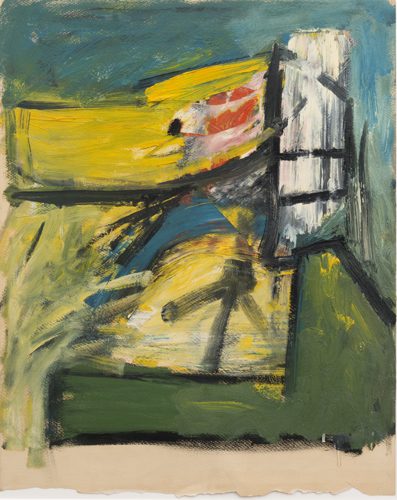
Pat Passlof: Paintings from the 1950’s at the Elizabeth Harris Gallery, New York.

untitled, c.1950's, oil on paper, 25 x 20 inches

untitled, c.1950’s, oil on paper, 25 x 20 inches

The current exhibition at Elizabeth Harris Gallery in New York City presents abstract oil paintings by Pat Passlof from the early 1950’s through the end of the decade. At the time this work was made, Passlof was only in her twenties. Born in Brunswick Georgia in 1928, she sought out and studied with Willem de Kooning at the famous Black Mountain College. Soon after, she took his advice and moved to New York City, embarking upon a painter’s life. In Manhattan, Passlof continued to receive private painting instruction from de Kooning and became close with the painters that populated the 10th Street artists’ community in the early 50’s. Through de Kooning, Passlof met the painter, Milton Resnick, whom she later married. Resnick no doubt introduced the young Passlof to the painting philosophy of Hans Hofmann, whose ideas, collected in The Search for the Real (not published until 1967) influenced a whole generation of painters. The New York art scene of the early 50’s was a hot bed of contention, influence, and personality. And it seems the young Passlof was for a time caught up in the wave, producing strong and ambitious, if derivative, work.

(more…)

#1. John Bunker writes on Richard Tuttle

Richard Tuttle. I Don’t Know. The Weave of Textile Language, at the Whitechapel Gallery, London.

Richard Tuttle, I Dont Know . The Weave of Textile Language, installation view 2014. Photo credit Stephen White

Richard Tuttle, I Don’t Know. The Weave of Textile Language, installation view 2014. Photo credit Stephen White

It’s easy to take for granted the shape-shifting and transitory ‘almost there’ quality of Tuttle’s work and forget the length of his career to boot. It is too easy to have caught a glimpse of 3 or 4 of his pieces over the years and think that you know his work. I caught such a glimpse last year in a large collection of American art. I was impressed by the subtlety and focus to his colour play, hard won, it seemed, from the frailty and ubiquity of the throw-away materials he manipulates or strings together somehow. No matter how fragile, or how far they wavered from the painterly rectangle, the works still held the wall and seemed to hold their own too against the more robust conglomerations of good ol’ American trash that the likes of Rauschenberg, Kienholz or Brecht could throw at me from the same show.

(more…)