#37. Tim Scott writes on Abcrit, Caro and Abstract Sculpture

Caro with his sculpture "Millbank Steps", 2004

Caro with his sculpture “Millbank Steps”, 2004

Surveying the numerous analyses in abstractcritical and Abcrit, it is evident that one subject has occupied the attention of many contributors: that of defining the meaning(s) of the word ‘abstract’. From technical definitions: ‘non objective’; ‘non figurative’; ‘non representational’; ’concrete’ etc., etc. to the more abstruse renderings defining the ‘break with traditional norms of painting ’; or rendering traditional material into non mimetic ‘form’, or Picasso’s projection of collage into three dimensions to create a new medium for sculpture, ‘construction’.

The term has also been widely interpreted to signify a new art form, one that eliminates mimetic illusion in favour of representing nothing but itself. Others argue that there is no such thing as representing ‘nothing’; everything must ‘represent’ something; every blob, every mark, is capable of being ‘something’ else.  ‘Abstraction’ is seen as being in a continuum from the past (of painting), through periodic changes of ‘making’ that create a new pictorial vision of the world, albeit by illusion. It can also be seen as  a complete break with the forms of the past in favour of new norms (usually largely derived from geometry), which are seen as representing a totally ‘abstract’ new ‘reality’, its subject not being derived from nature, but being ‘scientific’ in its new ‘truth’ (ignoring that science itself deals with ‘nature’). Yet another interpretation is seen as being the hallmark of a ‘modern’ art, an art that is of our time and synchronises with other major changes in society, living styles, engineering and technical development, all the signals that suggest that man has evolved, improved and developed in time.

Whichever semantic definition one prefers, abstraction as used to signify a new Art Form (of the 20th C.), which, though building on the foundations of the ‘old art’ (via the 19th C.), is perceived as radically different in its vision (pace all the arguments about abstract ‘content’).  Much discussion, however, has been about the ‘stepping stones’ of the 19th C.; in which abstraction is viewed as having always been integral to making art (largely painting) and which in its ‘modern’ (mid 19th C. on) developments, though representational, rejected the old formulae of three dimensional illusion, spatial perspective depth etc. to evolve totally new ways of looking, seeing and describing.

(more…)

#36. Tim Scott and Robin Greenwood discuss Abstract Sculpture

Tim Scott, "Bridge of Echoes I", 2014

Tim Scott, “Bridge of Echoes I”, 2014, laminated paper (for plywood)

The following is taken from a recent exchange of emails.

Tim Scott: Dear Robin, I thought you might like to read this by Clement Greenberg, re Abcrit discussions on “abstract content”:

“….The quality of a work of art inheres in its “content”, and vice versa. Quality is “content”, you know that a work of art has content because of its effect. The more direct denotation of effect is “quality”. Why bother to say that a Velasquez has “more content” than Salvador Rosa when you can say more simply and with direct reference to the experience you are talking about, that the Velasquez is “better” than the Salvador Rosa? You cannot say anything truly relevant about the content of either picture, but you can be specific, and relevant about the difference in their effect on you. “Effect” like “Quality” is “content”, and the closer reference to actual experience of the first two terms makes “content “virtually useless for criticism………indulge in that kind of talk about “content” myself. If I do not do so any longer is because it came to me, dismayingly, some years ago that I could always assert the opposite of whatever it was I did say about “content” and not get found out; that I could say almost anything I pleased about “content” and sound plausible……”

Robin Greenwood: Thanks Tim. We all define these things a bit differently, don’t we, but I’ve found the idea of “abstract content” quite useful recently. Time will tell if I’ve got it right or wrong.

Tim Scott: I’m interested. Are you saying that “abstract content” is different to any other sort of content? (Clem says it’s all the same but should be called “quality”; he doesn’t use the word “value”, as in value judgement.) Another point he doesn’t touch on is whether there is any difference between “sculpture content” and “painting content” in terms of definition.

(more…)

#35. David Sweet writes on Image, Object, and the Tradition of Paintedness

Robert Rauschenberg, "Collection", 1954-55, SFMOMA

Robert Rauschenberg, “Collection”, 1954-55, SFMOMA

The genre of the painting-relief/construction has been around for some time. Recently, however, this hybrid category has become more prominent, almost suggesting that, at a time when ‘pure’ painting struggles for relevance, the medium’s best chance of survival could depend on forming a coalition with the object.

There’s nothing very new about work in this category. Major exhibitions of Robert Rauschenberg and Jasper Johns, both at the Whitechapel in 1964, made an impressive case for merging the characteristics of two separate disciplines.[i] But the terms of the partnership favoured painting. Both artists developed their careers in the era of Abstract Expressionism and their gestural painting style derived its authority and confidence from that movement, even though they deployed it in a semi-satirical manner. Partial irony didn’t reduce the power of the painterly force that overwhelmed and absorbed the heterogeneous elements that their works contained.

The results were cluttered and palpable enough to be classed as ‘objects’, but they weren’t covered by the critique of literalism that the slightly later work of the minimalists received. Frank Stella’s paintings also manifested object-like tendencies but were exempt from this same criticism. Michael Fried argued that the pictorial activity of the ‘depicted’ shape, established their credentials as paintings by ‘defeating objecthood’.

(more…)

#34. Luke Elwes writes on Klaus Friedeberger at Delahunty Fine Art, London

"Black Space 21", 2014, oil on canvas, 73.7x73.7cm

“Black Space 21”, 2014, oil on canvas, 73.7×73.7cm

Klaus Friedeberger – Paintings & Works on Paper 1992-2015 is at Delahunty Fine Art, 21 Bruton Street, London W1, 17th May – 11 June 2016.  http://www.delahuntyfineart.com/exhibition/klaus-friedeberger-paintings-works-on-paper-1992-2015/

Friedeberger’s Black Space.

How many artists today would willingly embark on a path so seemingly solitary as that followed by Klaus Friedeberger? Now in his ninth decade he continues to paint with little regard for the usual support network – the periodic exhibitions and moments of critical attention – often seen as vital to sustaining an artist’s career.

That it should have taken so long for this work to become even partially visible (with a selection of paintings from the last two decades currently on display at Delahunty Gallery) is due both to personal choice and life history. After arriving in the UK from Berlin in 1939, his life became that of a peripatetic exile, first interned in this country and then transported as an alien to Australia, where his art education continued erratically, initially under the guidance of fellow European refugees and then through exposure to the work of Nolan, Boyd and the ‘Angry Penguins’.

But by the mid 1960s, when he was again settled in London, he had not only turned away from prevailing currents in British and American art – Pop art, colour field, minimalism – but decided to pursue a patient and decades-long private enquiry into the structural dynamics of abstract form rendered in black and white paint. It was the act of an outsider more philosophically attuned to existentialist practice, as well as to Tachist painting and the writing of Samuel Beckett.

(more…)

#33. Nick Moore writes on Basil Beattie at MIMA

Basil Beattie installation at MIMA, L to R:"Without End", 2005; "Never Before", 2001; "Hinterland", 1995

Basil Beattie installation at MIMA, L to R: “Without End”, 2005; “Never Before”, 2001; “Hinterland”, 1995

Basil Beattie – When Now Becomes Then: Three Decades, at MIMA until 12th June 2016.

“Only the paradox comes anywhere near to comprehending the fullness of life. Non-ambiguity and non-contradiction are one sided and thus unsuitable to express the incomprehensible.” CG Jung

This years exhibition highlights for me so far have been two substantial shows of big paintings; John Hoyland at Newport Street and Basil Beattie at MIMA, both a refreshing contrast to the multitude of ‘contemporary’ domestic abstraction often artfully and sometimes even subtly restrained in grids of one sort or another with no personal ‘signature’ in the facture.  Impersonal and emotionally cool, they are what Roger Hilton would have called “tidy”. Not so here. In these two shows it was so refreshing and invigorating to see progressions of series and witness the leap from identity to existence in such a strong way, especially in Beattie’s ‘retrospective’. And refreshing to hear him say that having a show like this is a way of ‘learning about what I am doing’. It is not a grand finished statement but a work in progress, a getting to know your own working process in a more objective way.

Beattie sees painting as a journey, full of doubt and uncertainty, but he also likes to use such words as ‘vividness’ and ‘intensity’ to describe the satisfactory outcomes. He ‘discovers things’ after he finishes a painting, doesn’t ‘know much about it before or during…’ He says in the film Corridors of Uncertainty that he ‘finds things that have meaning in a painting which I cannot necessarily or easily accommodate through speculating about them but they seem to impose themselves on the memory…’ Working in series is one way of making sense of this, allowing the images to shift and change until they are ‘worked out’ enough to move onto a new series. Some elements are stubborn and have a propensity to return later and be explored anew among different permutations and painterly adventures. The show at MIMA demonstrates this admirably, stretching from the eighties through samples of various series such as the Witness paintings, Brooklyn series and Janus series to a room full of what I will call dreampaintings made between 2012-15. The sequence of the exhibition is roughly chronological, arranged in four rooms covering examples from approximately 10yrs in each.

(more…)

#32. Robin Greenwood writes on Content and Continuity

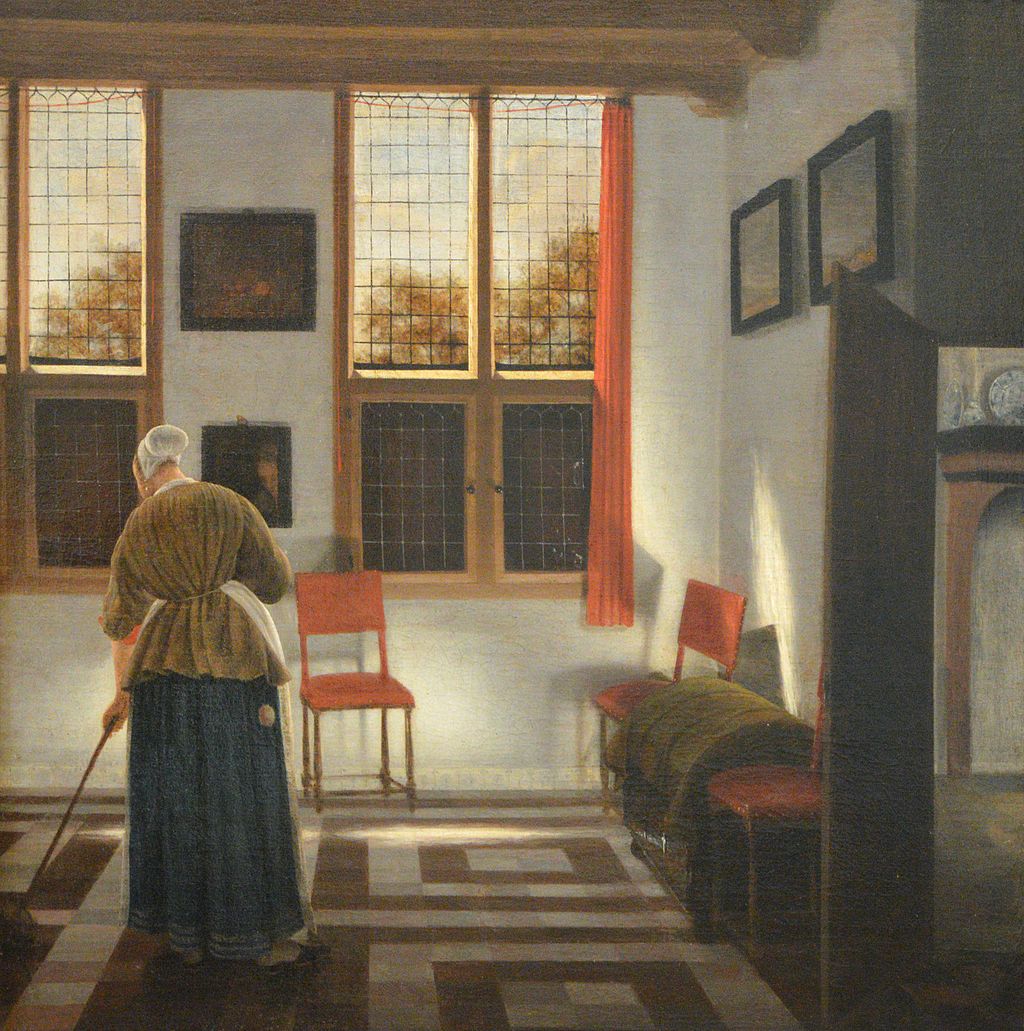
Pieter Janssens Elinga, "La Balayeuse", 1668-1672

Pieter Janssens Elinga, “La Balayeuse”, 1668-1672

“Shakespeare’s pre-eminence is of course due to his extraordinary originality; but to begin to understand his originality, we have to interpret the word correctly. It does not mean that he invented a kind of drama that was quite different from that to which his age was accustomed, or that he invented new ideas for his dramatic subjects. It means that as part of his poetic talent and his imaginative intensity he possessed an unusual critical power. This, too, must be properly defined. He left no assessments of his own or of anybody else’s work, but a great imaginative writer must use criticism to test the vitality of the literary forms of his age. He tests them, rather than invents new ones… [in order to be] continuous with the imaginative expression that nourished him…”

 “In all these plays Shakespeare is not rejecting the accepted forms of theatrical tradition; he is revitalizing them by bringing them into relationship with the actualities of real experience.”

C.Gillie, Longman Companion to English Literature; The Great Age: 1590-1620; Longman.

Lucky Shakespeare, to have lived at such a time, when forms and precedents and high, ambitious, competitive achievement were strong, and the artform in question could thus properly express the deepest feelings of the age. I’m not sure in visual art we are in the midst of anything like such interesting times, but nor do I believe that we are in an age of shallow feeling that must be mirrored in the contemporary art we make. But it strikes me as something of a dilemma; we might need on the one hand to overturn all precedent in abstract art so far; yet we can’t presume to make painting or sculpture without thought or structure, about any old thing and from garbage; and so, on the other hand, sympathising with all the achievements of abstract art to date, even if we consider them only minor, we might wish to continue to attempt to make something of their precedent – but yet more real, more intense… better.

(more…)

#31. Ken Carpenter writes on Three New York Shows: Burri, Pollock, Stella

Alberto Burri, “Rosso plastica (Red plastic)”, 1962, plastic (PVC), acrylic and burns on black cloth, 65 x 100 cm, private collection, © Fondazione Palazzo Albizzini Collezione Burri, Città di Castello / VG Bild-Kunst, Bonn 2016 / SIAE, Rome Photo: © Kunstsammlung NRW

Alberto Burri, “Rosso plastica (Red plastic)”, 1962, plastic (PVC), acrylic and burns on black cloth, 65 x 100 cm, private collection, © Fondazione PalazzoAlbizzini Collezione Burri, Città di Castello / VG Bild-Kunst, Bonn 2016 / SIAE, Rome. Photo: © Kunstsammlung NRW

Alberto Burri: The Trauma of Painting was at the Solomon R. Guggenheim Museum in New York from Oct. 9, 2015, to Jan. 6, 2016, and is at the Kunstsammlung Nordrhein-Westfalen in Düsseldorf from March 5 to July 3, 2016.

Jackson Pollock: A Collection Survey, 1935-1954 is on at the Museum of Modern Art through May 1, 2016.

Frank Stella, A Retrospective was at the Whitney Museum of American Art in New York from Oct. 30, 2015, to March 7, 2016. It will be at the Modern Art Museum of Fort Worth in Texas from Apr. 17 to Sept. 4 and the De Young Museum in San Francisco from Nov. 5 to Feb. 26, 201

NEW YORK: BURRI, POLLOCK, STELLA.

Alberto Burri was one of the giants of European matériel painting. The enormous exhibition, Alberti Burri, The Trauma of Painting, which at first occupied almost all of the Solomon R. Guggenheim Museum and is now at the  Kunstsammlung Nordrhein-Westfalen in Düsseldorf, presented numerous works from not quite a dozen series in the artist’s richly varied career. The exhibition was accompanied by a thoroughly researched catalogue of 279 pages. It argues persuasively that Burri’s artistic vocabulary emerged directly from his life experience.

Take for instance the “laborious sewing… stitching” and folding of Burri’s Sacchi (sackcloth paintings). Burri lived in Città di Castello, a mere half-hour’s bike ride away from Piero della Francesca’s Madonna del Parto in Monterchi, with, as Burri’s friend Sandra Blow recalls, its “mobile folds” of drapery “scrunched and tucked by laces.” The artist’s extensive military experience in Ethiopia, Yugoslavia and Tunisia, much of it as a doctor in the medical corps, required him not only to suture battle wounds but also to sew repairs in his own uniform. The exhibition curator Emily Braun writes, “Burri undoubtedly had images of combat wounds seared into his mind, not to mention the muscle memory of suturing actions.”

(more…)

#30. Geoff Hands writes on the Paintings of Katrina Blannin at Jessica Carlisle

Katrina Blannin installation at Jessica Carlisle

Katrina Blannin installation at Jessica Carlisle

KATRINA BLANNIN: ANNODAM is at Jessica Carlisle, 4 Mandeville Place, London W1U 2BF, 11th March – 9th April, 2016

Ruminations: Introduction

 “Paintings are there to be experienced, they are events. They are also to be meditated on and to be enjoyed by the senses; to be felt through the eye.” John Hoyland (Serpentine Gallery, 1979)

Looking at works of art gets us thinking, producing reactions of approval, disinterest or dissatisfaction. Such reactions appear instantaneous. Thereafter, one can move on or get involved. Further pondering, or ‘rumination’, might result in seeing a different painting, print or sculpture etc. Time is key.

In the quotation extracted from John Hoyland’s catalogue statement (above), the active and eventful meditation alluded to, fuses emotion (that which is ‘felt’ and ‘enjoyed’) with a visually stimulated encounter (via the ‘senses’). Paintings and other art forms are empowered by being perceived by the viewer. To “see through the eye”, rather than with the mind, is a statement affirming a visual poetics that has a particular, though not exclusive, relationship to abstract painting. Conceptually, and ironically, it establishes an anti-conceptual position.

(more…)

#29. Geoff Hands writes on shows by John Bunker and John Hoyland

John Bunker, 'Old Roan', 2015. 70cmx85cm, mixed media shaped collage.

John Bunker, ‘Old Roan’, 2015, 70cmx85cm, mixed media shaped collage.

Tribe: New & recent collages by John Bunker was at Westminster Reference Library, 35 St Martin’s Street, London; now closed.

John Hoyland: Power Stations At Newport Street Gallery, Newport Street, London until 3rd April 2016.

[This is the third article on Abcrit with views on the Hoyland show – see also #19 and #26. for other opinions and more illustrations]

Size Matters

Choosing to visit two exhibitions on the same day should always be considered with care, for one might critically overshadow the other. If you are fortunate the two will complement, or resonate with one another in some way. So, having spent the morning looking at the predominantly cinematic John Hoyland canvases in the inaugural ‘Power Stations’ exhibition at Damien Hirst’s Newport Street Gallery (NSG), an afternoon session viewing John Bunker’s comparatively small collages at the Westminster Reference Library was a suitable combination and, by good chance, seen in the right order.

After the impressive, no-expense-spared, attraction of the curatorially upmarket Newport Street location (just a 15 minute walk from Tate Britain), the unassuming public library, almost surreptitiously skulking down a side street, but only a stone’s throw from the National Gallery and the National Portrait Gallery, provided a haven of quiet consideration amongst the all-pervading commercial enterprises of central London. This scholarly location encouraged silent contemplation.

In a small but adequate space, eight of Bunker’s recent collages were arranged in linear fashion, encouraging the viewer to step up to each one to inspect the various elements. Something like double-portrait sized and displayed at head height, all but one of the collages were nailed to the wall – the odd one out was framed and a little superfluous. These islands of matter floating, though fixed, presented unassuming stuff from the urban world and, by association with the process of collage, the studio floor.

The collages were intimate, despite the attention of the spotlights, and fell silent in appropriate surroundings; whereas the high ceilinged, well-lit chambers, of Damian’s gaff in Newport Street created an uplifting sense of awe that could have elicited cries of “wow” from visitors. Not that a comparison between Hoyland’s paintings and Bunker’s collages is crucially relevant, or even fair, but the range of sizes and the visual impact of imagery in these works, posed questions of audience experience of the exhibition as spectacle – which can create a fulfilling encounter, large or small as the show might be.

Certainly, the aptly titled ‘Power Stations’ display would have impacted on the viewer for the sheer physical size of many of the canvases. And also, with an emphasis on visually explicit colour subject matter, and a celebratory exposition of the act of painting, the compelling experience of offering examples of a range of tour-de-force performances from the studio (a Rachmaninoff piano concerto perhaps – though with Hoyland there’s a New York city jazz twist) may not be too fanciful. It depends on the viewer’s preferences for painting, and music, I dare say.

(more…)

#28. David Sweet writes on Goya’s People and the Modernist Audience

Goya, Manuel Osorio Manrique de Zuniga, 1788.

“Manuel Osorio Manrique de Zuniga”, 1788.

At 70, I guess I typify the grisaille demographic that dominated the visitor numbers at the National Gallery’s show of Goya portraits. Goya’s an ‘old master’, safely beyond the reach of the contemporary agenda you might think, and in no need of approving or disapproving evaluation. With critical judgement suspended, the paintings should have offered an escape into the comparative certainties of the past, which is perhaps the main appeal of such exhibitions, especially for senior citizens. But while we might enjoy heritage excursions back into art history, the work itself has travelled in the other direction, into a future Goya never could have envisaged. The portraits arrive in our present, entering into our early 21st century culture, where, rather than being admired as a pleasurable anachronism, they present an unexpected challenge that tells us more about our times than a show of contemporary art would necessarily reveal.

I think what the Goya portraits tell the modern audience has to do with ‘experience’. Two connected definitions of experience are in play: Evidence for the first lies in the treatment of the faces, and for the second, in the clothes.

(more…)